Cornell trustees back Jewish president after confrontation with pro-Palestinian protesters
The protesters who had blocked Michael Kotlikoff’s car also will not face penalties
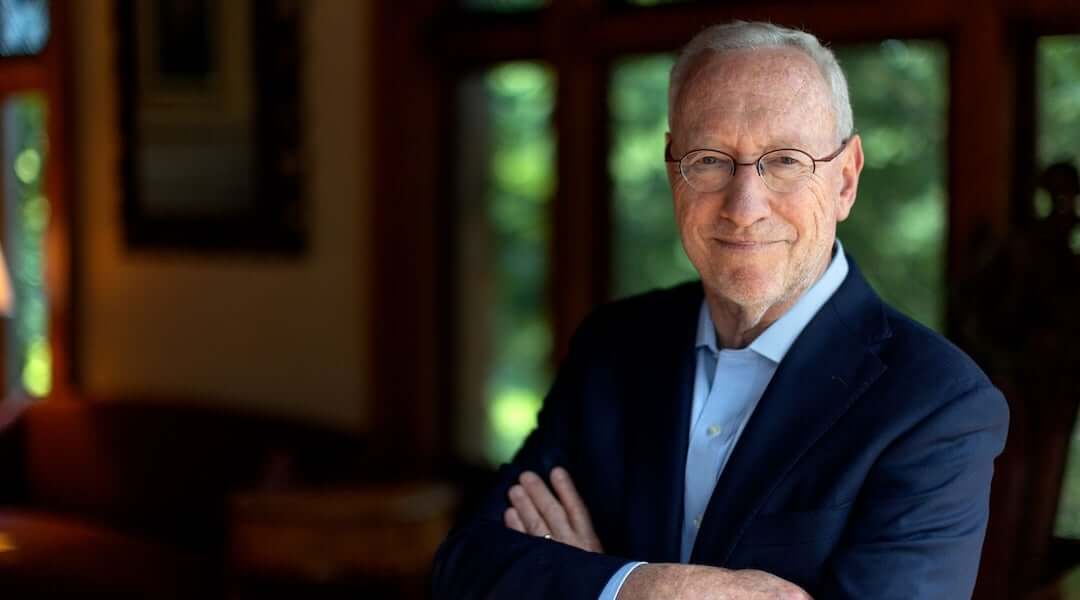
Cornell University President Michael Kotlikoff poses for a portrait in the A.D. White House on Thursday, June 6, 2024. Photo by Ryan Young/Cornell University
(JTA) — Cornell University’s Jewish president will not be penalized for a recent campus altercation with pro-Palestinian protesters who had surrounded his car following a campus debate on Israel, an investigation by the university concluded Friday.
The Ivy League school’s Board of Trustees issued a statement of support for Michael Kotlikoff following an investigation into the April 30 incident. Kotlikoff had recused himself from the investigation, which wrapped after eight days.
“President Kotlikoff has shown a steadfast commitment to Cornell’s values and principles, and we are confident he will continue to lead with integrity,” a Friday statement from the board’s ad-hoc investigation committee concludes.
The investigation also cleared the protesters, a mix of students and non-students, of any wrongdoing, even as it found that their actions “are inconsistent with university policies governing expressive activity and our standards for respectful conduct, safety, and the prohibition of intimidation.”
Kotlikoff will not be pursuing any complaints against the students involved, Cornell’s board said. The president himself did not immediately release a statement on the investigation’s results, and a spokesperson for the university declined to comment further.
The report’s release sought to quickly close the book on a whirlwind controversy at the Ithaca, New York, university, as long-simmering tensions between Kotlikoff and the campus’s pro-Palestinian contingent boiled over into a rare physical altercation between students and a college president.
The incident that prompted the investigation was the second part of a two-session debate on Israel, sponsored by the non-partisan Cornell Political Union. Kotlikoff was present to introduce the guest speaker, Jewish pro-Palestinian academic and activist Norman Finkelstein.
Multiple video sources from the Finkelstein event showed that, following the talk, members of the protest group Students for a Democratic Cornell followed the president to his car and appeared to try to block its path. When he did edge his way out of his parking spot, they said he bumped some of the protesters with his vehicle, releasing video to the student newspaper The Cornell Daily Sun to back up the allegation.
Kotlikoff issued a statement the next day calling the incident one of “harassment and intimidation,” while some of the protesters accused him of injuring them and running over one person’s foot. The university released its own footage from a security camera in a scene that presented a different view than that of the students, though the exact nature of the confrontation remains murky.
The Cornell trustees who conducted the investigation said the protesters’ initial claims of wrongdoing on Kotlikoff’s part could not be verified by campus police, in part because the affected individuals “refused medical treatment from the EMS team and refused to provide sworn statements as to their account of the incident.”
The board added, “None of the individuals at the scene have provided sworn statements to CUPD [campus police], despite CUPD’s repeated attempts to collect sworn statements in the days following the incident.” The Jewish Telegraphic Agency has reached out to Students for a Democratic Cornell for comment.
Some campus groups including the graduate student union and its affiliated labor union had called on Kotlikoff to resign. Some campus graduate student associations cited what they called an “explicit act of violence against these students” and what they felt was the “misleading nature” of Kotlikoff’s own statement. Cornell’s chapter of the American Association of University Professors also criticized the president’s actions.
But Kotlikoff had his supporters, too. National outlets including The Washington Post’s editorial board celebrated him for having “stood up to campus bullies.” A faculty and student petition supporting him also circulated this week. The petition, which was shared with JTA, says Kotlikoff acted appropriately in the face of “physical intimidation.”
“If we characterize the obstruction of a vehicle and the pursuit of an individual as ‘peaceful protest,’ we erode the safety of our entire campus,” reads the petition, whose signatories, including the number, have not yet been made public. “This is not a matter of siding with a specific policy or a specific person. It is about whether Cornell remains a place where any member of our community (student, faculty or staff) can move freely without fear of being surrounded or harassed.”
Since his appointment as Cornell’s president in 2024, initially on an interim basis, Kotlikoff has weathered a series of Israel-related controversies. He drew blowback from academic freedom advocates for criticizing a planned class to be taught on Gaza by a Jewish pro-Palestinian professor, and in March vetoed two anti-Israel student government resolutions. Under his watch the university also struck a controversial deal to pay $60 million to the Trump administration to resolve antisemitism investigations.
Menachem Rosensaft, an adjunct professor at Cornell’s law school and former general counsel of the World Jewish Congress, is one of Kotlikoff’s backers on campus. Rosensaft told JTA that, though Kotlikoff has made clear his own pro-Israel views, he remains committed to free expression on campus — which he argued the protesters were trying to silence.
“People who have an agenda don’t like those who don’t have an agenda, and who just want to play it straight down the middle,” Rosensaft said. “Mike has played it straight down the middle and he is doing it appropriately. The university is lucky to have him and I’m pleased to say that the board agrees.”
Kotlikoff’s commitment to the debate series on Israel, despite his personal disagreements with Finkelstein, was proof of this, Rosensaft suggested. The first part of the series had featured Israeli historian Benny Morris, and the debate series boasted an unusually diverse list of ideological partners, ranging from Students for Justice in Palestine to the Zionist Organization of America, pro-Israel advocacy group StandWithUs and Cornell’s Jewish Studies program.
Cornell’s commencement is set for May 23. Kotlikoff is scheduled to deliver an address.
This article originally appeared on JTA.org.
I’m personally matching all gifts to the Forward, up to $36,000. Can I match your gift now?

Hello, fellow Forward reader! I’m Joel Brown, a Forward reader and supporter for more than 15 years, and currently the chair of the board of directors.
I’m an avid Forward reader because it ticks so many of my essential boxes: excellent journalism, Jewish focus and diverse viewpoints. In today’s political climate, what I most appreciate is the Forward’s independence — made possible by the generosity of its membership.
The Forward is committed to bringing you unbiased, nuanced Jewish news. From my position as board chair, I see an exciting future as we expand our position as the definitive independent voice of contemporary American Judaism.
— Joel Brown, Forward board chair
Support our mission to tell the Jewish story fully and fairly.