What does a swastika mean?
The infamous symbol is inflammatory and inscrutable — it can be used to promote fascism and white supremacy, and to condemn it
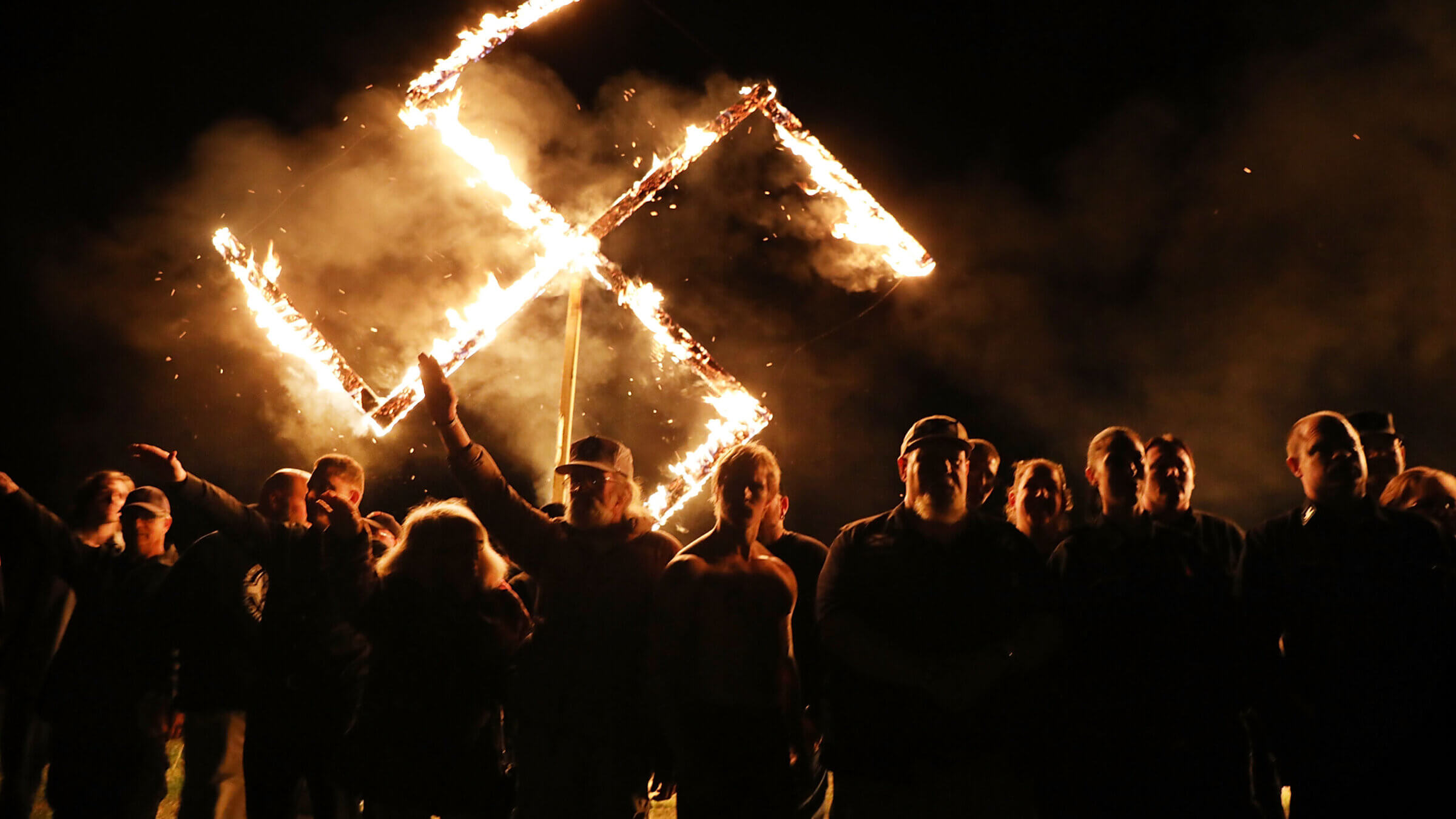
Members of the National Socialist Movement, one of the largest neo-Nazi groups in the US, hold a swastika burning after a rally on April 21, 2018 in Draketown, Georgia. Photo by Spencer Platt/Getty Images

By Arno Rosenfeld May 20, 2026
Antisemitism Decoded is the Forward’s biweekly newsletter that helps you separate the signal from the noise and understand current debates over Jewish safety. Sign up here to get it in your inbox.
Jews may not agree on much these days, but we all know that a swastika is shorthand for celebrating the Nazi regime, white supremacy and the mass murder of Jews. At least when the intent is clear.
Vandals who sprayed swastikas on a Jewish school in Brooklyn last fall made a clear statement, as did two teens who added antisemitic slogans to the swastika drawn outside a home in suburban Detroit in April, as did those who appended “Heil Hitler” to their graffiti on a Jewish community center in Queens earlier this month.
Other cases are murkier. Sometimes swastikas appear without explanation scrawled in public bathrooms or bus stops. Hikers in Seattle have grown frustrated with recurrent swastika graffiti on a popular trail that in one instance was paired with an ominous, if confusing, message: “He’s waching [sic].”
And then there are the swastikas displayed to condemn fascism. A man in my San Francisco neighborhood liked to wear a shirt featuring an enormous red swastika, which startled me every time I saw it, even though it also said “F— Nazis” and featured a boot stomping on the symbol.
Some Hindu groups have also sought to reclaim the swastika, which originally held meaning for various eastern religions, and argue that the Nazi version of the symbol is better called a Hakenkreuz.
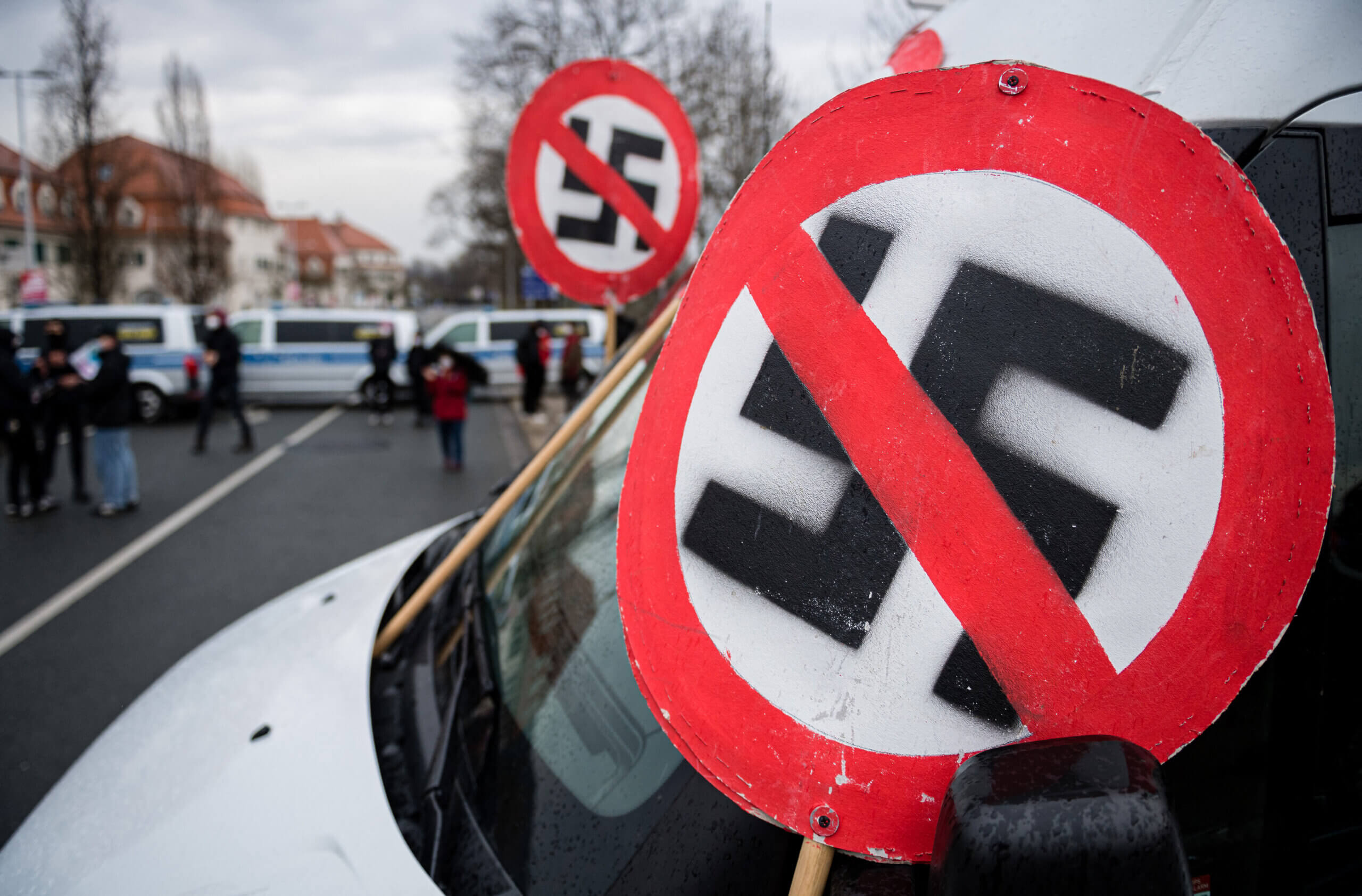
But the most contested contemporary uses of the swastika are those that seek to brand Israel and its supporters as Nazis. Israeli flags featuring blue swastikas in place of the Star of David are not unusual at large pro-Palestinian demonstrations, and a similar but rather odd version of this flag — purple and featuring two swastikas alongside a Jewish star atop the New York University logo — flew over a building on campus last week.
“We are shocked and deeply troubled that this hateful symbol expressing antisemitism was raised on a flagpole overlooking Washington Square Park,” Wiley Norvell, a school spokesperson, told the student newspaper.
That equating Israel with Nazi Germany should be considered be antisemitic is an axiomatic truth for many Jews, and a prohibition on such comparisons is enshrined in the controversial, but widely used, International Holocaust Remembrance Alliance’s working definition of antisemitism.
“It invokes painful collective memories for Jews,” wrote Paul Iganski, a British hate crimes scholar. “Those who play the Nazi-card know exactly what it means.”
***
Beyond the emotional gut punch that displaying a swastika can pack — there have also been incidents of demonstrators taunting Jews with swastikas displayed on their phone screen — many Jewish scholars argue that the comparison is antisemitic because it is meant to diminish the reality of the Holocaust.
Deborah Lipstadt, the State Department’s antisemitism envoy during the Biden administration, has said that people who compare Israeli policy to the Nazis are engaged in “soft-core denial” of the Holocaust.
“They are making a false comparison which elevates by a factor of a zillion any wrongdoings Israel might have done, and lessens by a factor of a zillion what the Germans did,” she told JTA. “That’s not to defend everything Israel does, but you can’t call it a Holocaust unless you want to distort what the Holocaust is.”
A similar strain of argument contends that comparing Israel to Nazi Germany is intended to demonize Israel and is therefore part of the “new antisemitism” that projects longstanding animosity toward Jews onto the Jewish state. “When Israel’s actions are blown out of all sensible proportion; when comparisons are made between Israelis and Nazis and between Palestinian refugee camps and Auschwitz — this is antisemitism, not legitimate criticism of Israel,” Natan Sharansky wrote as part of his “3D Test.”
There is, of course, a tautology at play in the arguments from both Lipstadt and Sharansky: Comparing Israel to the Nazis is antisemitic because it is an outrageous exaggeration. But many of those who make these comparisons argue that there are legitimate parallels to draw between the two governments.
Jean Améry, a Jewish writer from Austria who survived the Holocaust, wrote about his great dismay with the European left’s turn against Israel and Zionism — including Nazi comparisons — but acknowledged disturbing similarities between rumors of Israeli soldiers torturing Palestinian prisoners and his own experience at the hands of the Nazis during the Holocaust, which he said tested his allegiance to the state. “In my value system, for all that I have experienced the full horror of its concretization, the abstract category ‘human being’ outranks the concept ‘Jew,’” Améry wrote in 1977. “When barbarism begins, even existential commitments must end.”
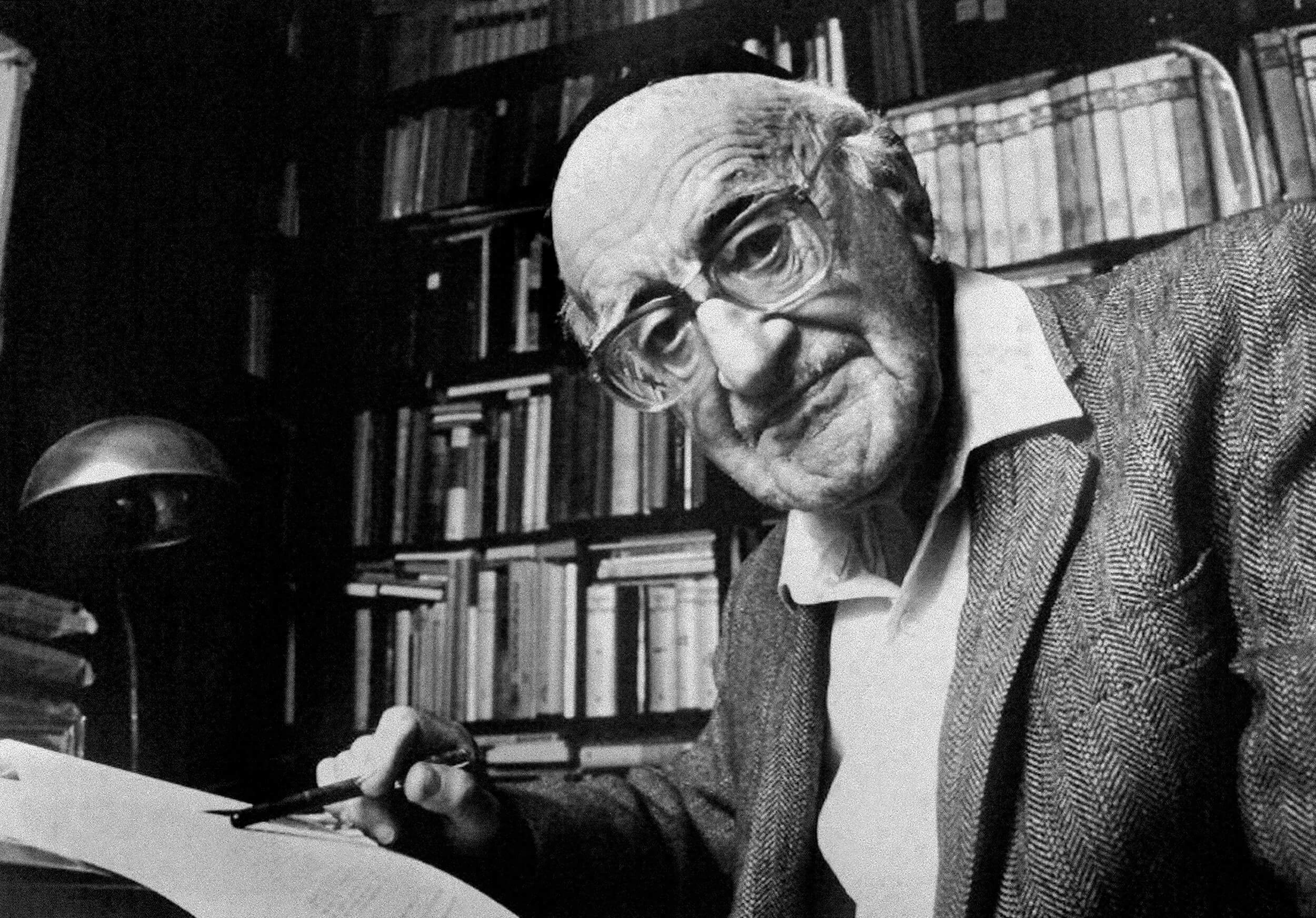
Yeshayahu Leibowitz, the brilliant Israeli scientist and public intellectual who escaped Europe for Mandate Palestine shortly before the Holocaust, called Israeli judges who allowed Arab prisoners to be tortured “Judeo-Nazis” and warned that the entrenched occupation of the West Bank and Gaza coupled with rising ethno-nationalism among Israeli Jews was sending the country down the same road as Germany.
Then there’s the genocide claim, which is distinct from direct Nazi analogies — the Holocaust was not history’s only case of genocide, though it remains by far the most famous — and has been accepted by many Jewish scholars and political leaders, including Jeremy Ben-Ami, president of dovish but nonetheless Zionist advocacy group J Street.
Norman J.W. Goda, a professor of Holocaust studies at the University of Florida, has spoken out forcefully against the genocide claim, which he argues “encourages what historians call ‘Holocaust inversion’ — the mischaracterization of Israel’s self-defense efforts as genocide.”
The argument that Israel’s opponents are using the Holocaust in offensive ways to score cheap political points is weakened, somewhat, by the kneejerk insistence by many of the country’s supporters that Iran and Hamas are equivalent to the Nazis and that its Oct. 7 attack was an act of genocide. It seems that both sides of the Israeli-Palestinian conflict remain stuck in a framework where the Holocaust seems like the most potent point of reference.
Israeli philosopher Omri Boehm has lamented that the Israeli government is “using the memory of the Holocaust to fight human rights” while, at the same time, the global left is dismissing Holocaust remembrance.
“It’s become almost impossible to talk and think about it,” Boehm said.
And this only captures aspects of the Jewish debate. Many Palestinians feel, at a minimum, as though they have been forced to pay the price for the crimes of Nazi Germany through displacement and occupation.
***
I should end on a point of caution. The swastika is at once inflammatory and inscrutable — it can be used to promote fascism and white supremacy, and to condemn it — and is rarely received well, even when it is used by opponents of Nazism.
A few years ago, Kurosh ValaNejad pasted “kinetic art” on the fence of a Los Angeles museum that was meant to look like the Iranian flag from one angle and the Nazi swastika from another. ValaNejad was trying to compare the Iranian government to the Nazis, but most passersby only saw a huge Nazi banner and police announced plans to charge ValaNejad with a hate crime.
And in my reporting on George Washington University, I repeatedly heard a story about a swastika being drawn on a Jewish student’s dorm room. It was true. The vandal had drawn the swastika, along with a Hitler mustache, on photos of Donald Trump and Mike Pence that were taped to the door. But the headline version made it sound like unadulterated antisemitism.
The most famous spate of swastika vandalism also turned out to be far stranger than it initially appeared: The so-called swastika epidemic that began with vandalism at a synagogue in Cologne, West Germany, in 1959 and rapidly spread across the globe — stretching from Rhodesia to the United States and even Israel — was revealed in the past few years to be part of a Soviet propaganda campaign that sought to paint capitalist countries as antisemitic.
Who knows what the perpetrators of the swastika stunt at NYU were trying to communicate. The flag was hoisted over the Steinhardt School, named for Jewish philanthropist and Birthright booster Michael Steinhardt. Was he the target? Was it a Nazi message suggesting that NYU itself was controlled by Jews? Was it an anti-Nazi message equating Israel with the Third Reich? Was it something even more convoluted or strange than either of those options?
The lesson here — in case it needs to be spelled out — is that, while I don’t believe in limiting the parallels or lessons that we can draw from history, anyone who wants their political message to be read in good faith should avoid relying on swastikas to make their point.
I’m personally matching all gifts to the Forward, up to $36,000. Can I match your gift now?

Hello, fellow Forward reader! I’m Joel Brown, a Forward reader and supporter for more than 15 years, and currently the chair of the board of directors.
I’m an avid Forward reader because it ticks so many of my essential boxes: excellent journalism, Jewish focus and diverse viewpoints. In today’s political climate, what I most appreciate is the Forward’s independence — made possible by the generosity of its membership.
The Forward is committed to bringing you unbiased, nuanced Jewish news. From my position as board chair, I see an exciting future as we expand our position as the definitive independent voice of contemporary American Judaism.
— Joel Brown, Forward board chair
Support our mission to tell the Jewish story fully and fairly.