Changing Jewish views on Zionism could scramble the antisemitism debate
The Zionist majority among American Jews may evaporate over the next 20 or 30 years
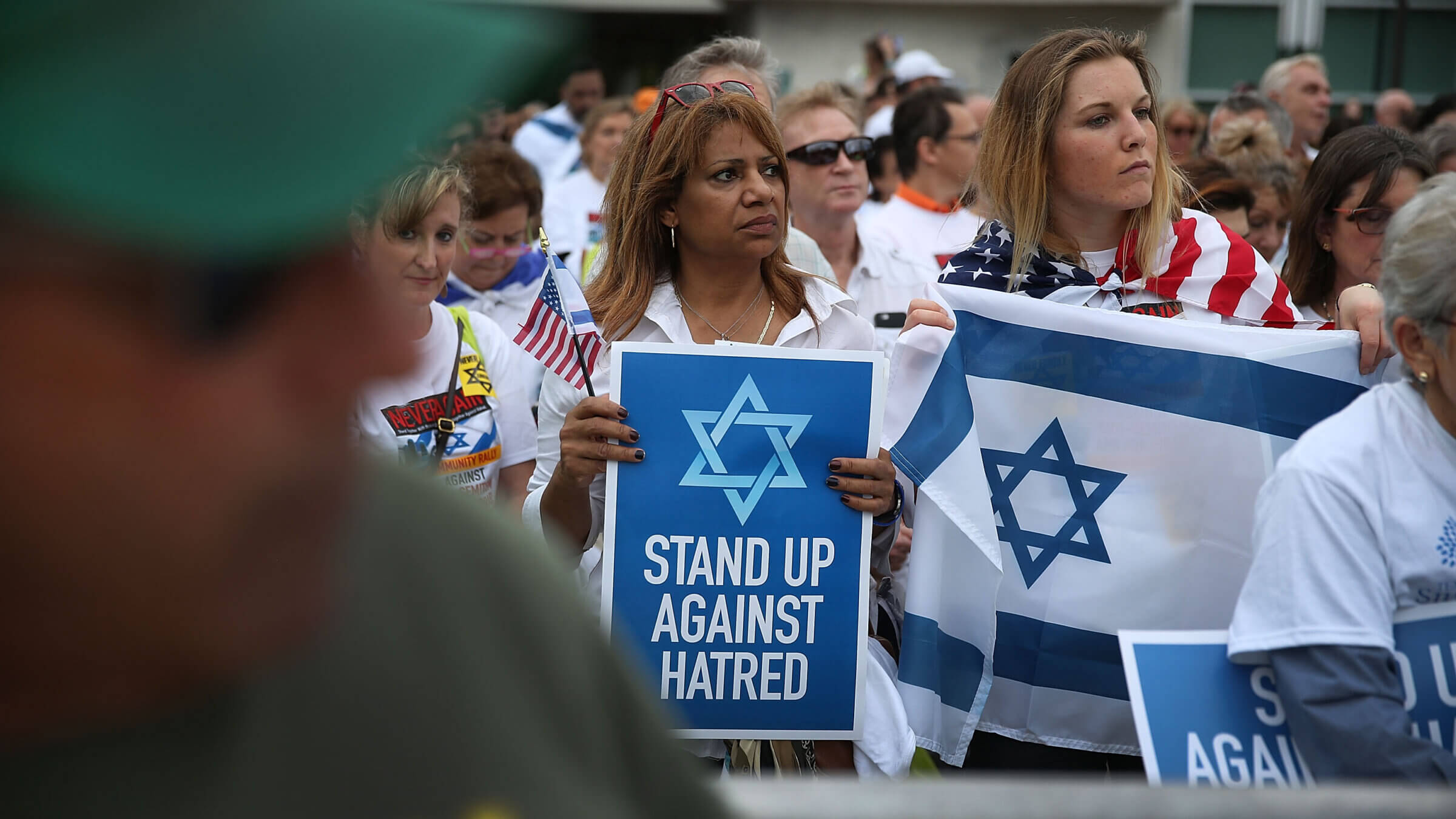
A community rally against antisemitism on November 15, 2015 in Miami Beach, Florida. Photo by Joe Raedle/Getty Images

By Arno Rosenfeld June 3, 2026
Antisemitism Decoded is the Forward’s biweekly newsletter that helps you separate the signal from the noise and understand current debates over Jewish safety. Sign up here to get it in your inbox.
Should hostility toward Israel be understood as an expression of animus toward Jews? That question sits at the center of most contemporary debates over antisemitism, and the views of Jews themselves are often cited by partisans on both sides.
Many Jewish leaders have argued that because Zionism — meaning general support for the existence of a Jewish state in Israel — is so widespread among Jews, those on the left should accept that anti-Zionism is at least sometimes a form of antisemitism.
There are other arguments that rest on merits divorced from identity, including that Israel is held to a double standard for antisemitic reasons, or that it’s offensive to deny Jews an independent homeland following the Holocaust. But the claim that support for Israel is a core part of Jewish identity is especially important for both legal and moral reasons — legally, it’s what allows the government to place limits on anti-Zionist campus protests, for example, while morally it suggests that respecting Jews as a group means respecting their attachment to Israel.
The fact that this argument has failed to resonate among many liberals has become itself presumed evidence of antisemitism. “It is a progressive article of faith — much heightened during the Black Lives Matter protests following the murder of George Floyd in 2020 — that those who do not experience racism need to listen, to learn, to accept and not challenge, when others speak about their experiences,” David Baddiel, a Jewish comedian, said during his book tour for Jews Don’t Count. “Except, it seems, when Jews do — non-Jews, including progressive non-Jews, are still very happy to tell Jews whether or not the utterance about them was in fact racist.”
Progressives often respond that the existence of Jewish anti-Zionists negates this argument — they are in fact listening to Jews, and those Jews agree with them.
And so the question of who the representative Jews are — those who view attachment to Israel as an important part of Jewish identity, or those who insist there is no inherent connection between the two — has become central to how to understand antisemitism.
The Jewish establishment long held up statistics claiming that 95% of American Jews were Zionist, a claim that always rested on a shaky foundation but one that became widely repeated and helped marginalize the vocal minority of anti-Zionist Jews.
More recently, the Jewish Federations of North America has distributed data acknowledging that only a minority of American Jews identify as “Zionist,” but arguing that other proxies for Zionism — like supporting Israel’s right to exist as a Jewish and democratic state — still approach 90% agreement.
Other data, like the American Jewish Committee’s finding that 83% of Jews in the U.S. consider the statement that “Israel has no right to exist” to be a form of antisemitism, appear to confirm that the vast majority of the Jewish community subscribed to at least a passive form of Zionism.
But a new survey has called this assumption into question. It found that 24% of Jewish adults want to replace Israel with a binational state, nearly double the share who expressed that preference the last time the question was polled a few years ago, and that figure jumps to 44% of Jews under 35 and 51% among non-Orthodox Jews in that age group.
The general trend of younger Jews drifting away from Israel — even as a majority of the overall population remains attached — has been consistent for many years, and if the surge of support for a binational state among Jews under 35 continues, the Zionist majority among American Jews may evaporate over the next 20 or 30 years.
This has serious consequences for who gets to speak on behalf of these Jews. If anti-Zionist Jewish organizations like Jewish Voice for Peace represent 5% of the community, it is easy to treat them as fringe voices. Even at 10%, 15% or 20%, they’re still representing a small minority of Jews. But this becomes impossible at 45% or 50%, with significant consequences for who is understood to be a representative Jew in debates over Zionism and antisemitism.
The data itself is solid.
It comes from Jim Gerstein, a Democratic pollster with expertise in polling American Jews for organizations like J Street and the Jewish Democratic Council of America (both of which are Zionist organizations).
Gerstein and his sponsors have long been willing to poll questions that other Jewish organizations won’t, and it was his firm that found in 2021 that 38% of U.S. Jews under 40 believed Israel was an apartheid state.
But there are important caveats.
The current polling suggests that a significant minority of American Jews both say the best resolution to the Israeli-Palestinian conflict involves replacing Israel with a binational state — widely considered to be an expression of anti-Zionism — while still saying that Israel should be allowed to exist as a Jewish and democratic state and that opposing Israel’s “right to exist” is antisemitic.
This underscores the failure of terms like “Zionist” and “anti-Zionist” to capture how American Jews really feel about Israel.
What does it mean for someone to support the premise of Zionism — a Jewish state in Israel — while simultaneously advocating for its eradication? One possibility is that they might support the concept of a Jewish and democratic state, but believe that Israel is failing as a democracy and prioritize restoring its democratic status over maintaining its Jewish majority.
That might suggest a roadmap for pro-Israel Jewish organizations in the U.S. to focus more on addressing Israel’s far-right shift, rather than simply on defending the country against its American critics.
And what could it mean that some Jews want to replace Israel with a binational state but, at the same time, believe that denying Israel’s “right to exist” is antisemitic? Perhaps they understand a binational state as a legitimate reconstruction of the government, while denying Israel’s “right to exist” sounds like support for the country’s violent destruction.
That could mean that anti-Zionist leaders should do more to condemn the growing share of the left that is expressing support for organizations like Hamas.
Either way, the evidence points to an American Jewish community that is fracturing along generational lines, but the fallout from those divisions could be softened if leaders are willing to open the door to more honest and nuanced conversations than they’ve been ready to have to date.

Did you know that only 2% of Forward readers donate to support our nonprofit newsroom? That 2% make it possible for millions to read the Forward without a paywall or subscription — removing any barriers to the full and fair Jewish story.
But while the Forward is free to read, it isn’t free to produce. Big stories — like deep dives into the antisemitism data, political scoops or reporting trips to college campuses — take months of research and fact-checking. All while we keep you informed of what you need to know each day.
— Rachel Fishman Feddersen, Forward Publisher & CEO
Support our mission to tell the Jewish story fully and fairly.