Quashing France’s Israel Apartheid Week

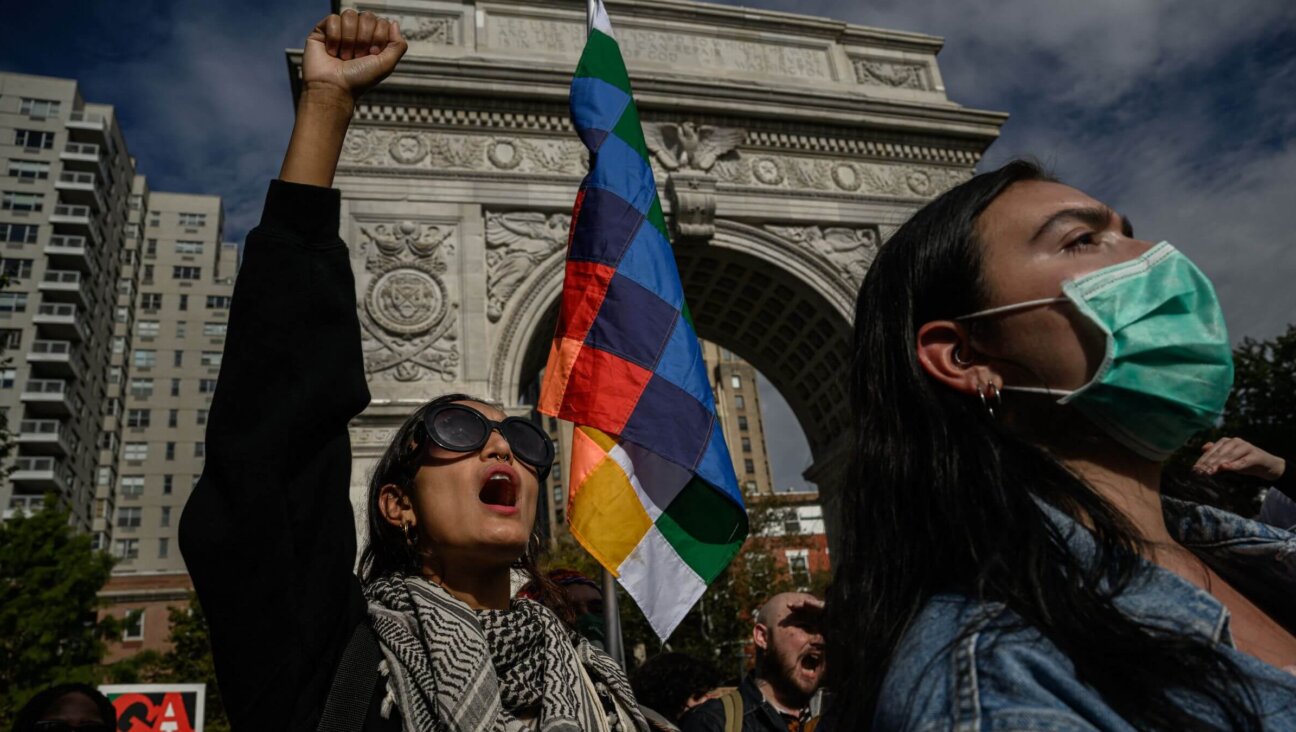
Pro-Palestinian protest in Paris last fall Image by Getty Images
Robert Zaretsky February 28, 2012
This is the week that wasn’t — at least if you planned on attending the colloquium “New sociological, historical and legal approaches to the call for an international boycott: Is Israel an apartheid state?” Scheduled to take place on February 27 and 28 at the University of Paris VIII, the colloquium was quashed last week by Pascal Binczak, the university rector. Needless to say, Binczak’s decision, no less than the colloquium itself, have spurred tremendous controversy.
From the outset, the colloquium was less than colloquial. The conference poster depicts an Arab wearing a keffiyeh, walking along the wall dividing Israel from the West Bank. Superimposed on the wall is the colloquium’s title — the sort of framing that transformed the question “Is Israel an apartheid state?” into a rhetorical exercise. One need only imagine a poster with the title “Is Hamas a reliable interlocutor for Israel?” superimposed on the image of a terror-filled, blood-stained and body-strewn street in Tel Aviv, to understand that in neither case is a true exchange of views sought.
Moreover, the titles for the colloquium’s various panels — ranging from “Spatial Apartheid in the Occupied Zones” to “State of Discrimination in Israel” and “The Civil Administration of Apartheid” — seemed to promise declamation rather than dialogue. The same applies to the participants, most of whom are active participants in the boycott campaign or pro-Palestinian movements in France or other European countries, some of whom viewed the colloquium as a platform to demand the exclusion of Israelis from academic conferences held in Europe.
As a result, it was inevitable that the Representative Council of Jewish Organizations in France (CRIF) would issue a strong protest. No less inevitably, when Binczak withdrew the university’s support, the organizers concluded he had caved into pressure from CRIF. The headline in Mediapart, an on-line journal, captured this sentiment: “CRIF orders censorship, Paris VIII obeys.” In an open letter published last week in Le Monde, the organizers acknowledged that while the colloquium “could lead to polemical exchanges,” this was not reason enough for “partisan associations to exclude them from public debate.” The organizers’ apparent lack of irony in describing CRIF as “partisan” was no less odd than its belief that Binczak’s refusal to allow them to use the university’s buildings was tantamount to “exclusion from public debate.” The fact that the colloquium has simply moved down the street from Paris VIII and will be held today and tomorrow at a union hall in the same neighborhood underscores the claim’s absurdity.
In his reply, Binczak made a few elemental points. First, far from undermining the freedom of expression, his decision sought to defend it. Not only did the colloquium fall short of the university’s legal mandate to “respect the diversity of opinion,” but the nature of its panels and participants made clear that “the pluralism of opinions, the contradictory character of debate and great intellectual responsibilities of the university community were less important than political ends.” Second, Binczak noted that his efforts to persuade the organizers to include a greater range of participants fell on deaf ears. Instead, the organizers released an announcement declaring that the “complicity of Europeans in the continuation of the occupation and Israeli oppression is the result of threats, intimidation and brutality.” Finally, Binczak pointed out that a number of the communiqué’s apparent supporters, including the League of Human Rights, immediately disassociated themselves from it.
That Israel’s policies in the occupied territories are valid, indeed compelling subjects of debate and discussion seems clear. But one hardly need be an unconditional supporter of CRIF — which compared the colloquium’s organizers to Stalinists — much less of the settlements in the West Bank, to rally to Binczak’s decision. In a world increasingly vulnerable to the gangrene of partisan rage and monologic fury, the university remains one of the few havens for the values that inform true colloquia: intellectual exchange and open-mindedness.
It’s our birthday and we’re still celebrating!
We hope you appreciated this article. Before you go, we’d like to ask you to please support the Forward’s independent Jewish news.
This week we celebrate 129 years of the Forward. We’re proud of our origins as a Yiddish print publication serving Jewish immigrants. And we’re just as proud of what we’ve become today: A trusted source of Jewish news and opinion, available digitally to anyone in the world without paywalls or subscriptions.
We’ve helped five generations of American Jews make sense of the news and the world around them — and we aren’t slowing down any time soon.
As a nonprofit newsroom, reader donations make it possible for us to do this work. Support independent, agenda-free Jewish journalism and our board will match your gift in honor of our birthday!
Support our mission to tell the Jewish story fully and fairly.