Congress thinks my college is failing on antisemitism. My Jewish students disagree
A new House report on campus antisemitism seems to have involved minimal engagement with actual Jews at actual universities
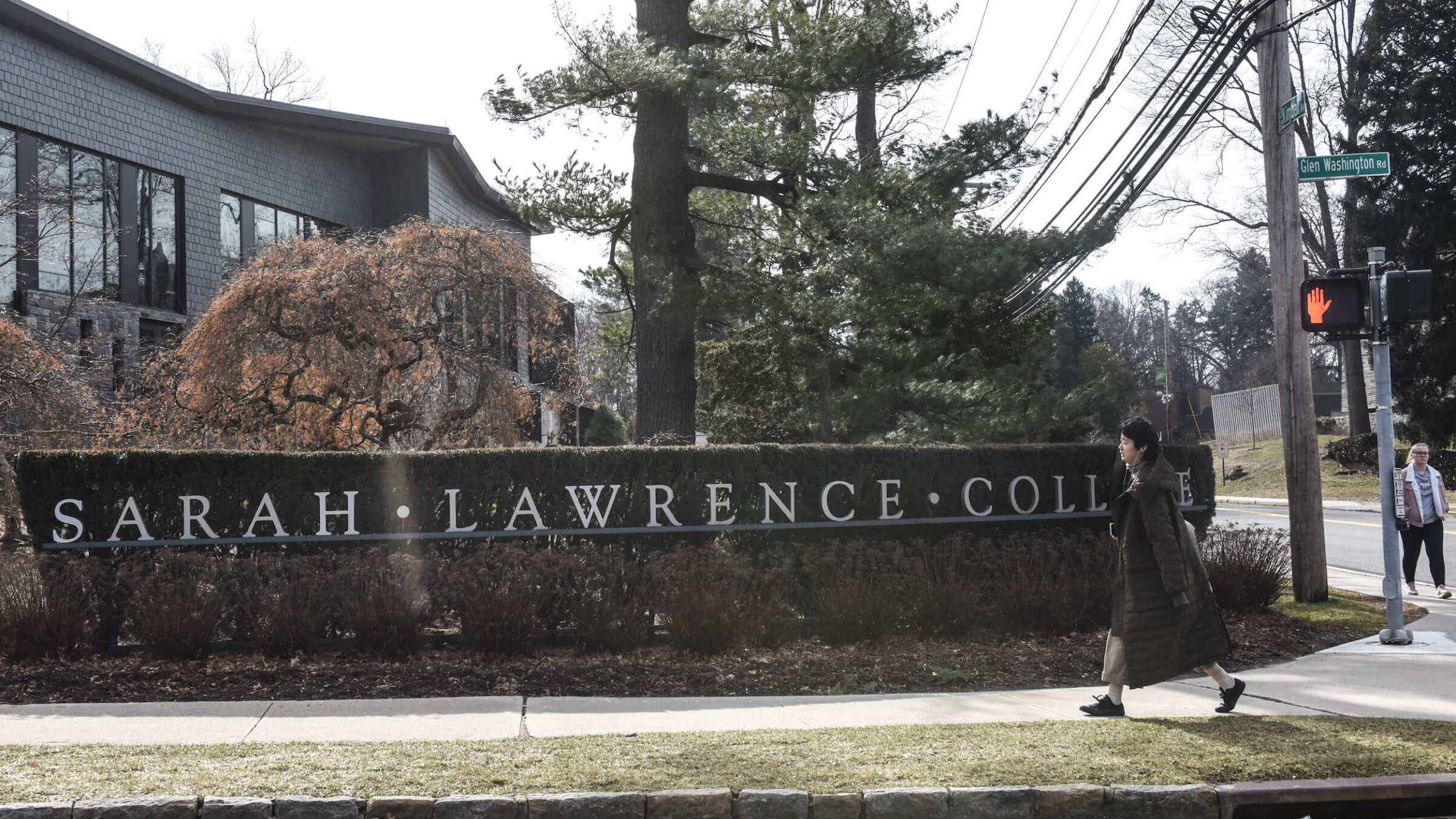
Sarah Lawrence College in Bronxville, New York. Photo by Stephanie Keith/Getty Images

Joel Swanson April 20, 2026
When the House Education and Workforce Committee released its report on campus antisemitism last month, I learned about it from a news alert on my phone. That surprised me. The college at which I teach Jewish studies — Sarah Lawrence, a small liberal arts school in Bronxville, New York — is named in the report as one of five schools the committee investigated for failures to address antisemitism. Yet I never encountered anyone involved with this investigation.
I teach Jewish and non-Jewish students — bright, inquisitive young people eager to learn about Jewish history, Jewish thought and Jewish identity. I have worked with Jewish student groups. I am, professionally and personally, someone whose entire working life is oriented around Jewish life on this campus.
If this investigation was as thorough as Congress would have us believe, I probably should have heard about it at some point before it was released — or even, just possibly, been asked some questions as part of it.
That silence is not incidental. It is the heart of everything that is wrong with this report, which insists that Jewish students on campuses like mine are living under siege. The committee’s account of my institution was assembled without consulting, as far as I can tell, the faculty members best positioned to speak to Jewish life on campus or the range of Jewish students whose experiences directly contradict the report’s conclusions. What was assembled instead appears to be a file of curated incidents, selected to support a predetermined conclusion.
To be clear, antisemitism on campus is a serious problem. It takes forms both crude and subtle — casual conflations of Jewish identity with Israel, occasional slurs and social pressure on Jewish students to renounce affiliations or loyalties with Jewish groups seen as friendly to Israel. My own students have come to me with these issues, which are deeply troubling, and which campuses have yet to come up with clearly effective strategies for combatting.
But what the Education and Workforce Committee has produced is not a serious accounting of antisemitism. It is a political document dressed in the language of civil rights enforcement. It is yet more evidence that, when it comes to the federal government’s efforts against antisemitism, Jews are being spoken over, not spoken for.
Overlooked Jewish diversity
At Sarah Lawrence, I teach Jewish students who are passionate Zionists. I also teach Jewish students who are members of Jewish Voice for Peace, participate in pro-Palestinian organizing, and have complicated, evolving relationships to Israel shaped by family history, religious tradition and their own moral reasoning.
I teach students who grew up in Orthodox communities, students who grew up entirely secular, students for whom Jewishness is a daily religious practice and students for whom it is primarily an ancestral identity activated by encounters with bigotry. I teach Israeli students who came to Sarah Lawrence specifically because American higher education offered them an open intellectual environment that they value.
What these students seem to agree on — despite their many political differences — is that they do not recognize the picture of campus life being painted by this committee.
They broadly do not experience their Jewish identity as something requiring constant protection from their classmates. What many of them do experience, and what they have told me plainly, is profound discomfort at having their identity conscripted into political arguments they did not choose.
The committee’s report is such a conscription. It tells Jewish students what they are supposed to feel. It tells them who their enemies are. And it erases, wholesale, the significant portion of the Jewish campus community whose views on Israel, Palestinian rights, and the politics of campus speech do not fit the narrative the committee has advanced.
This is not how you protect Jewish students. This is how you exploit them.
The IHRA problem
The report specifically criticizes Sarah Lawrence for not adopting the IHRA definition of antisemitism, in a case study of this kind of overreach. As the single faculty member at Sarah Lawrence wholly committed to Jewish studies — making my scholarly expertise the most directly relevant to this question of anyone on my campus — I want to be unequivocal. The Jerusalem Declaration, which we have adopted instead of the IHRA definition, is the better tool.
The Jerusalem Declaration’s core definition of antisemitism — developed by an international group of scholars working in Holocaust history, Jewish studies, and Middle East studies — explains that antisemitism is discrimination, prejudice, hostility, or violence that targets Jews as Jews. It is accompanied by 15 detailed guidelines for understanding antisemitism, drawn up because the field recognized that context and nuance are not optional when identifying and addressing hatred.
This is how scholars in my discipline are trained to think, and it is the approach our students deserve.
The IHRA definition, by contrast, was drafted primarily as a data-collection instrument for European monitoring organizations. Kenneth Stern, the definition’s lead drafter, has said repeatedly that it was never intended to become part of disciplinary codes. He has even testified before Congress against legislation that would enshrine the IHRA definition as enforceable policy on campuses. Stern writes that the definition “was never intended to be weaponized to muzzle campus free speech.”
When the person who wrote the definition is sounding the alarm about how it is being used, perhaps Congress should listen.
The specific problem with the IHRA definition, as scholars in my field have documented extensively, is that seven of its 11 illustrative examples involve the state of Israel with language broad enough to characterize legitimate forms of political speech and academic inquiry about Israel as antisemitic.
I know from my own work that the chilling effect of IHRA on academic freedom is not theoretical.
One of the definition’s most contested illustrative examples declares that it may be antisemitic to draw comparisons between Israeli policy and the Nazis. I regularly teach the Israeli Orthodox scientist and philosopher Yeshayahu Leibowitz, one of the most important Jewish and Israeli thinkers of the 20th century, who warned persistently after the 1967 Six-Day War that the logic of military rule over another people would corrupt Israeli institutions and dehumanize both the occupied and the occupiers. He used the term “Judeo-Nazis” to describe what he feared that Israel risked becoming.
If Sarah Lawrence operated under the IHRA definition, my students would not have the opportunity to debate Leibowitz’s findings. Nevermind that he was eulogized by Israeli President Ezer Weizman as one of the greatest figures in the intellectual life of the Jewish people; his concern about his own country’s direction would make teaching him taboo, in turn making my students’ education in the full landscape of Jewish thought less complete.
I also couldn’t teach them about former Israeli Defense Minister Moshe Ya’alon’s 2026 claim that the ideology of Jewish supremacy now dominant in the Israeli government resembles Nazi racial theory. Or how Yair Golan, the former IDF deputy chief of staff and current leader of the Democrats party in the Knesset, has drawn parallels between trends in Israeli society and the processes that preceded the Holocaust in Europe.
These are Israeli patriots, soldiers, and statesmen engaging in exactly the kind of morally serious, historically grounded reckoning that higher education is supposed to teach students to undertake. Under the IHRA definition, my students would never have the chance to learn from them — or decide, for themselves, what they think about these arguments.
The committee’s report does not reckon with this kind of potential cost. Instead, it flatly recommends that every college across the United States adopt the IHRA definition. Conspicuously, it does not point to a single incident at any institution in its report that the IHRA definition would identify as antisemitic but the Jerusalem Declaration would not. If the committee believes IHRA is necessary rather than merely ideologically preferred, it should be able to demonstrate a gap — a real case in which alternate definitions of antisemitism failed.
The risks of chilling free speech
The absence of any such example is not a minor oversight. It speaks to the report’s failure to contend with the actual lived experience of students on campus.
In talking with students who have experienced antisemitism on my campus — American and Israeli alike — I have found they are not concerned by whether the school will adopt the IHRA definition.
They are not asking for less protection. They are asking for the right kind. What some of them have told me — and I take this seriously — is that they would find it chilling if political speech and classroom debate about Israel and Palestine were suddenly rendered even more risky.
The broader agenda behind this report is not difficult to see. Campus antisemitism is a genuine problem that has, since the Hamas attack of Oct. 7, 2023, been manipulated by the American right as part of a sustained effort to delegitimize universities.
Jewish students are not the constituency this campaign is designed to serve. They have been made instruments of a broader ideological battle against the liberal values that gain purchase when people are educated in environments that reward independent thought.
Honest intellectual engagement with Jewish experience means studying the history of persecution and survival; the philosophy of identity and belonging; the ethics of memory; and the complexity of diaspora and national identity. These are not safe or comfortable subjects. They require exactly the kind of open, contested, sometimes painful intellectual environment that the House Committee professes to be protecting while actually working to undermine.
Sarah Lawrence is not a perfect institution. No college or university is. But it is one where Jewish life is visible, valued and genuinely diverse. My Jewish students learn by arguing with each other, challenging each other, and engaging across lines of political disagreement. The truth about Jewish life is almost always more complicated than people with clear-cut political aims would have us believe. That complexity is not a problem to be managed or a weakness to be exploited. It is at the very center of what a liberal arts education is supposed to be about.

Did you know that only 2% of Forward readers donate to support our nonprofit newsroom? That 2% make it possible for millions to read the Forward without a paywall or subscription — removing any barriers to the full and fair Jewish story.
But while the Forward is free to read, it isn’t free to produce. Big stories — like deep dives into the antisemitism data, political scoops or reporting trips to college campuses — take months of research and fact-checking. All while we keep you informed of what you need to know each day.
— Rachel Fishman Feddersen, Forward Publisher & CEO
Support our mission to tell the Jewish story fully and fairly.