A British spy, a notorious murderer, the Indiana Jones of the insect world, and a very Jewish history
In ‘To Life,’ author Joel Greenberg explores the strange-but-true stories of Jews and the natural world
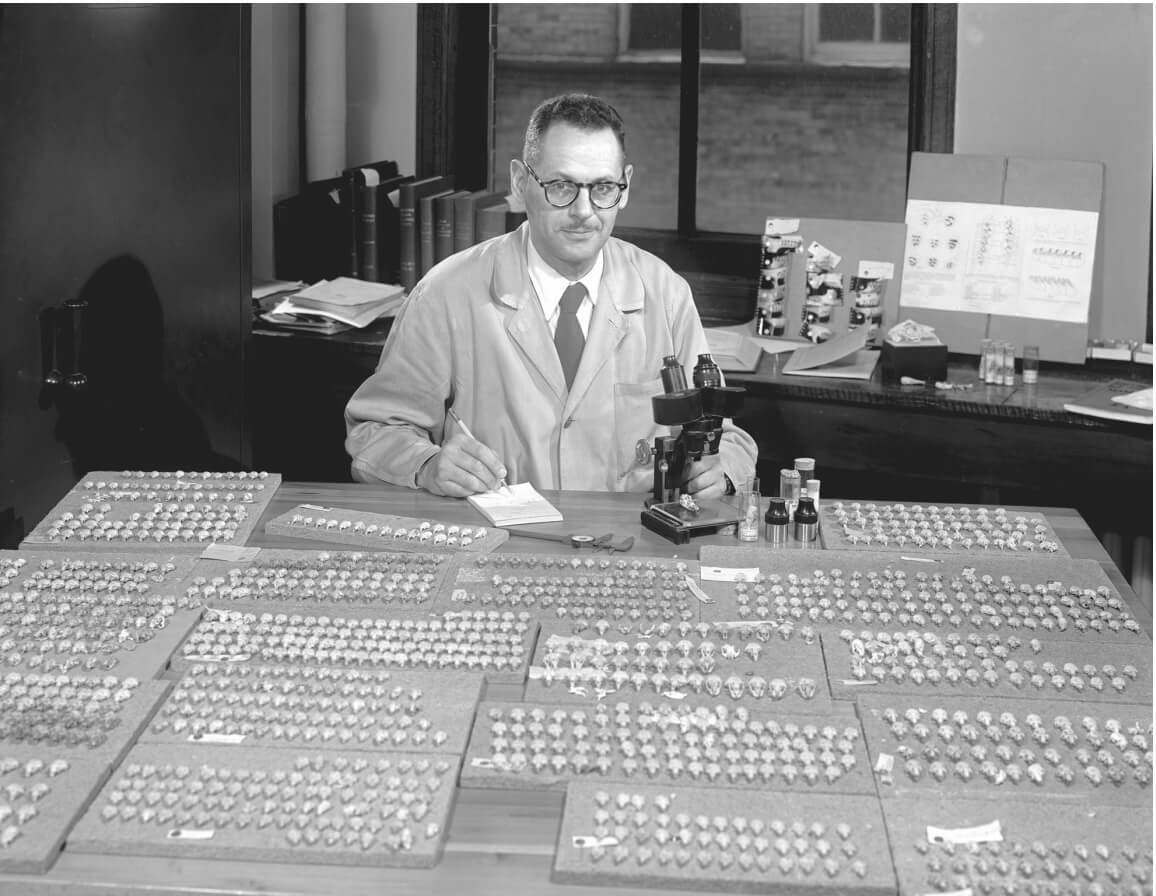
Philip Hershkovitz in his lab at Chicago’s Field Museum in 1955. Courtesy of The Field Museum
Jews are often thought of as urban, bookish folks who don’t venture out into the wild. But there have been plenty of Jews who break that mold — Abraham Cahan, founder of the Forward, was himself a birder. In To Life: Jews Exploring Nature, author Joel Greenberg, with Judith Winston, a research associate at the Smithsonian Marine Station in Florida, tells the life stories of a group of Jewish researchers, naturalists and environmentalists. I spoke with Greenberg, a research associate of the Field Museum and the Chicago Academy of Sciences Peggy Notebaert Nature Museum, book author and avid birder who lives in Westmont, IL, about the accomplished and often adventurous lives of the scientists he profiled. This conversation has been edited for length and clarity.
Countering the common perception of Jews as indoor cats, you found a group of Jews who spent their careers hunting spiders, skinning mammal specimens and handling snakes. Is the cliché inaccurate?
I cite Fran Lebowitz, who says that the outdoors is what you pass through when you go from your apartment to a cab. For a variety of reasons, Jews are kind of urban people. But when you have a literature that goes back 4000 years, you can find anything in it. You find people loving nature and people hating it.
Did your subjects’ Judaism play a role in drawing them to study the natural world?
There are threads that are well recognized in the Jewish world, though they certainly aren’t unique to it, that had an influence — like education being important, and supporting your children. But I picked people who manifested their Jewishness in different ways. Joan Ehrenfeld, an ecologist and environmentalist, was very Orthodox, and Judaism was very much part of the foundation of what she did. Whereas Philip Hershkovitz, a neotropical mammalogist at the Field Museum, kept it to himself to the point that his kids were shocked to learn that they were Jewish.
Andrew Spielman, who studied insect vectors of infectious disease, was known for arguing with people over individual words when they were writing papers. Longtime assistants said he approached these things almost like a Talmudic scholar.
Some of the people you profile have Hollywood-worthy life stories, starting with Aaron Aaronsohn. Can you tell a little bit about him?
He’s the person whose story goes back the farthest in time. His family left Europe to escape the pogroms, and settled in Palestine. He became totally intrigued by insects and plants, and became a real authority. On a trip to Germany, he met some world-famous botanists. They were interested in an ancient form of wheat called wild emmer, a single specimen of which had been found close to what is now the Syrian–Israeli border. They encouraged Aaronsohn to look for the plant because it might hold qualities that would increase the resilience and nutrition of modern wheat strains. He searched — and found it in a vineyard near the Golan Heights. It made him world-famous.
Just before the start of World War I, in which the Ottoman Empire sided with Germany, there was an infestation of desert locusts — billions of them. The Ottoman army commander said, ‘Who can help me with this?’ Everyone said, ‘Aaronsohn.’ So they brought in Aaronsohn. He and the team he assembled were allowed to go everywhere — to transportation hubs, to military bases. They became a spy ring, feeding the British the most detailed and accurate intelligence that was available.
Britain’s principal military goal was to take Jerusalem. The general there had failed twice. Then they brought in Field Marshal Edmund Allenby. He developed a rapport with Aaronson, followed his suggestions, and took Jerusalem in one try. What Aaronsohn did on behalf of the British was a major factor in Arthur Balfour issuing the British declaration in support of a national home for the Jewish people in Palestine. So it had an incredible impact on the world.
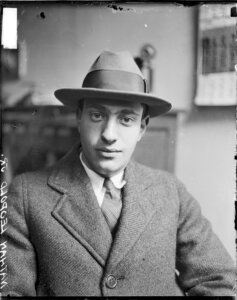
Another remarkable story, in a very different way, is that of Nathan Leopold. He and his friend Richard Loeb murdered a 14-year-old boy in 1924; but he was also a highly respected birder. Talk a little about your decision to include him.
I’ve long had an interest in him. Leopold is beyond understanding. He and Loeb committed a horrific crime. But he was one of the youngest people ever to be published in The Auk (now Ornithology), the country’s premier ornithological journal, when he was just under 14 years old. And he did important work on Kirtland’s warblers, a bird which back then was very poorly known. He was the first to correlate the rarity of the warbler with parasitism by brown-headed cowbirds. That knowledge might well have been a factor in saving the bird from extinction.
While he was in prison, he agreed to be injected with malaria, which during World War II was a big problem for US troops in Asia. When he was paroled to Puerto Rico, he got a master’s degree in public health and wrote Checklist of Birds of Puerto Rico and the Virgin Islands.
He did this terrible thing — but he also had incredibly broad interests and accomplishments.
You write about how antisemitism nearly derailed the career of Libbie Henrietta Hyman when she was at the University of Chicago.
She loved plants and wanted to do botany, so she entered UChicago’s botany program. But she was in a class that was being taught by a graduate student who was an ardent eugenicist who hated Jews, among other groups. He forced her out.
But she found a home in zoology, staying at the University of Chicago from undergraduate to doctorate and staying 15 years as a research assistant to her advisor. She authored two lab textbooks that sold enough copies for her to reach financial independence. She left Chicago and moved to New York, where she worked on her greatest accomplishment — a six-volume compendium called The Invertebrates. She worked out of an office at the American Museum of Natural History, and illustrated the volumes herself. They received world acclaim.
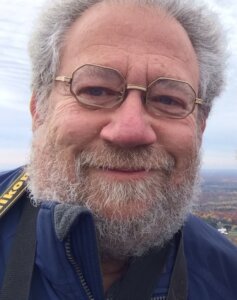
Several of these folks sound like Indiana Jones-level adventurers, spending months in jungles collecting specimens — like Andrew Spielman, a public health entomologist who studied insects that transmit human disease.
His daughter called him “Indiana Papa.” Once he was in Jamaica monitoring water-filled pots for mosquitoes, and he encountered this big guy who said, ‘You know what they call me? “Big Blade.’” He showed him his machete. Spielman had to flee. Another time he was in Ethiopia and he and a colleague went out at night looking for hippopotamuses, and they were surrounded by Ethiopian armed forces who thought they were spies. It got really heated, but fortunately, things calmed down.
Hershkovitz went on his last field trip to Brazil when he was 82 years old. I’m blown away by this. Another time he took his wife and their oldest daughter to Colombia for 18 months. They stayed in cities and he was out there in the hinterlands collecting specimens. His wife would write to him. She was totally supportive of him, but she wrote, “My dream is to move back to Chicago, go to the A&P, and have a good doctor and dentist.”
There were even dangers back home. At the Field Museum, herpetologist Hymen Marx witnessed an awful incident with a venomous snake.
Marlin Perkins at the Lincoln Park Zoo had received a bunch of snakes. He thought one of them was a boomslang, a venomous tree snake, but it didn’t quite match the pictures. So he had somebody drive the snake over to the Field so that Marx, herpetologist Karl Schmidt and the herpetology curator could look at it. They all handled it — but it bit Schmidt in the thumb. He died within two days. He refused medical assistance because he didn’t want to alter the symptoms. He kept a diary of the details; he wanted it to be scientific.
Witnessing that affected Marx greatly. It used to be that you could have live snakes at the Field; Marx used to walk around with a python around his neck and torso. But after that there could be no live snakes.
You yourself are a Jewish naturalist and birder. Is being Jewish connected to your passion for the natural world?
My family was pretty secular; I went to Hebrew school for one year. But when I was at the University of Arizona, a group of us birders went to this remote area in southern Mexico. We actually contributed to scientific knowledge: We obtained the first known chicks of the horned guan, and we discovered that the azure-rumped tanager, which was thought to be rare, in fact just had a very narrow elevational range.
It was Passover, and a friend in Tucson gave us a piece of matzo and some of the other elements. It wasn’t a full-fledged seder, but we did this little seder in a place where I’m sure there’s never been one before or since. It’s a part of me.

Did you know that only 2% of Forward readers donate to support our nonprofit newsroom? That 2% make it possible for millions to read the Forward without a paywall or subscription — removing any barriers to the full and fair Jewish story.
But while the Forward is free to read, it isn’t free to produce. Big stories — like deep dives into the antisemitism data, political scoops or reporting trips to college campuses — take months of research and fact-checking. All while we keep you informed of what you need to know each day.
— Rachel Fishman Feddersen, Forward Publisher & CEO
Support our mission to tell the Jewish story fully and fairly.