Trump announced a national Shabbat — and a giant celebration of Christianity the very next day
Shabbat 250 is followed by Rededication 250, a large event on the National Mall featuring Christian nationalist speakers
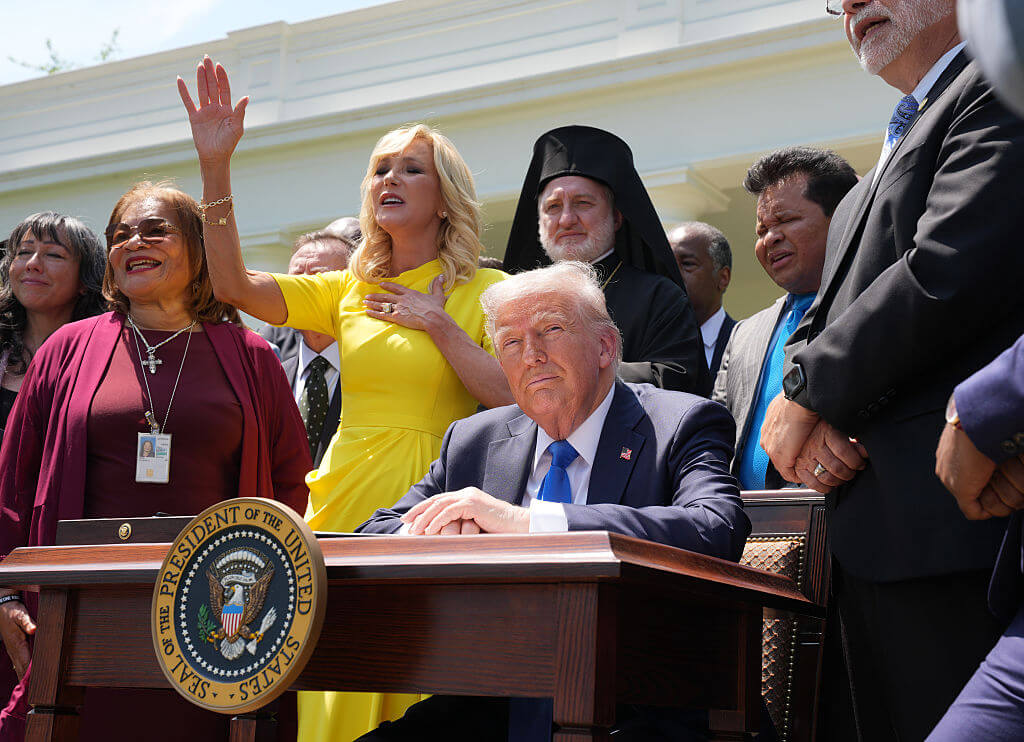
Paula White, head of the White House Faith Office, leads a prayer next to President Donald Trump and other religious leaders during a National Day of Prayer event at the White House in May 2025. Photo by Andrew Harnik/Getty Images

By Mira Fox May 13, 2026
To celebrate the 250th birthday of the United States, President Trump has announced several religious ceremonies. This weekend is Shabbat 250, in honor of Jewish Heritage month, beginning Friday night and carrying into Saturday.
“We celebrate the contributions that Jewish Americans have made to our way of life, we honor their role in shaping the story of our Nation, and we remember that religious devotion, learning, and service to others are enduring pillars of a thriving culture,” the announcement says.
But that recognition of Judaism is followed the very next day by Rededicate 250, a celebration “about the history and the foundations of our nation, which was built on Christian values,” as Paula White-Cain, Trump’s senior faith advisor, said in a webinar earlier this month for the National Faith Advisory Board, adding that attendees shouldn’t worry the event might include “praying to all these different Gods.”
In that same webinar, Brittany Baldwin, an executive of the America 250 taskforce planning the event, reassured viewers that the event would focus on Christianity and not give much space to other religions to ensure it has “the right focus for our community of believers.”
“The vast majority of the speakers are Christian,” Baldwin said. “If you do see another religion represented, it would probably be in a modest way, talking about religious freedom.”
All this is certainly mixed messaging as far as the place of Jews in the nation’s celebrations is concerned.
Rededicate 250 will feature dozens of Christian speakers including pastors; figures such as Dr. Larry Arnn, the founder of Hillsdale College, a private, conservative Christian school; members of the Trump administration including Pete Hegseth, who has openly voiced support for Christian nationalism; Jonathan Roumie, who plays Jesus on the hit Christian show The Chosen; and a selection of Christian musical performers. Rabbi Meir Soleveichik is the sole non-Christian slated to participate.
Rededicate 250 and Shabbat 250 are both headed by the larger task force organizing the 250th birthday celebration, led by the public-private partnership organization founded for this purpose, Freedom 250, the funders of which include Exxon Mobile, Palantir, and Wall Builders, an advocacy group “integrating the elements of Biblical faith and morality throughout all aspects of American life and culture.” Its page highlights religion as a central piece of the nation’s birthday, advertising initiatives like “America Prays,” a site where Americans can post prayers and commit to praying 10 minutes every week for the country from May 7 until July 4 this year.
The back-to-back Shabbat and Rededicate events are taking place shortly after the Trump administration released its report on anti-Christian bias, the work of a task force on the topic Trump founded shortly after taking office for his second term. For nearly 600 pages, the report inveighs against what it frames as oppression of Christians in the U.S., with examples including American embassies flying rainbow pride flags, President Biden’s declaration of a Trans Day of Visibility and limitations placed on church services during the COVID-19 pandemic.
Though the report mentions the importance of freedom of religion to all Americans — and notes that Christians make up 62% of the U.S. population — the papers, much like the Rededicate 250 event, heavily emphasize Christianity’s particular importance in the U.S.’s founding. No one disputes this — the founders were Christian. But the document takes it a step farther, interpreting Christianity’s centrality in American history to imply that the religion should play an essential role in the government.
“Christianity was embedded into both American government and society, to its great credit and benefit,” the report says, “even as its laws strive to protect religious pluralism.” After outlining Christianity’s historical influence, the document concludes that it is just as central to the U.S. today. “The Christian faith has been an indispensable feature of American governance and society,” it says, “from the earliest colonies to present.”
The report, as its title implies, focuses exclusively on Christianity. But even then, it excludes certain beliefs. It offers a definition of the religion, stating that “most” Christians oppose LGBTQ marriage and abortion, quoting liberally from the Bible to support this point, though many churches differ in their interpretations of the verses or actively reject the stated beliefs on LGBTQ marriage or abortion.
“This belongs to a package, a story, about who ‘we’ are, when they talk about ‘we the people,’ or ‘in God we trust.’ When they use that word ‘we’ — who are the ‘we?” said Robert W. Tuttle, a professor of religion and law at George Washington University’s law school, of the report. “Whose voices are silenced in this? We know whose voices are being lifted up. But whose voices are silenced?”
The task force report, the America Prays page and the page for Rededicate 250 largely avoid mentioning Jesus by name, and Freedom 250’s site even has a brief “Jewish blessing for the government” from 1789. All ostensibly leave space for non-Christian religious observance and prayer. But looking at the contents and speaker lists, Christianity is the only religion that is given more than passing attention. Judaism is the only minority religion mentioned at all.
Instead, all of the events frame the nation’s founding, and its birthday, as a gift from God — a God implied to be Christian. On the Rededicate 250 site, three “pillars” are outlined for programming at the nine-hour event on Sunday. One is “a reflection on God’s providence throughout 250 years, honoring the faith that inspired America’s founders and has carried us forward in every generation since.” The next is personal testimonies, and the final is the titular rededication, asking for God to grant the U.S. another 250 years.
The rhetoric “suggests such an image of the state being the recipient of this divine blessing, this divine empowerment,” said Tuttle. “And it’s troubling because when the state claims that it has authority from God, it loses what is crucial about our specific political arrangement, which is the idea that we the people create the government. The government is not a creation of god. ‘We the people,’ — this is a secular compact.”
Why, then, among numerous events all dedicated to Christianity, have a national Shabbat? Many Christians see Jews as part of a unified “Judeo-Christian” society and system of values, one that often downplays the differences in beliefs, practices and culture between Jews and Christians. And Shabbat is becoming increasingly popular among Christians; Charlie Kirk’s book on the topic encouraged his fellow Christians to observe a specifically Jewish Shabbat on Saturday instead of the Christian Sunday Sabbath — all while downplaying and even stripping away the Jewish beliefs from the practice.
Shabbat 250 too encourages Americans of “all backgrounds” to observe Shabbat this weekend, one that Trump said should center “gratitude for our great Nation.” In this schema, Shabbat, too, can fit in with the celebrations’ Christian focus.
“How do we knit together a religiously pluralistic polity into a society? They’ve offered one way to do it — we’re going to center this one. If you don’t wish to join it, we’ll tolerate you,” Tuttle said, in summary. “It’s the story of who belongs and who doesn’t belong.”
Did you know that only 2% of Forward readers donate to support our nonprofit newsroom? That 2% make it possible for millions to read the Forward without a paywall or subscription — removing any barriers to the full and fair Jewish story.
But while the Forward is free to read, it isn’t free to produce. Big stories — like deep dives into the antisemitism data, political scoops or reporting trips to college campuses — take months of research and fact-checking. All while we keep you informed of what you need to know each day.
— Rachel Fishman Feddersen, Forward Publisher & CEO
Support our mission to tell the Jewish story fully and fairly.