Judge blocks Trump bid to suspend refugee funding, in legal victory for Jewish group HIAS
Another ruling allowed some refugees to enter the United States
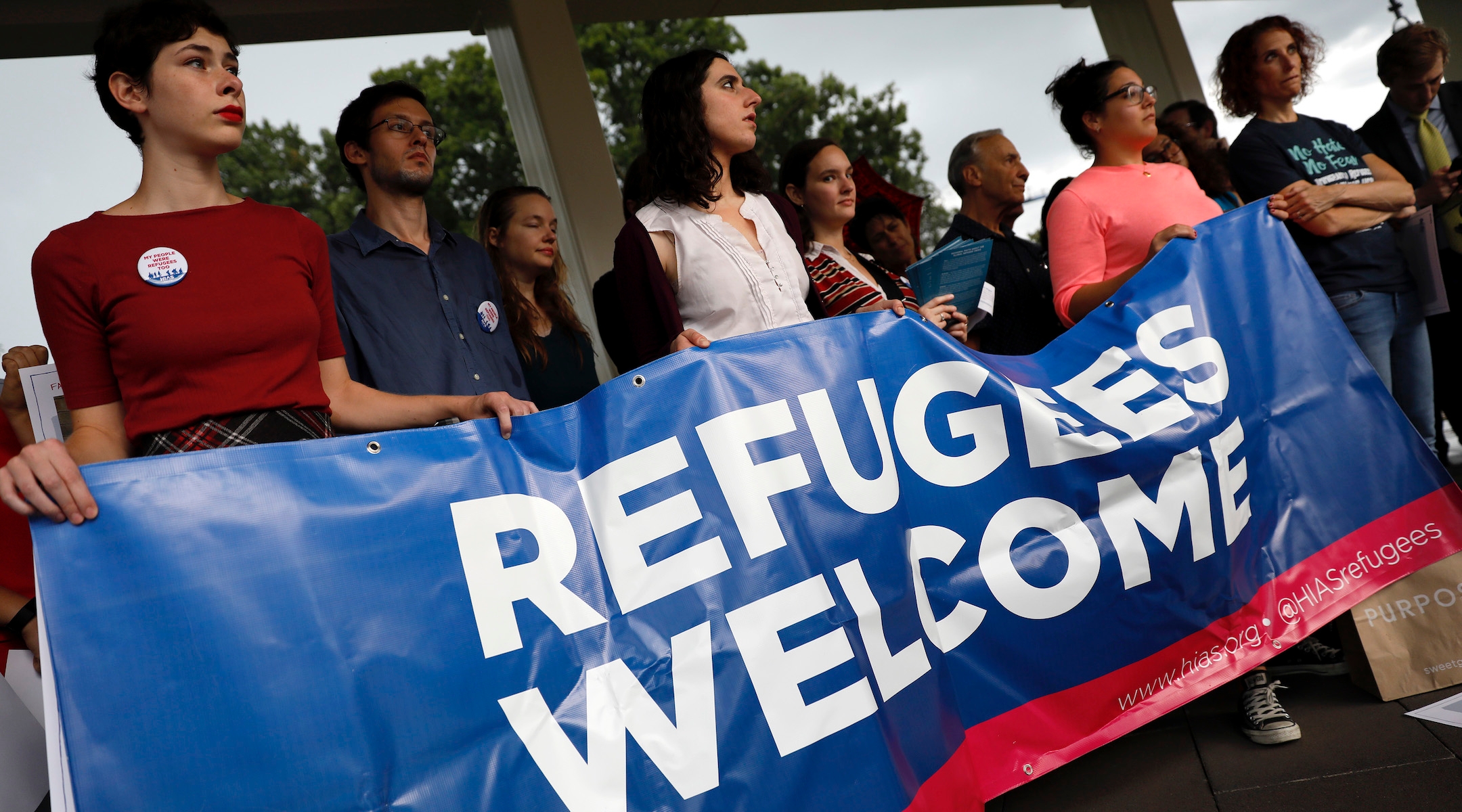
Activists hold a banner during a pro-refugee demonstration organized by HIAS outside the U.S. Capitol, Sept. 14, 2017. (Aaron P. Bernstein/Getty Images)
(JTA) — The Trump administration’s bid to suspend funding for refugee admissions was partially blocked by a Seattle federal judge Monday, in response to a lawsuit by refugee aid agencies including the Jewish group HIAS.
The injunction from Judge Jamal N. Whitehead found it unlawful for the administration to terminate its agreements with the refugee resettlement agencies. Monday’s injunction ordered the federal government to restore funding to the agencies.
“The court has been clear yet again: the government’s efforts to dismantle the refugee resettlement system are unlawful and are harming refugees whose lives have been thrown into limbo,” said Melissa Keaney, the senior supervising attorney for the International Refugee Assistance Project, which filed the lawsuit, in a press release.
HIAS celebrated the ruling. It is joined in the suit by Church World Service and Lutheran Community Services Northwest, as well as nine people affected by Trump’s action.
“The Jewish community is all-too-familiar with what happens when countries turn their commitments to refugees, and that’s why HIAS will keep fighting in court for the lives and the safety of displaced people around the world,” said HIAS President Mark Hetfield in a press release.
The lawsuit, Pacito v. Trump, was filed by the International Refugee Assistance Project (IRAP) in response to a January executive order suspending the U.S. Refugee Admissions Program, the decades-old system governing refugees’ entry into the United States.
In another development in regarding Trump’s immigration crackdown, a federal court Tuesday ruled that a preliminary injunction for refugees who had been conditionally approved before Trump’s executive order should be lifted. The ruling enables those refugees to enter the United States.
“We welcome this continued relief for tens of thousands of refugees who will now have the opportunity to restart their lives in the United States, and look forward to arguing this case in full,” said Keaney in a statement.
Did you know that only 2% of Forward readers donate to support our nonprofit newsroom? That 2% make it possible for millions to read the Forward without a paywall or subscription — removing any barriers to the full and fair Jewish story.
But while the Forward is free to read, it isn’t free to produce. Big stories — like deep dives into the antisemitism data, political scoops or reporting trips to college campuses — take months of research and fact-checking. All while we keep you informed of what you need to know each day.
— Rachel Fishman Feddersen, Forward Publisher & CEO
Support our mission to tell the Jewish story fully and fairly.