Trump national Shabbat divides America’s Jews ahead of National Mall prayer rally
Some are embracing the boost for Judaism’s central practice. Others say it’s an avatar of Christian nationalism
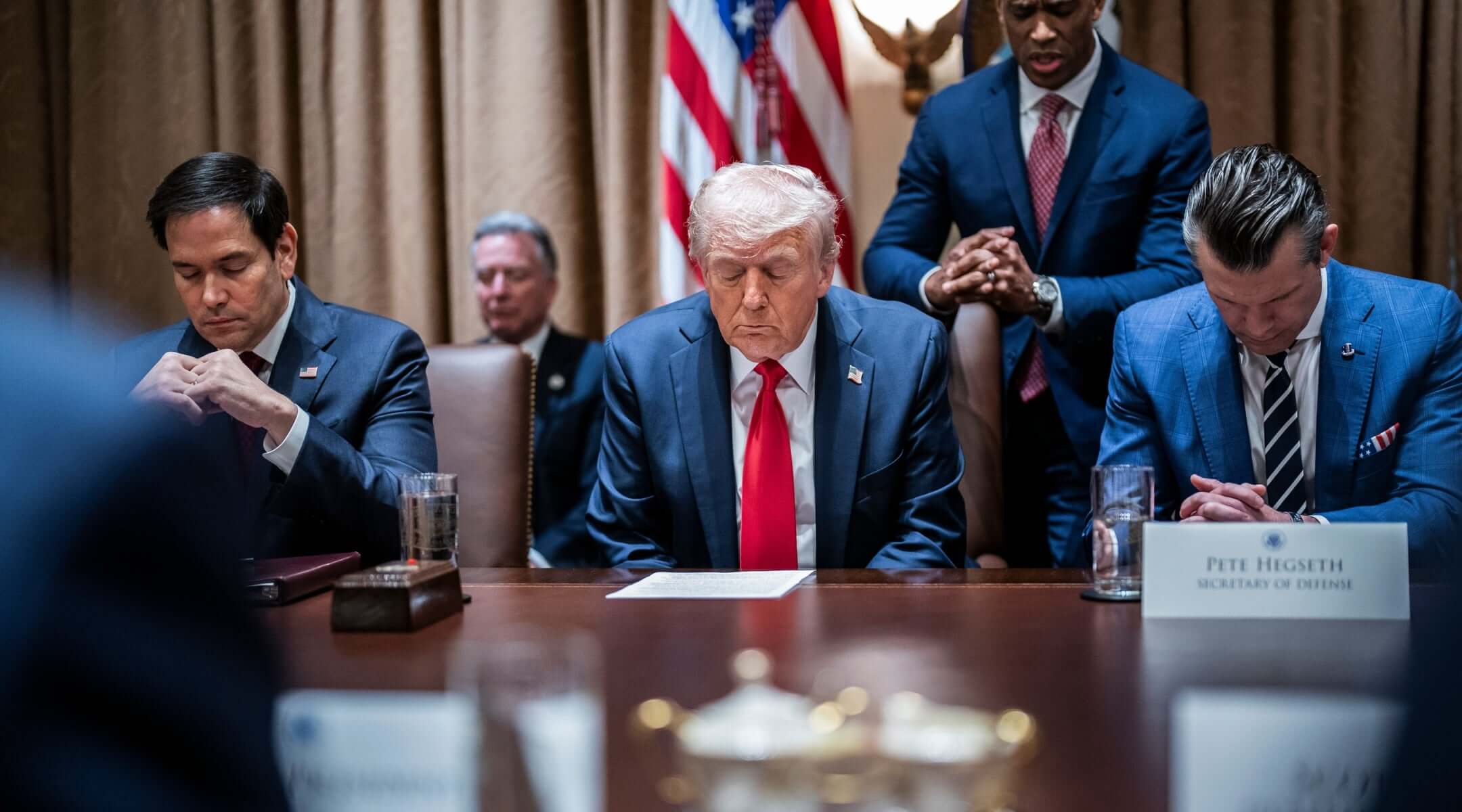
President Donald Trump prays at the first cabinet meeting of his second term at the White House in February, 2025. (Jabin Botsford/The Washington Post via Getty Images)
(JTA) — As part of a 250th anniversary celebration of the United States, President Donald Trump is calling on Americans to pray together in a nine-hour marathon on the National Mall Sunday featuring a host of Christian speakers — and one rabbi.
But first, Trump is calling on Jews to mark Shabbat, the Jewish day of rest from sundown Friday to nightfall Saturday, and encouraging other Americans to consider embracing the ritual as well.
“In special honor of 250 glorious years of American independence and on the weekend of Rededicate 250 — a national jubilee of prayer, praise, and thanksgiving — Jewish Americans are encouraged to observe a national Sabbath,” Trump said in his Jewish American Heritage Month proclamation on May 4.
“From sundown on May 15 to nightfall on May 16, friends, families, and communities of all backgrounds may come together in gratitude for our great Nation,” he continued. “This day will recognize the sacred Jewish tradition of setting aside time for rest, reflection, and gratitude to the Almighty.”
The call marked the first time that an American president has formally urged the celebration of Shabbat. Trump’s daughter Ivanka, who converted to Judaism before marrying Jared Kushner, now a prominent Trump advisor, reportedly observes Shabbat according to traditional interpretations of Jewish law.
Trump’s call echoes the legacy of conservative Christian activist Charlie Kirk, who was fatally shot in September. Kirk’s book detailing his own observance of a “Jewish Sabbath” every week was published posthumously.
The exhortation has received mixed reviews from the American Jewish community. Some Jews have said they appreciate the gesture and recognition of a central tradition to Judaism, and even are promoting their own Shabbat services as part of “Shabbat 250.”
Others say Trump is appropriating Judaism to promote conservative political goals and Christian nationalism, a movement backed by a portion of Trump’s base that scholars say could push the country in a direction that is less hospitable to Jews.
Support for the initiative has been strongest among Orthodox Jews, who tend to be more politically conservative. Rabbi Josh Joseph, executive vice president of the Orthodox Union, endorsed Trump’s call soon after it was made.
“This weekend, following President Trump’s encouragement, we will mark Shabbat 250,” he said in a statement earlier this week. “We will pause to acknowledge all the blessings that the Almighty has provided American Jews through the unique devotion to liberty embedded in this nation.”
Some Orthodox synagogues, including many affiliated with the Chabad Hasidic movement, have announced “Shabbat 250” programming, such as dinners and special speakers. The group Young Jewish Conservatives, meanwhile, doled out $180 grants to conservative Jews under 35 who committed to hosting at least five people for a Shabbat dinner in their homes.
More than 7,500 people have declared on a new website, Shabbat250.org, their intention to observe Shabbat. Some Orthodox commentators tied Trump’s proclamation to the week’s Torah portion, which describes how the Israelites, having been freed from Egypt, took a census of themselves in the desert as their new nation came into focus.
“Today we celebrate the numbers, the 250th anniversary, but like a census, this milestone must also be a springboard from which to consider where America is going,” wrote Jonathan Feldstein, president of the Genesis 123 Foundation, a nonprofit that aims to build ties between Jews and Christians, on his Substack.
On the other side, Rabbi Jonah Pesner of the Religious Action Center of Reform Judaism is among the faith leaders scheduled to participate in a virtual event Friday morning that organizers say will “explain why so many religious Americans of diverse faiths are alarmed and alienated by attempts to use America’s 250th birthday as an opportunity to frame the US as a ‘Christian nation’ and to misrepresent the approach to religious tolerance and freedom adopted by our founders and Constitution.”
The perspective is shared widely on the Jewish left, where many leaders say it is inappropriate and harmful for Trump to involve himself in Shabbat.
“When the state meddles in our sacred affairs, blurring the already fuzzy lines between church and state, it doesn’t elevate the Sabbath; it diminishes the democracy that 250 years of history were supposed to protect,” Rabbi Amichai Lau-Lavie of the progressive Lab/Shul wrote in a blog post Wednesday. “I suggest we each adapt this ‘National Shabbat’ in our own unique way – not because a leader commanded it, but because our humanity demands it.”
The debate comes ahead of the prayer rally planned for the National Mall on Sunday. The event, called Rededicate 250, is organized by a nonprofit called Freedom 250, which is advertising an event lineup featuring Christian music as well as “Freedom Trucks” that provide educational material provided by the conservative advocacy group PragerU and the Christian classical school Hillsdale College.
Organizers are also promoting performances by U.S. military bands as well as participation from several Trump administration officials, including Secretary of State Marco Rubio and Defense Secretary Pete Hegseth. Trump himself is set to appear by video, and House Speaker Mike Johnson, a Republican from Louisiana, will also take the stage.
Of the 33 prayer leaders set to appear, about half are of evangelical or non-denominational evangelical Christian practice. Baptist, Catholic and Seventh Day Adventist speakers will also speak.
The only non-Christian speaker on the lineup is Rabbi Meir Soloveichik, an Orthodox rabbi and senior scholar at the Tikvah Fund, a politically conservative Jewish think tank, who also sits on the Religious Liberty Commission that Trump created last year.
Rachel Laser, the Jewish CEO of Americans United for the Separation of Church and State, denounced the rally as part of a rising tide of Christian nationalism.
“If President Trump and his allies truly cared about America’s legacy of religious freedom, they would be celebrating church-state separation as the unique American invention that has allowed religious diversity to flourish in our country,” she said in a statement. “Instead, they continue to threaten this foundational principle by advancing a Christian Nationalist crusade to impose one narrow version of Christianity on all Americans.”
The rally comes as Americans are growing more appreciative of religion, even if they do not necessarily practice any themselves. A new Pew Research Center report out this week shows that an increasing minority of American adults say religion is “gaining influence in American life” and more than half of Americans say religion plays a positive role in society.
The proportion of Americans who believe Christianity should be declared the official religion of the United States has grown slightly in recent years and now stands at 17%, according to the survey. A much larger proportion of Americans, 43%, said they believe Christianity should not be an official religion but that the government should promote Christian moral values.
The White House will host a reception to mark the start of Shabbat 250 late Friday afternoon.
The attention to Shabbat jolted by Trump’s proclamation has spurred a wave of non-political attention to Shabbat, too. The writer Daniella Greenbaum Davis, for example, explained rabbinic teachings in a column in the Washington Post urging non-Jews to consider adopting Shabbat as a mindfulness practice.
“Shabbat is a Jewish tradition,” Davis wrote. “But the case for a weekly day of rest, taking a formal break from worldly concerns, is universal.”
This article originally appeared on JTA.org.
I’m personally matching all gifts to the Forward, up to $36,000. Can I match your gift now?

Hello, fellow Forward reader! I’m Joel Brown, a Forward reader and supporter for more than 15 years, and currently the chair of the board of directors.
I’m an avid Forward reader because it ticks so many of my essential boxes: excellent journalism, Jewish focus and diverse viewpoints. In today’s political climate, what I most appreciate is the Forward’s independence — made possible by the generosity of its membership.
The Forward is committed to bringing you unbiased, nuanced Jewish news. From my position as board chair, I see an exciting future as we expand our position as the definitive independent voice of contemporary American Judaism.
— Joel Brown, Forward board chair
Support our mission to tell the Jewish story fully and fairly.