Jewish Rep. Steve Cohen will not run for reelection after Tennessee GOP redraws his district
Cohen also took issue with a Republican rival calling him “an old, white Jewish guy.”
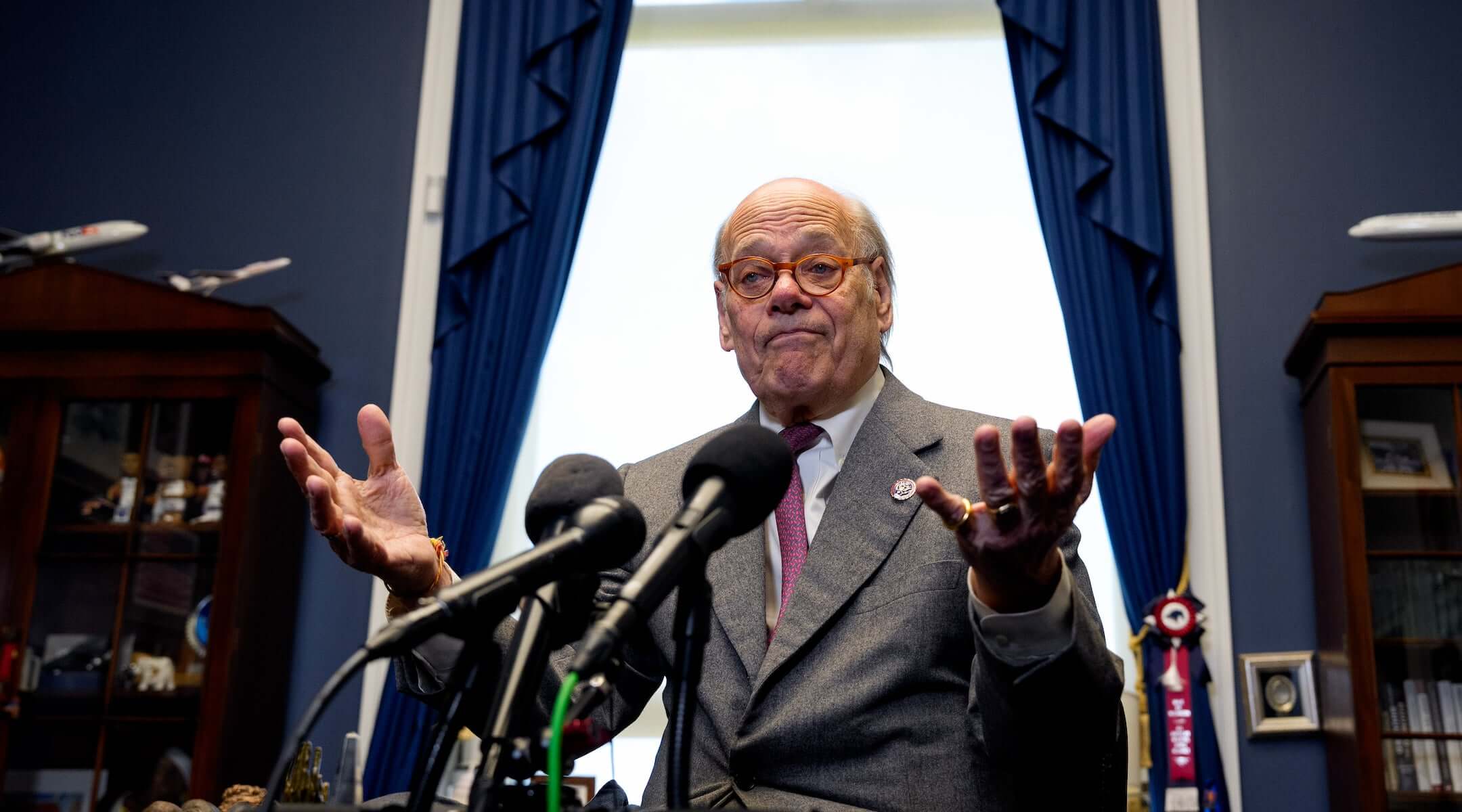
Rep. Steve Cohen gestures during a news conference in his office on Capitol Hill on May 15, 2026 in Washington, DC. Photo by Andrew Harnik/Getty Images
(JTA) — Rep. Steve Cohen, the Jewish Democrat from Tennessee at the center of a controversial Republican-led redistricting push, announced Friday that he will not seek reelection.
In his press conference announcing his decision, the congressman also took a swipe at a Republican rival for referring to him as “an old, white Jewish guy.”
Cohen, whose Memphis-area district is being splintered into three different districts, is one of a handful of Jewish Democratic casualties of the mid-decade redistricting sprint engineered to push the GOP’s House advantage in this year’s midterm elections.
“I don’t want to quit. I’m not a quitter. But these districts were drawn to beat me,” Cohen told reporters during a press conference in his Washington, D.C., office.
In addition to Cohen, a cohort of three Jewish Democratic congresspeople in Florida are facing new uphill battles for reelection following that state’s GOP-led redistricting. Reps. Debbie Wasserman Schultz, Lois Frankel and Jared Moskowitz have all seen their districts become more favorable to Republican challengers after the state’s congressional map was redrawn.
But the Tennessee state house’s last-minute redrawing of Cohen’s district, which is majority African-American and the state’s sole Democratic U.S. House seat, has spurred the most controversy. Tennessee’s 9th has one of the highest concentrations of Black voters in the country.
“The fact that each of these new districts was drawn to divide almost exactly into thirds the Black voting population of the 9th District suggests serious racist and unethical intent and raises legal issues about the use of race being the true predominant factor in this redistricting effort,” Cohen said in a statement earlier this month.
Cohen has represented the district since 2006, and said he’s won the support of many Black voters in Memphis despite early skepticism over whether a white candidate could effectively represent the majority-Black district.
“They didn’t think a Caucasian could ever win,” he said. “But they underappreciated the love of the African-American people for a candidate who represented them well.”
The congressman left the door open for a run pending a lawsuit, filed by the Tennessee Democratic Party and other organizations, asking for a temporary restraining order on the redrawing. But he also appeared resigned to the possibility that those lawsuits would not prevail, telling reporters at his office Friday that it was “the most difficult moment” of his career.
“If I get the chance, I’ll do it,” he said. “But otherwise I’ll be retiring from Congress and, I guess, from public life.”
Cohen also took a swipe at Tennessee GOP Rep. Andy Ogles, who, he said, “referred to me the other day as ‘an old, white Jewish guy,’” while defending the state’s redistricting plan on Newsmax.
Ogles, a hardline conservative congressman who has served Tennessee’s 5th Congressional District since 2023, is currently facing a primary challenger while also remaining under scrutiny for alleged campaign finance violations tied to his campaign in 2022.
“Well, I guess I’m old and I’m Jewish and I’m white. But why [did] he have to say ‘white Jewish guy,’ as distinguished from a Black Jewish guy, Sammy Davis and a few other people?” Cohen mused. “As far as ‘white Jewish guy,’ does that mean there’s something different among Jewish people and white people? I don’t know what he’s saying. He doesn’t either.”
The other congressman from Memphis, Republican David Kustoff, is also Jewish. (They attend the same synagogue, the Reform congregation Temple Israel.) A 2010 redistricting moved most of Memphis’ Jewish community, estimated at about 10,000 and including the largest Orthodox congregation in the United States, into Kustoff’s district, Tennessee’s 8th.
This article originally appeared on JTA.org.
I’m personally matching all gifts to the Forward, up to $36,000. Can I match your gift now?

Hello, fellow Forward reader! I’m Joel Brown, a Forward reader and supporter for more than 15 years, and currently the chair of the board of directors.
I’m an avid Forward reader because it ticks so many of my essential boxes: excellent journalism, Jewish focus and diverse viewpoints. In today’s political climate, what I most appreciate is the Forward’s independence — made possible by the generosity of its membership.
The Forward is committed to bringing you unbiased, nuanced Jewish news. From my position as board chair, I see an exciting future as we expand our position as the definitive independent voice of contemporary American Judaism.
— Joel Brown, Forward board chair
Support our mission to tell the Jewish story fully and fairly.