"Jew’s Apple," and Other Names for Eggplant

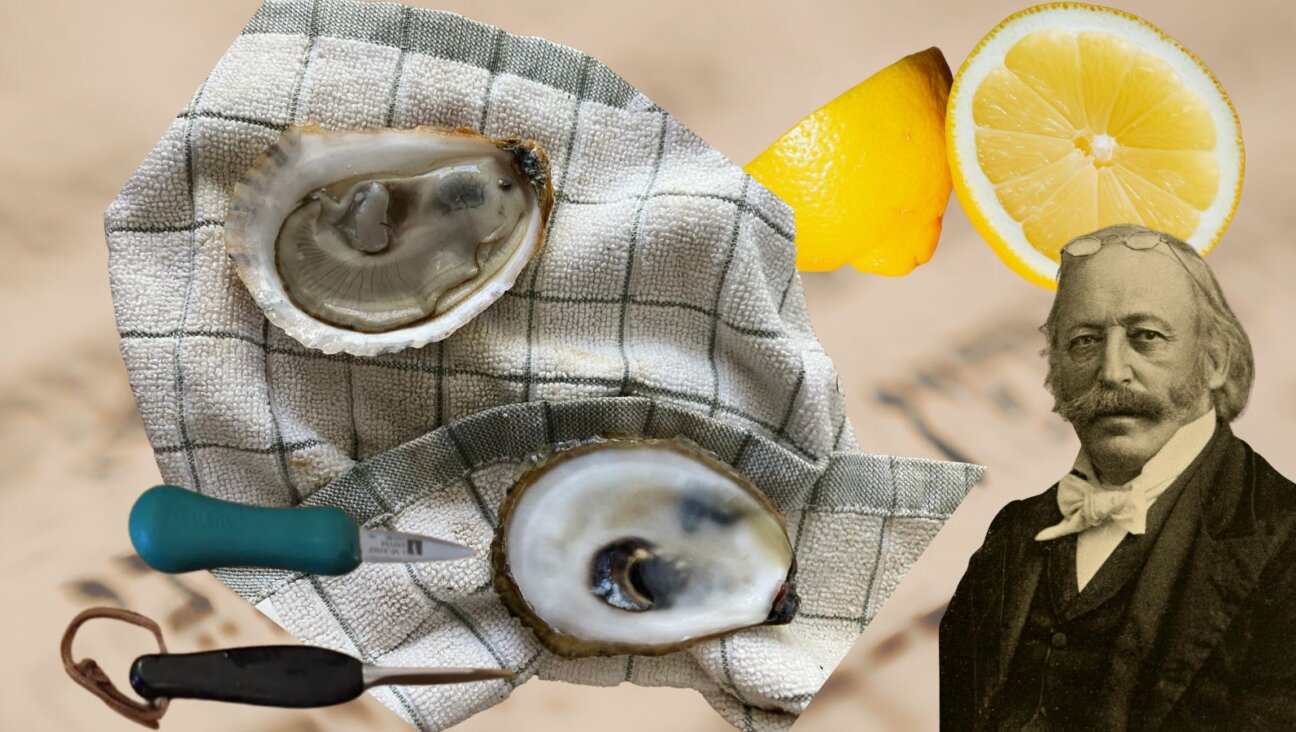
Graphic by Angelie Zaslavsky
Reader Mike Benn wrote to the Forward’s word fiend Philologos about a childhood memory of bronjenas, a flame roasted eggplant dish that his grandmother who lived in Palestine in the early 20th century made. The dish, while now called h’atsil al ha-esh in Israel and by other names the Balkans, lives on as a roasted eggplant mixed with tahini and/or yogurt. Read the article to find out the origin of eggplant and the many words used for it around the globe including the “Jew’s apple”.
Janna Gur, doyenne of Israeli cooking, offered us her recipe for the dish, which is smoky, creamy and slightly nutty from the raw tahini. Share your favorite eggplant recipe with us in the comments.
Roasted Eggplant
Reprinted with permission from Janna Gur’s “The New Book of Israeli Food.”
Roasting eggplants on an open flame can be messy but is definitely worth the effort as the smoky aroma adds immensely to the taste.
First line your stovetop with aluminum foil. Place a whole eggplant) or more than one if you are confident) on a rack over the open flame and roast, turning occasionally, until the skin is scorched and blackened and the fleck feels soft when pierced with a wooden skewer or a fork. The eggplant can also be broiled in the oven, or grilled on a charcoal barbeque. Cool slightly (to avoid burning your hands) and peel, carefully removing every last bit of scorched skin, or cut in half lengthwise and scoop out the flesh with a wooden spoon.
Ideally, roasted eggplant should be served shortly after roasting and seasoned while still warm to ensure optimal absorption of every spicy nuance. But if you need to store it for later, drain the roasted flesh of excess liquid, cover with oil and refrigerate.
Season before serving.
Roasted Eggplant with Yogurt and Tahni
Adding both these last two ingredients produces a delightful dip.
Add 1 cup yogurt and ¼ cup raw Tahini to the flesh of two roasted eggplants. Season with 2 tablespoons chopped mint leaves, 2 tablespoons lemon juice, 2 cloves crushed garlic, salt and freshly ground black pepper. If the mixture is too thick, add water gradually and stir to desired texture.
Why I became the Forward’s Editor-in-Chief

You are surely a friend of the Forward if you’re reading this. And so it’s with excitement and awe — of all that the Forward is, was, and will be — that I introduce myself to you as the Forward’s newest editor-in-chief.
And what a time to step into the leadership of this storied Jewish institution! For 129 years, the Forward has shaped and told the American Jewish story. I’m stepping in at an intense time for Jews the world over. We urgently need the Forward’s courageous, unflinching journalism — not only as a source of reliable information, but to provide inspiration, healing and hope.
Support our mission to tell the Jewish story fully and fairly.