Class assignment: Get to know your murdered Jewish neighbors
A history teacher in Saint-Quentin, France, is reconstructing a lost community, one story at a time
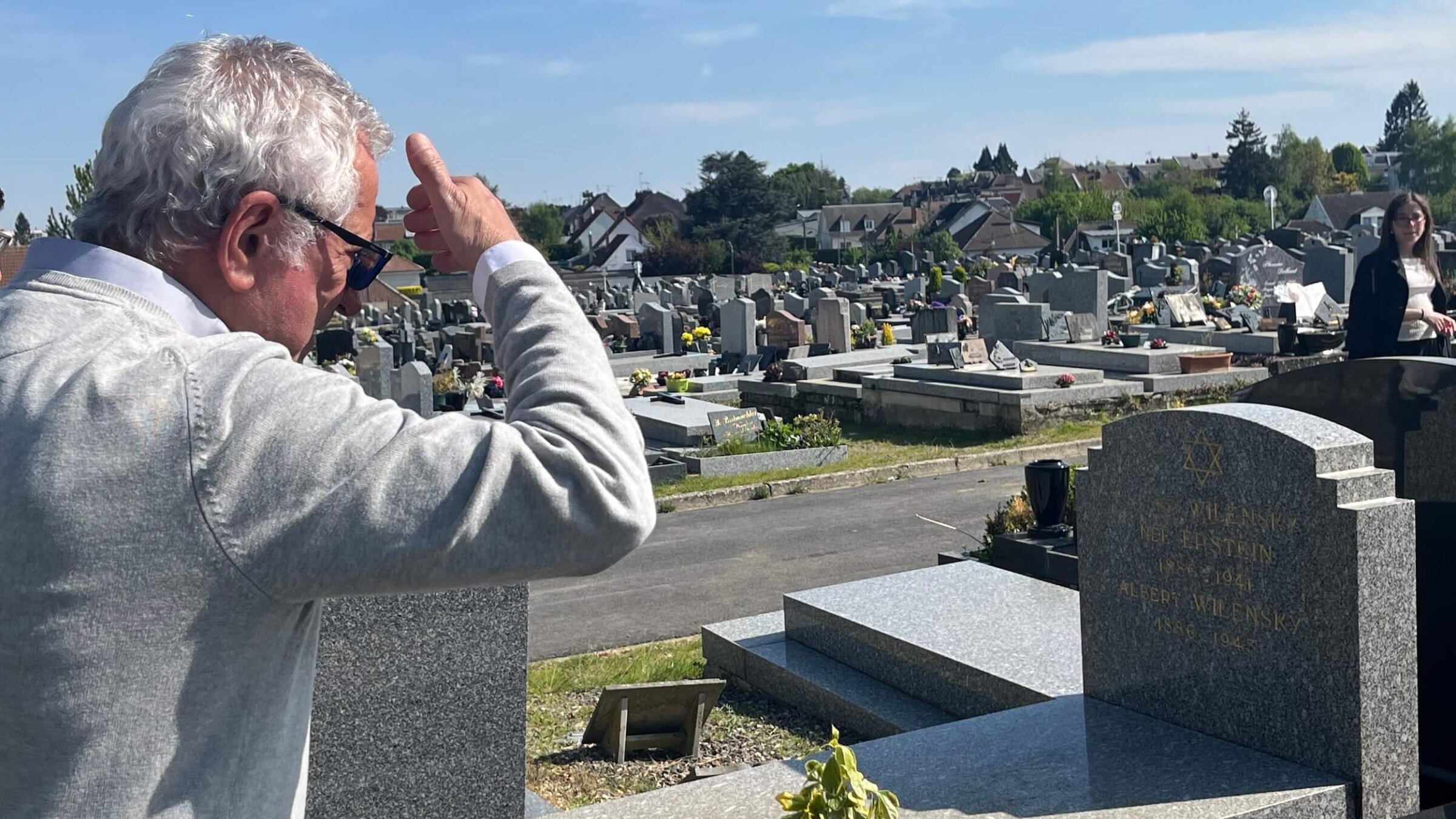
Alain-Sam Federowski ponders his family gravestone, with a spot reserved for himself. Photo by Alyssa Katz
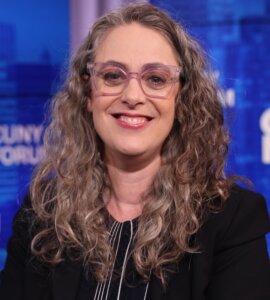
By Alyssa Katz May 1, 2026
Last Sunday, my cousin, his cousin, their spouses and I arrived by rental car into a small city that until then had existed for us only as a blip on a genealogy chart: Saint-Quentin, in northeast France, where my cousins’ great-uncle Marcel had lived alongside, for a time, their grandfather.
We were here thanks to the determined efforts of a history teacher named Damien Bressolles, who since 2023 has been assigning his classes of high school seniors to construct written portraits of neighbors dragged out of France and deported to their deaths during the Holocaust.
Bressolles has done the math: Saint-Quentin had around 400 Jewish residents before the war, 87 of whom were deported. Only five returned from the camps.
The last Sunday of April is National Deportation Remembrance day in France, marked with marching band processions, flag rituals and hearty renditions of “La Marseillaise” and Resistance songs. This year in Saint-Quentin, the proceedings that began at the Warsaw Ghetto memorial by the River Somme included something new: a strong showing of Jews.
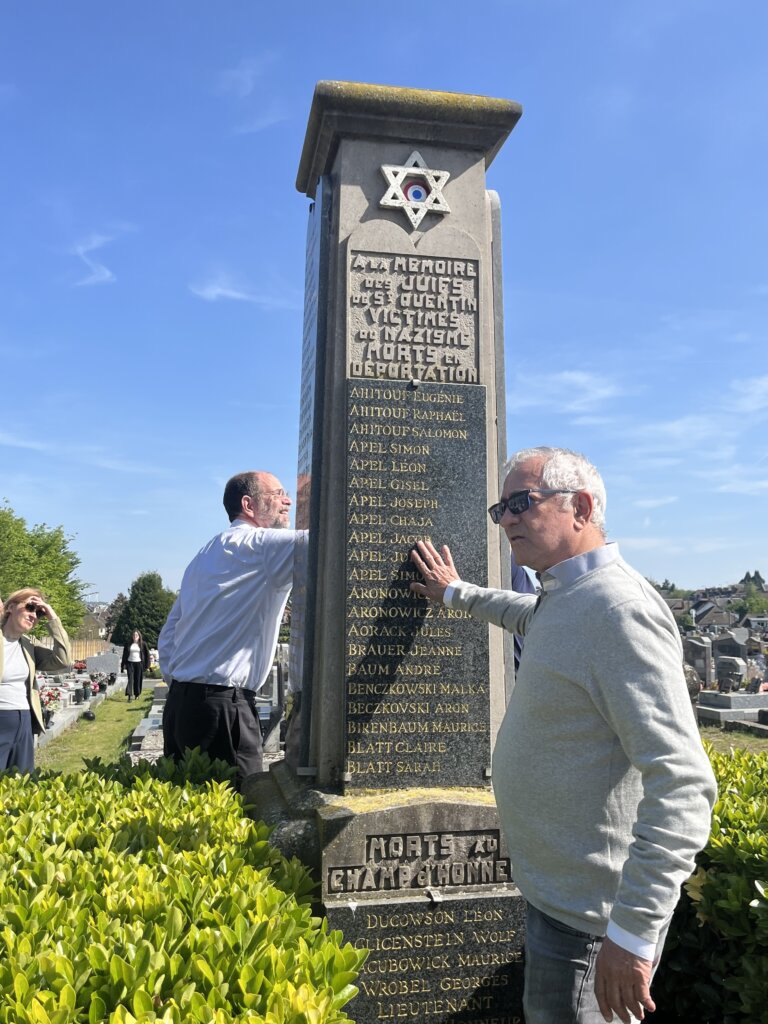
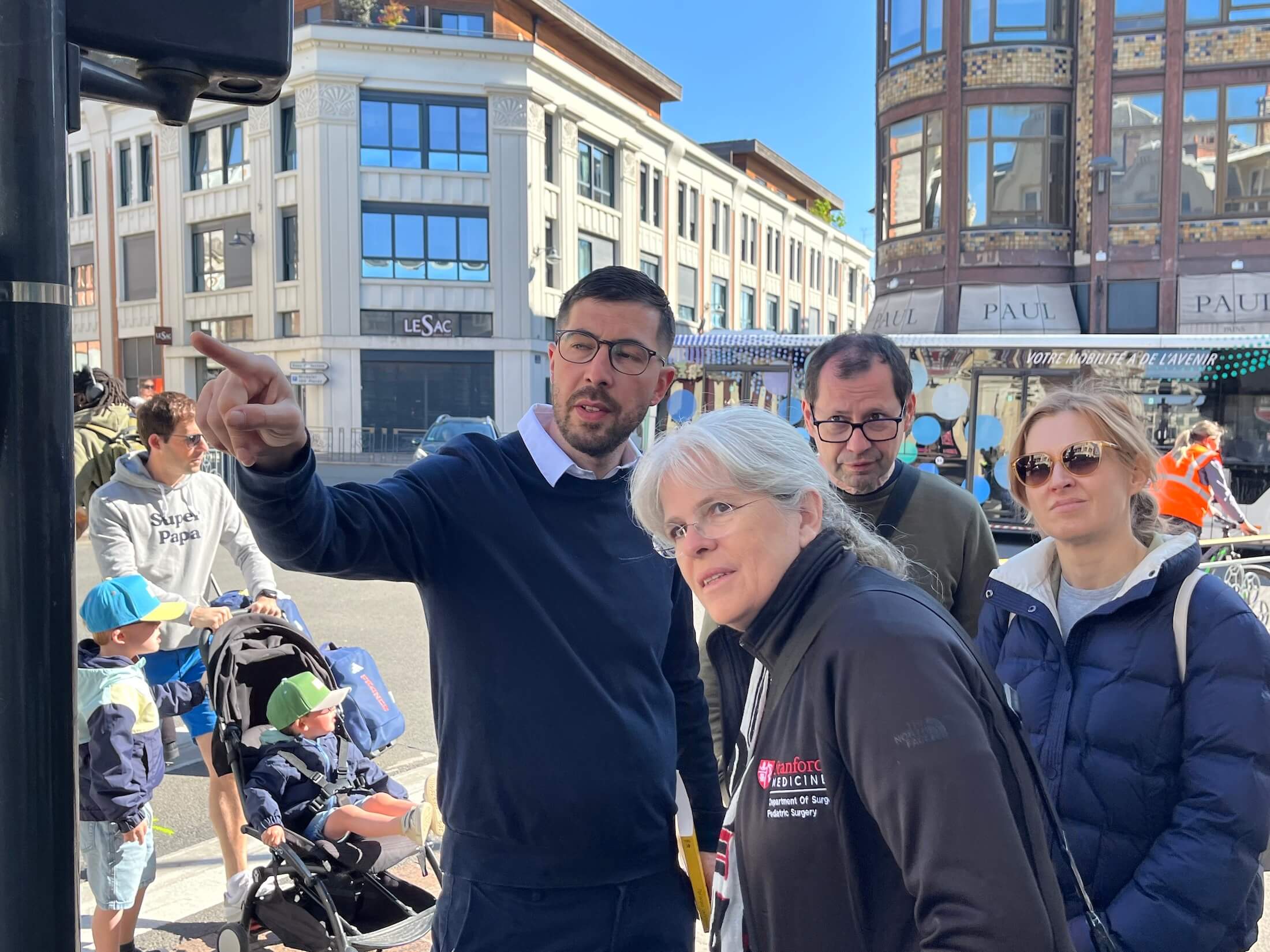
Bressolles and his students had given us the gift of getting to know our own families, and gathered us for a reunion. A couple dozen of us got to know one another over champagne at City Hall, where we toasted Bressoles, and then during a tour around town. We ended at the cemetery where Bressoles first spotted the deportation memorial that sparked his yearning to learn about his lost Jewish neighbors.
Many participants were descended from parents and grandparents who had left Saint-Quentin before it could betray them — but not everyone. Yvon Doukhan’s family survived in town because they were Algerian, and the Nazis didn’t recognize their name as Jewish. He showed us their house, just off the main square.
Alain-Sam Federowski’s father, a military officer, was protected, ironically, as a prisoner of war in Austria. His mother fled with other family members to the south of France and worked in melon fields. The Federowski family gravestone, which sits next to the deportation memorial pylon in the cemetery, is crammed with names, with a small blank spot on the lower left reserved for one more: Alain-Sam’s own.
Gilles Weiss is a magician and local son, who bought a house in Saint-Quentin to use for storage midway between performances in Paris and Brussels, and discovered wood paneling with Hebrew carved in it. He determined that those panels had been salvaged from the deportation train cars, the desperate farewells of passengers to their loved ones.
Saint-Quentin is a quiet and dignified little city that, before Nazis controlled France, had been a hub for the textile industry, and therefore home to hundreds of Jews. They operated looms, sold merchandise, ran the shops that lined the Rue D’Isle, learned there and prayed there.
Now, just three Jewish families remain.
Restoring Jewish presence
Bressolles, who is in his mid-30s and hails from southern France, is not alone in asking young Europeans to confront the Holocaust person by person, story by reconstructed story, participating in bringing the dead to a shadow of life.
A family-led French project called Convoi 77 is working with teachers and students to identify and produce biographies of everyone on the last train from Drancy to Auschwitz in July 1944 — a train that carried some residents of Saint-Quentin.
But Bressolles’ project at Jean Bouin high school brings a distinctively local lens — one that Bressolles calls “historical, civic, and deeply human.” He and his students are restoring Jewish presence to a place from which it had been eradicated with intent. As elsewhere, Nazis destroyed the synagogue after the human purge.
Camille Sazerin, a 17-year-old participating in the school project, had no idea that Jews had been part of her community — never mind that they had so violently been torn away, sent to another country to be slaughtered. (Bressolles has brought some of his students to Auschwitz and Birkenau.) She became so committed to Bressoles’ project that she, alone among the students, spent the entire last day of spring break with us, after delivering a speech with a classmate at the ceremony by the Somme.
She hopes she’ll find a way to continue with the project after graduation, she told me. “I don’t want to finish,” she said.
Another student, Manon Jurczinsky, who is 18, wrote me in a testimonial translated into English about her research on the Goldblum family. “This project made me realize that these events could also happen in our own town and not only in large cities like Paris,” she said. “I also understood that wherever Jews went, they were hunted and persecuted, and most of them were deported to camps. Saint-Quentin showed us that this family had come here to ‘hide.’ They had jobs and a way to live, but it was not enough. Perhaps they could even have been part of our own family.”
Bressolles has focused the project on individual people, starting with the few dozen names on the cemetery memorial. He digs up an array of documents, such as birth, marriage and death records, then asks his students to read through and write up narratives based on the information.
Verifying and building on the student work, Bressolles puts together detailed dossiers on each of the people profiled, including historical context for their biographies. Eventually, he expects, their collective research will become a book.
Revived relatives
That effort has connected Bressolles to the descendant families, who get relief from the common burden of working alone to excavate the stories of murdered relatives. His files, gleaned from the French National Archives and other sources, go far deeper than merely facts and dates.
In reading the students’ historical portrait of Marcel Rapoport — my uncle’s uncle — my cousins discovered details they hadn’t known about his brother Max, who was their grandfather, and another brother, Jacob, who had also passed through Saint-Quentin.
Using naturalization records, the eight-page writeup details the intensive bureaucratic efforts that Marcel had to go through in order to bring his fiancée, Chaja Grynsztejn, over to France from Łódź, Poland — proof that the immigrant will have a source of financial support and not be a burden on the state, that they are not a criminal, and so on.
Saint-Quentin police records document pivotal moments during the Occupation — such as when Marcel had his Grammont 5555 radio confiscated in 1941 under a German law forbidding Jews from possessing receivers. Even the issuance and ongoing monitoring of the stars of David they were forced to wear as identification has been preserved in a local police file — as was the record of their arrest by local French authorities. Marcel and Chaja were on the first transport from Saint-Quentin to Auschwitz, and died there.
My cousin Gill Pratt rallied our little delegation here as part of his global project of repairing family ruptures. Starting during the COVID pandemic with questions to his mom during her isolation in a senior living facility, in the years since he has tracked down relatives in Poland and Brazil and brought us together to get to know one another.
They were lost to us, not because they were killed but because their parents chose to protect them from what they considered dangerous knowledge of their Jewish identity.
One of the relatives Gill found was Krzyzstof Goszcyzynski, who lives in Łódź, and had had no idea his grandfather was Jewish. That was Max Rapoport, who lived in Saint-Quentin for a time but at some point, for reasons unknown, moved back to Łódź, Europe’s textile manufacturing mothership.
“Talking to dead people is much easier. You can invent any characteristic for them,” reflected Gill about the unknowns. “It’s really wonderful because you see them; you discover documents about them and you make up a story about what they were like. They were always wonderful, never difficult.” (Gill, for the record, is always wonderful.)
A shared conversation
The corollary: talking to the living is hard, especially when all my years of high school and college French have collapsed in a rusty heap of disuse doused in Spanish I since learned.
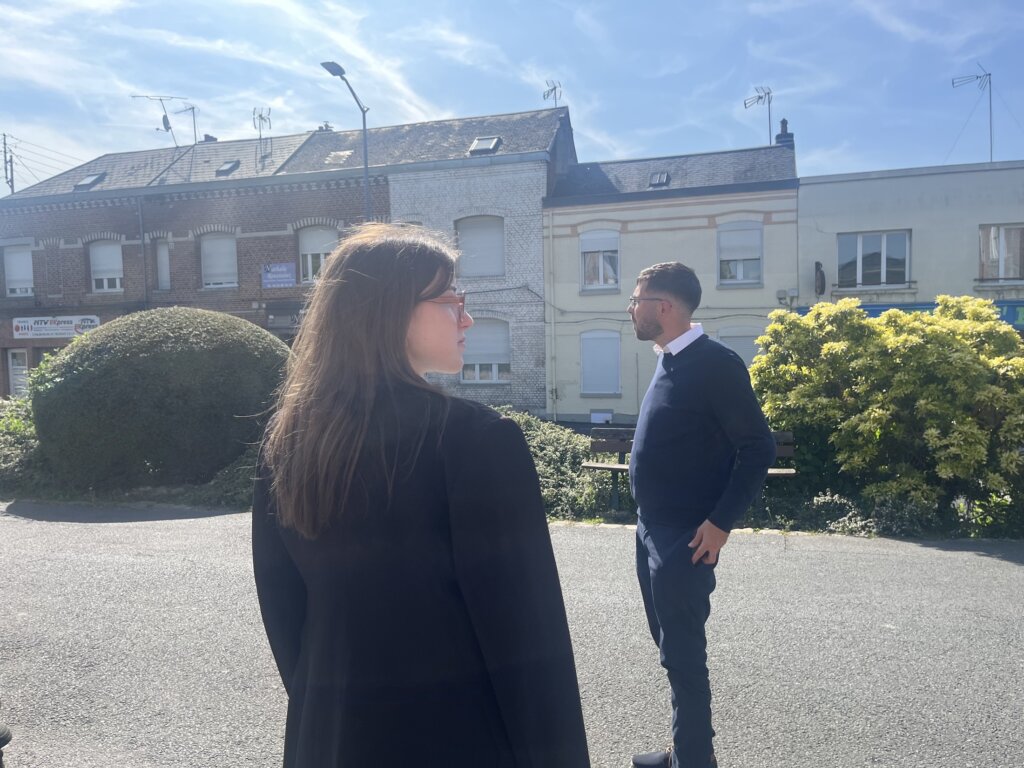
Over lunch, I sat near Camille, the 17-year-old student, and did the thing that journalists do, while she, the dutiful and sharp student, answered my questions, with both of us switching back and forth between French and English to ensure we were understood.
How did the project make her feel? Sad. She described it as “very intense.”
Which families did she document? Apel and Goldblum.
What do you want to do professionally? Teach special ed, or work with survivors of domestic violence.
Then the student had questions for me.
How do Americans see the French? (A lesson on red states and blue states, and the Iraq War and Freedom Fries followed.) Are there things about French culture that I do not like? (The pop music, with an extremely specific exception for Serge Gainsbourg.)
Then, in politely coded English, she asked me: How do I approach political subjects, when so often people are not able to talk to one another about them? I suspected she was alluding to Israel and Gaza, and she confirmed that’s what she meant.
I responded in unexpectedly fluent, confident French. To translate: I do it by having conversations just like this one, where I speak to the person in front of me, respect their individual humanity, offer my perspective, and listen. I don’t take my views to social media. And, I said, more people need to do exactly this: talk, and listen. She nodded.
By the end of the day, dozens of us had joined a new WhatsApp group Bressolles created, called Communauté Juive Saint-Quentin. The hundreds who had lived here were gone, their stories and photos bare traces of their lives. The synagogue — which Weiss, the magician, designed, and where he has installed the carved wood from the deportation train — has to bring in people from nearby communities for the high holidays in order to have a minyan.
Nonetheless, from Paris and Łódź and California and New York here we briefly were as a collective presence in the city that had almost forgotten us, and revived in the name of the WhatsApp group: the Jewish community of Saint-Quentin.
I’m personally matching all gifts to the Forward, up to $36,000. Can I match your gift now?

Hello, fellow Forward reader! I’m Joel Brown, a Forward reader and supporter for more than 15 years, and currently the chair of the board of directors.
I’m an avid Forward reader because it ticks so many of my essential boxes: excellent journalism, Jewish focus and diverse viewpoints. In today’s political climate, what I most appreciate is the Forward’s independence — made possible by the generosity of its membership.
The Forward is committed to bringing you unbiased, nuanced Jewish news. From my position as board chair, I see an exciting future as we expand our position as the definitive independent voice of contemporary American Judaism.
— Joel Brown, Forward board chair
Support our mission to tell the Jewish story fully and fairly.