A Jewish gun club teams up with the NRA, in pursuit of self-defense
The ‘Lox and Loaded’ partnership comes as anxieties fuel interest in firearms and concerns about ripple effects
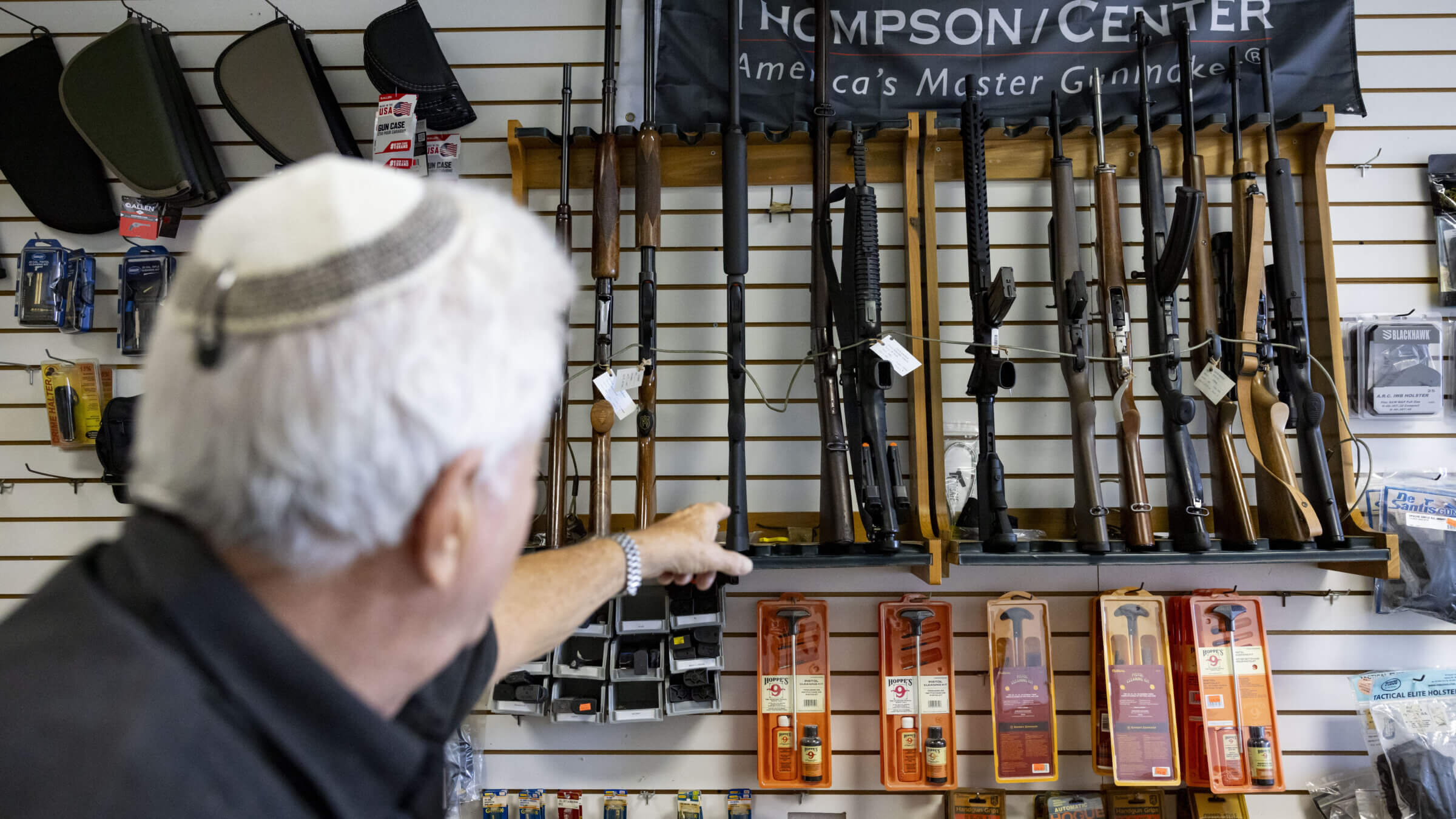
An owner points to rifles for sale at a store in Miami Beach, Florida, Oct. 23, 2023. Photo by Eva Marie Uzcategui/Bloomberg via Getty Images

By Louis Keene April 17, 2026
Capitalizing on heightened anxieties and surging Jewish interest in gun ownership, the National Rifle Association this week announced a partnership with a national Jewish gun club, in a move the mega gun lobby group says will help in the fight against antisemitism.
“People are scared,” said Gayle Pearlstein, the Chicago firearms instructor who launched Lox & Loaded, the Jewish group the NRA is teaming with. “You can see it in their faces. People see history repeating itself.”
The arrangement will give Lox & Loaded access to NRA resources — and give the NRA a foothold in a burgeoning demographic as its core membership wanes. It is the first partnership of its kind between the NRA and a Jewish group.
“When people think of the NRA, they don’t necessarily think of Jewish populations, right?” Justin Davis, director of public affairs for the NRA, said. “To help bridge that gap between never having touched a firearm, getting world class training, comfortability and proficiency in firearms, I think it’s a great opportunity for the community.”
Lox & Loaded, a for-profit company founded last March, is one of several Jewish gun groups that has emerged in the U.S. since the Hamas attacks in Israel on Oct. 7, 2023, with many targeting first-time gun owners. Pearlstein says it has attracted more than 1,000 members and established 49 local chapters nationwide.
The rising Jewish interest in gun ownership is also prompting concerns, and not just among gun violence experts who stress risks to gun owners. Security experts working with Jewish institutions are also forced to plan for unpredictable scenarios involving concealed weapons.
A national brand
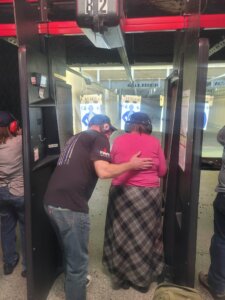
After the Hamas-led attacks of Oct. 7, Pearlstein started offering discounted pistol lessons to the Chicago Jewish community. “I really wanted to do something to help the community,” she said, “and I didn’t want to just give tzedaka (charity) or just send money over to Israel.” Then she started giving concealed carry classes through the Chicago Jewish Alliance, a local pro-Israel group.
Eventually she joined forces with a similar group in Cleveland to form Lox & Loaded,whose members pay $118 a year for training, monthly shooting practice and other events.
Many of those members, she said, are seniors — and quite a few are longtime gun skeptics turning to firearms for self-defense after personally experiencing antisemitism.
The partnership comes amid an uptick in antisemitic violence and in the wake of multiple high-profile antisemitic terrorist attacks that were both carried out and stopped with guns. In the Temple Israel attack in West Bloomfield, Michigan, last month, a man armed with a rifle rammed a truck loaded with explosives into the synagogue before he was shot dead by a security guard.
And it points to a spillover effect from the increased focus on security — a developing interest in firearms not just in synagogues, but also in domestic life.
Historically, American Jews have among the lowest rates of gun ownership in the country. Just 10% of Jews owned guns according to a 2005 report, compared to 26% nationwide at the time; in 2018, a survey found 70% of American Jews said gun control was more important than protecting gun rights.
But newer data points to a change in tune; for example, NYPD reports show a spike in concealed carry permit applications after October 2023. Whether an increase in Jewish gun ownership actually makes American Jews safer, however, is hotly contested.
Pearlstein, who is a longtime NRA member, said the partnership came about after she introduced herself to the organization’s executives at a national trade show in January.
Davis, who was one of the people she met that day, said the NRA had been paying attention to the rise in antisemitic attacks and was eager to help.
“Meeting with folks from Lox & Loaded has been incredibly eye-opening,” Davis said, “to see the transformation that’s happening — the community of folks who are realizing that they have to take their safety into their own hands.”
That newfound Jewish enthusiasm comes at a ripe moment for the NRA, which has been beset in recent years by government efforts to break it up and declining revenue overall. Its former chief executive was found guilty of financial misconduct. And the organization filed for bankruptcy, only for a judge to block its petition.
For Pearlstein, the benefits were clear: the NRA still has the resources to throw behind additional training and club recruitment, as well as safety courses that are considered the industry standard. Pearlstein emphasized that Lox & Loaded “does not push guns in people’s faces.”
A promotional video released by the NRA about the new partnership highlights Jewish vulnerability. In the two-minute spot, news coverage of the Temple Israel attack rolls on screen — including an image of the suspect brandishing a rifle — followed by video of college protesters chanting “globalize the intifada.”
“Today, Jewish families face unprecedented threats, simply for who they are,” a voiceover intones. “Many thought they’d never need to defend themselves — until now.”
Inbox: The National Rifle Association (NRA) announces partnership with "Lox and Loaded," a Jewish firearms club founded last year in response to rising antisemitism after Oct. 7. pic.twitter.com/gXlpdQRbwb
— Jacob N. Kornbluh (@jacobkornbluh) April 14, 2026
Through the scope
Pearlstein’s club is part of a “material increase” in Jewish gun groups since Oct. 7, many catering to first-time gun owners, according to Michael Masters, national director of the Secure Community Network, an organization that provides safety guidance to hundreds of Jewish institutions. Some of those groups now provide neighborhood patrols, first response and armed security outside synagogues.
But it’s unclear what safety benefits come from the prospect of increased Jewish gun ownership itself — and some say the trend introduces new safety concerns.
Lately, Masters has been fielding lots of questions from synagogues whose members want to bring their guns to services. Last year his organization released a white paper detailing best practices for concealed carry in houses of worship.
Complicating the picture is that Jewish gun groups, like gun groups in general, vary in their adherence to standardized training curriculums or certification requirements — meaning not everyone who joins them comes away equally prepared.
“Those distinctions between different groups can result in inconsistencies for the community,” Masters said, “all of which can have significant impacts on life, safety and liability.”
Gun violence researchers also point to ripple effects that accompany gun ownership.
Deborah Azrael, director of research of the Harvard Injury Control Research Center, said that decades of studies have consistently shown that access to guns is associated with substantially increased risk of suicide for both a gun owner and their family.
“There isn’t really any compelling evidence of a countervailing benefit in terms of homicide reduction,” Azrael said. “And on the contrary, there’s evidence that you increase your risk of dying, and the people you love dying, if you bring a gun into the home.”
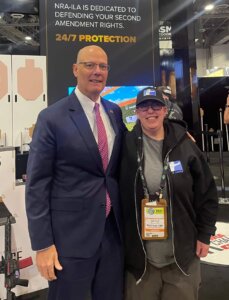
Davis, the NRA spokesperson, said that if someone wants to harm themselves, they will do it whether they have a gun or not. The bigger issue, he said, was a national mental health crisis that had gone unaddressed — and which factored into the violent threat American Jews now face.
“It’s an old adage, but when the seconds count, police are minutes away,” Davis said. “You have to be able to be your own first responders.”
Azrael said research undercut the notion that armed crime victims could reliably help themselves. When guns are used in self-defense, she said, the people who use them aren’t significantly less likely to be injured or to lose property than people who fight back in other ways, or run.
And she was suspicious of the idea that firearms training would prepare an amateur to act in a worst-case scenario. “You’re asking people to take on a role that police officers often don’t do that well,” she said.
Masters, too, was conscious of a possible disconnect between firearm ownership and capacity to respond safely in those scenarios. Lately, he said, he has begun advising law enforcement that active threat scenarios in Jewish spaces may feature armed civilians trying to help.
And he was also aware that not everyone in a synagogue felt comfortable or safe with more guns around them.
“This is perhaps a transition for many members of the community in how they feel about this issue, but it’s a reality that people have an option and are exercising it,” Masters said. “As security professionals, we have to deal with that reality.”

Did you know that only 2% of Forward readers donate to support our nonprofit newsroom? That 2% make it possible for millions to read the Forward without a paywall or subscription — removing any barriers to the full and fair Jewish story.
But while the Forward is free to read, it isn’t free to produce. Big stories — like deep dives into the antisemitism data, political scoops or reporting trips to college campuses — take months of research and fact-checking. All while we keep you informed of what you need to know each day.
— Rachel Fishman Feddersen, Forward Publisher & CEO
Support our mission to tell the Jewish story fully and fairly.