Protesters picket Manhattan synagogue over Israel real estate sale, testing Mamdani and new law
The NYPD kept demonstrators and counterdemonstrators nearly a block away from Park East Synagogue, where a prior protest spurred measures to protect houses of worship
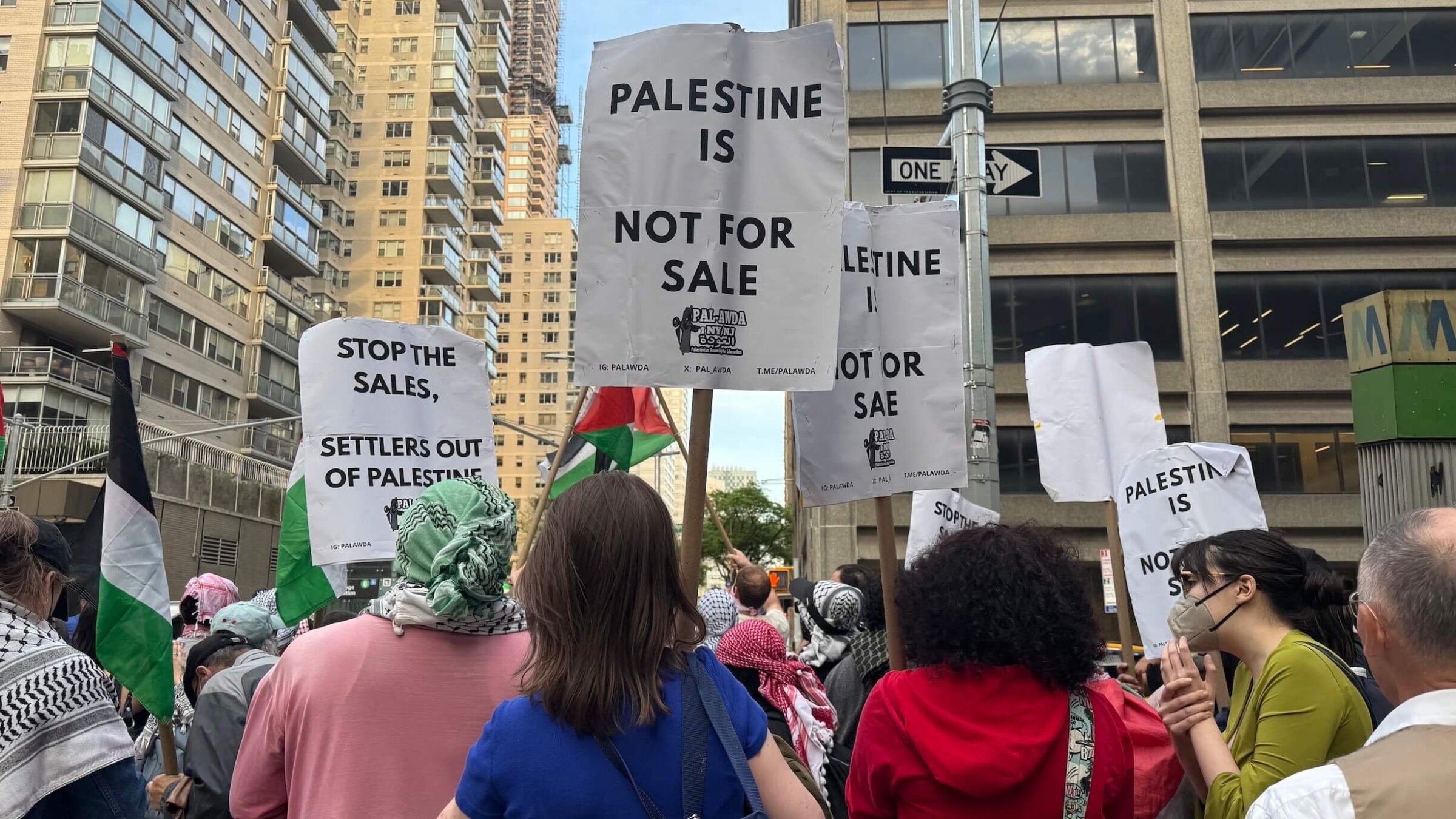
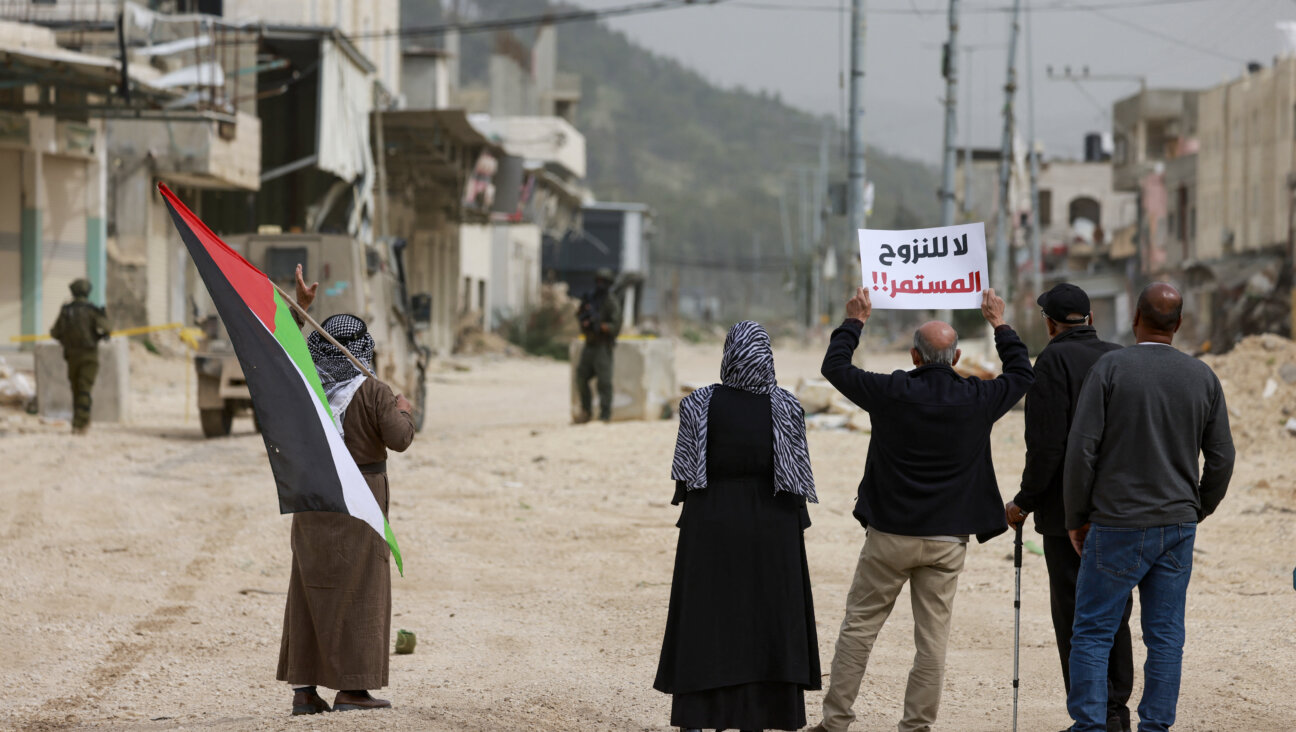
Pro-Palestinian protesters near Park East Synagogue in Manhattan, May 5, 2026. Photo by Hannah Feuer


By Hannah Feuer and Jacob KornbluhMay 5, 2026
Protesters thronged a Manhattan synagogue Tuesday night outside an event promoting real estate in Israel and the West Bank — returning to the scene of a clash last year that prompted a new law shielding houses of worship and put the heat on newly elected mayor Zohran Mamdani.
The demonstration at Park East Synagogue on the Upper East Side drew more than 100 protesters, kept nearly a block away from the house of worship by barricades and a heavy NYPD presence.
Chants of “There is only one solution, intifada revolution,” “From the river to the sea, Palestine will be free,” and “We don’t want a two-state, we want ’48” rose from the crowd — slogans Zionist organizations view as antisemitic and a call for violence and removal of Jews in the region.
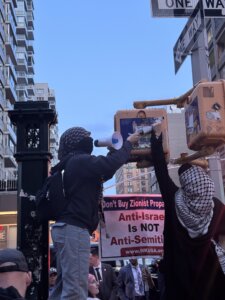
At one point, two protesters near the event ripped down a plastered poster of the Lubavitcher Rebbe that read “Messiah is here” from a traffic light and threw it in the trash.
A smaller group of pro-Israel counterprotesters rallied across the street from the pro-Palestinian demonstrators.
A spokesperson for the synagogue said it rented out the space for the Great Israeli Real Estate Event, which advertised properties for sale in Israel and the West Bank.
The standoff comes just days after a new law governing protests outside houses of worship took effect — a measure that City Council Speaker Julie Menin introduced after a November 2025 demonstration at Park East Synagogue.
The protests, combined with what some Jewish leaders saw as slow or equivocal responses from Mamdani, led to calls for legislation that would limit demonstrations near houses of worship.
Menin initially aimed to establish protest-free buffer zones of up to 100 feet outside synagogues but revised the bill after pushback from Police Commissioner Jessica Tisch, some progressive Jewish groups and free speech advocates, under threat of legal challenges.
A watered-down version of that legislation that allows the NYPD to determine how large buffer zones need to be on a case-by-case basis passed with a veto-proof majority last month. Mamdani allowed the bill to become law without his signature.
Mamdani meanwhile vetoed a similar bill that would apply to schools. The Council could still vote to override that veto.
Police closed off the entire street where the synagogue sits to the public, while allowing the event’s attendees to enter. The demonstrators were well over 100 feet away from the building — a greater distance than even the largest buffer zone proposed by Menin.
Outside event promoting Aliyah and real estate in Israel at Park East Synagogue:
Protesters gathered on intersection of 68th and Lexington chanting “Intifada revolution, there is only one solution,” “from the river to the sea, Palestine will be free,” and “We don’t want a two… pic.twitter.com/tXCTDSGGLv
— Jacob N. Kornbluh (@jacobkornbluh) May 5, 2026
Supporters of the law argued that its flexible standard — allowing the NYPD to determine buffer zone distances rather than specifying them precisely — would protect protesters’ rights. But the security at Park East showed how that discretion can, in practice, expand protest-free zones by granting the NYPD wide latitude to set the distance themselves.
A spokesperson for Mamdani, a vocal critic of Israel, said on Tuesday before the protest that the mayor is “deeply opposed” to the event, characterizing the sale of property in the West Bank as a violation of international law. The spokesperson, Sam Raskin, nevertheless emphasized that the city was ready to ensure the safety of participants entering the venue and those demonstrating.
“Our administration has been clear that we are committed to ensuring safe entry and exit from any house of worship, and that such access never be in question while all protesters are able to exercise their First Amendment rights,” said Raskin ahead of the event.
‘People are outraged’
Tuesday’s event was the first time under the new law, but the NYPD protest plan it calls for is still a work in progress: the police department still has another month to present a plan and 90 days to publicize it.
Local politicians noted the sensitive nature of the protest, saying that alone is reason to condemn it.
Assemblymember Alex Bores and Councilmember Virginia Maloney, who represent the district where the synagogue is located, said in a joint statement that the situation naturally evoked “painful memories of times when people have been harassed while entering houses of worship.”
Micah Lasher, a state legislator who is vying for the open congressional seat on Manhattan’s west side, described the protest as “intended to create fear in the hearts of Jewish New Yorkers and stigmatize the community.” Lasher said leaders should condemn the protest, no matter any disagreement on policy.
Rob Jereski, a local attorney who works with CODEPINK and is Jewish, came to support the Palestinian side. Jereski said he had reservations about the security perimeters, arguing it kept protesters too far from the real estate event.
“I know the new law is supposed to maintain free speech and honor the Constitution, but this doesn’t seem to do it,” Jereski said. “The fact that Jews pray in a place doesn’t mean that crimes that are committed in that place should be without a response if people are outraged.”
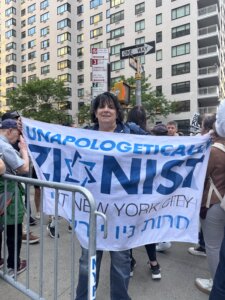
Some counterprotesters also criticized the new Council measure — for not going far enough.
“That’s outrageous that it’s not clear that you cannot demonstrate and harass kids or people around religious institutions,” said Tomer Morad, a demonstrator on the Israeli side.
Karen Lichtbraun, an activist affiliated with the Zionist Herut movement in New York, said the new bill was a “joke” that doesn’t address the problem.
“Today, thank God, they’re away from the synagogue,” she said. “But what happens if next time the police commissioner decides that they can be 50 feet or 10 feet away?”

Hello, fellow Forward reader! I’m Joel Brown, a Forward reader and supporter for more than 15 years, and currently the chair of the board of directors.
I’m an avid Forward reader because it ticks so many of my essential boxes: excellent journalism, Jewish focus and diverse viewpoints. In today’s political climate, what I most appreciate is the Forward’s independence — made possible by the generosity of its membership.
The Forward is committed to bringing you unbiased, nuanced Jewish news. From my position as board chair, I see an exciting future as we expand our position as the definitive independent voice of contemporary American Judaism.
That’s why I’m paying it Forward, by matching $36,000 of reader gifts. It’s an investment in the Forward’s newsroom, to continue telling the American Jewish story with truth and independence.
— Joel Brown, Forward board chair
Support our mission to tell the Jewish story fully and fairly.