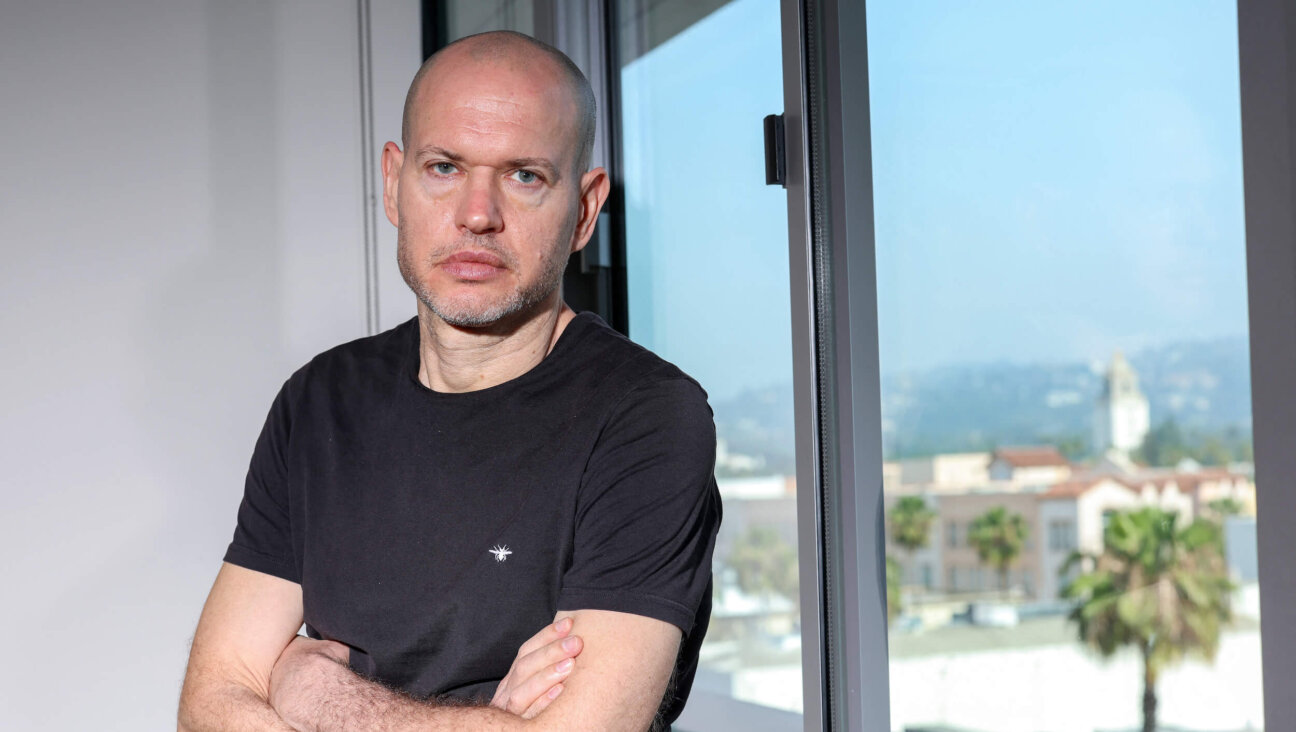
Deni Avdija might not win Most Improved Player. But he can achieve something greater.
The winner of Tuesday’s Play-In advances to the one place Avdija’s never been in his six seasons: the NBA Playoffs.

PORTLAND, OREGON – APRIL 10: Deni Avdija averaged 24.2 points, 6.9 rebounds and 6.7 assists in his All-Star sixth season. Photo by Soobum Im/Getty Images

By Louis Keene April 13, 2026
In any other year Deni Avdija, the NBA’s reigning Israeli superstar and its most talented Jewish player in at least half a century, might be a shoo-in for the league’s Most Improved Player award. The 6-foot-8 forward inflated his scoring average from 16.9 to 24.2 — good for 14th in the NBA — as he made his first All-Star team and guided the Portland Trail Blazers to their first winning season in five years.
But in spite of his team’s social media campaigning, this year’s award seems most likely headed to the Atlanta Hawks’ Nickeil Alexander-Walker, whose 20 points-per-game more than doubled last year’s average. Sportsbooks made Alexander-Walker an overwhelming favorite to win, and while I would debate the merits — Avdija also raised his assist numbers, had a bigger role on his team and made a more difficult leap — I can’t really argue the odds.
Anyway, with the regular season over, Deni is onto more important things — starting Tuesday night, when his Blazers take on the Phoenix Suns in the biggest game of his career to date. The winner of Tuesday’s Play-In (10 p.m. ET on Amazon Prime) advances to the one place Avdija’s never been in his six seasons: the NBA Playoffs.
At stake is more than just Avdija’s drought of 425 games without a playoff appearance — the fifth longest streak of any active player. It’s also the 10 years Israeli fans watched Avdija’s Jewish countryman Omri Casspi play without seeing him in the postseason. Casspi’s 588 games with seven different teams are the fourth-most without playing in the playoffs in NBA history (and the most of any player born after 1950). An ignominious record, indeed.

As Jewish Telegraphic Agency has noted, Israeli-born journeyman TJ Leaf, who is not Jewish, made the playoffs as recently as 2021. And others have pointed out that Casspi’s team made the playoffs in 2014, but he did not play. But Avdija himself seems to regard this as a possible breakthrough.
“First taste of the playoffs — I think ever for an Israeli player,” he said — last year, before the Blazers barely missed the Play-In.
If the Blazers do end the Jewish Israeli playoff curse, it will be thanks to Avdija, who’s answered every call for the franchise this season. In two critical late-season games against the Los Angeles Clippers — their rival for the 8th playoff seed — Avdija led all players in scoring both times, including 35 points April 10 as Portland grabbed hold of the 8-seed.
Avdija’s work will be difficult against Phoenix, which in Dillon Brooks employs one of the stingiest wing defenders in the Association. Avdija was one of the best in the league at drawing fouls — he was third in the NBA in free throw attempts — and the game may depend on how closely the referees officiate contact. As for prior experience, Avdija only played one full game against the Suns this year, scoring 19 points in a 17-point loss; Portland split the other two matchups.
Because they secured the 8-seed, the Blazers will have a second chance at making the playoffs even if they lose. The winner of Wednesday night’s Clippers-Golden State Warriors matchup will face the loser of Blazers-Suns. Two chances to win one, and make (Jewish) Israeli hoops history.

Hello, fellow Forward reader! I’m Joel Brown, a Forward reader and supporter for more than 15 years, and currently the chair of the board of directors.
I’m an avid Forward reader because it ticks so many of my essential boxes: excellent journalism, Jewish focus and diverse viewpoints. In today’s political climate, what I most appreciate is the Forward’s independence — made possible by the generosity of its membership.
The Forward is committed to bringing you unbiased, nuanced Jewish news. From my position as board chair, I see an exciting future as we expand our position as the definitive independent voice of contemporary American Judaism.
That’s why I’m paying it Forward, by matching $36,000 of reader gifts. It’s an investment in the Forward’s newsroom, to continue telling the American Jewish story with truth and independence.
— Joel Brown, Forward board chair
Support our mission to tell the Jewish story fully and fairly.