Women aren’t equal citizens in Israel. But this week brought us closer than ever
At the same time the right-wing seeks to curtail women’s religious freedom, women rabbis celebrated an unprecedented win
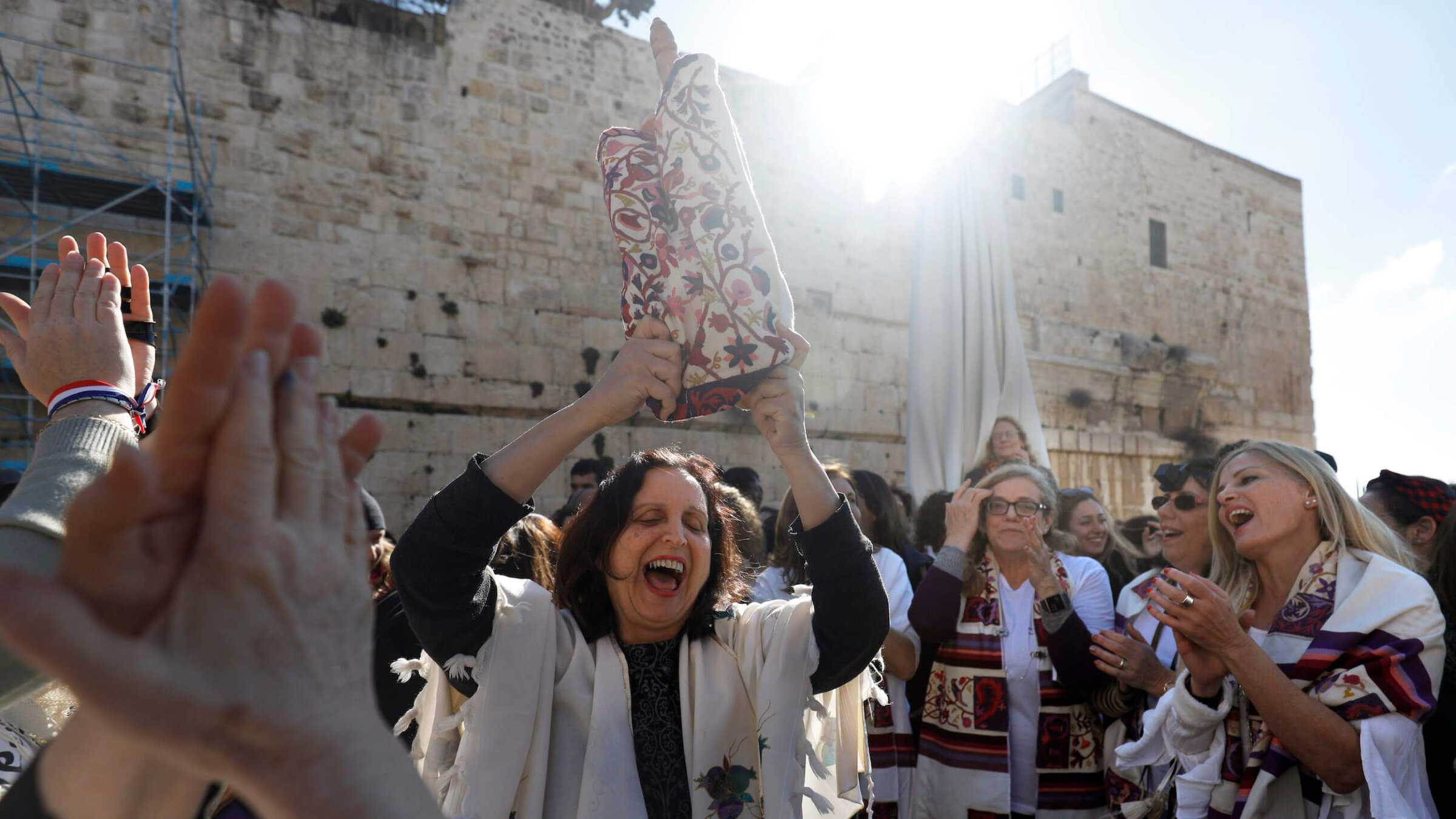
A member of the liberal Jewish religious movement “Women of the Wall” dances with a Torah scroll during an event marking the organization’s 30th anniversary on March 8, 2019. Photo by Gali Tibbon/AFP via Getty Images
On Monday, three women sat for an exam — and changed the course of Israeli history.
Never before have women been permitted to take the rabbinical exams issued by Israel’s Chief Rabbinate. But thanks to a groundbreaking Supreme Court ruling in July which deemed such exclusionary practices unlawful, three scholars were able to break this glass ceiling.
Yaara Widman Samuel, Ruth Agib and Rachel Tzaban’s victory against gender-based discrimination in Israeli society is momentous, an achievement rooted in many years of tireless advocacy, courageous leadership and unflinching determination. And yet, it is but one victory in a larger, ongoing battle for gender and religious equality in Israel, a battle waged over decades and across many fronts.
Recently, I had the privilege of witnessing another front in this battle at the Western Wall. There, I joined Women of the Wall, advocates for equal rights at the Kotel, for their Rosh Chodesh Adar service. It was an experience I will never forget.
Women of the Wall are engaged in an epic struggle for equality under Israeli law. For more than 37 years, they have gathered on Rosh Chodesh — the holiday that marks the start of each new Jewish month — to pray, sing, and read Torah at the Western Wall. Their mission is simple: to secure women’s right to pray at the Wall.
And for more than three decades, they have been met with anger, disdain, humiliation and denial. Most recently, Israel’s Knesset advanced a law that would prohibit non-Orthodox and egalitarian prayer at the Western Wall complex. The proposed law would grant Israel’s two chief rabbis exclusive authority over the Wall, allowing them to define prayer and what constitutes “desecration.” Under this law, those who “desecrate” prayer — such as women who wear tallit or tefillin, or mixed gender groups that gather for worship — could face up to seven years in prison.
And yet, like the women who fought for the right to take the Chief Rabbinate’s rabbinical exams, Women of the Wall has not been silenced or deterred. They know that the Western Wall is not the property of one denomination or community; it belongs to all Jewish people — regardless of gender, denomination, or affiliation.
Israel’s Declaration of Independence states that the country “will ensure complete equality of social and political rights to all its inhabitants irrespective of religion, race, or sex.” This promise must extend to the Western Wall as well. All Jewish women should be welcome at the Kotel, and all should feel safe to practice their Judaism in the manner they choose. These principles of equality and inclusion are essential to Israel’s democracy and religious identity.
But not all would agree.
When the Torah is contraband
On Rosh Chodesh Adar, we arrived at the entrance to the Wall a few minutes before 7 a.m. Even at that early hour, it was already crowded with worshippers.
The energy was charged and tense. As our group approached the security check, we were met with immediate hostility.
The security guards often harass and humiliate Women of the Wall participants. This day was no different: they asked us to remove our coats and demanded every bag be checked by hand. Purses were emptied, tallitot unfolded, even wallets were scrutinized — all in the name of preventing something “dangerous” from entering the plaza.
The “dangerous” items they were seeking were Torahs.
That morning, we carried a Torah proudly to expose the absurdity and injustice of the situation: how could our religion’s foundational document be treated as dangerous?
Security did not take kindly to our effort. Needless to say, the Torah was not allowed inside.
Shaken, we made our way toward the Wall. As we walked, we found ourselves surrounded by mobs of children, many apparently from traditional communities, who screamed hateful things, calling us heretics and shouting at us to leave. They mocked women wearing kippot and tallitot, pushing and shoving as they did.
Their contempt wasn’t surprising; similar scenes have unfolded many times, over many years. But it was shocking — and deeply disheartening.
When it came time to leave the plaza, many of us held hands, for solidarity, but also for safety. We circled back to the Kotel entrance, to read from the Torah, since we couldn’t do so at the Wall itself.
As we read, the commotion reached a crescendo. The noise was deafening, and we were increasingly hemmed in by rioting crowds. Meanwhile, the security guards — tasked with keeping the peace — not only allowed the agitators to continue, but targeted us. Ultimately, two of our prayer leaders were detained — simply because they were women reading Torah.
Not at the Wall. Outside the Wall.
Incredulously, these women — rather than the violent crowds around them — were deemed a “disturbance to public order.” rather than the violent rioters attacking them. And yet, even amidst this harassment, they bravely stood their ground. Until the moment they were detained, they prayed with sincerity, with strength, and — appropriately for the start of Adar, a month that ushers in joy — with audacious joy.
A continuing fight
After their release from police custody, the two women who had been arrested put out a video in which they said, defiantly, “We will be back!”
And indeed, in honor of Rosh Chodesh Iyyar they returned. While their Torah was seized yet again, they remained undeterred, declaring: “We will not give up our Jewish right. We held a Torah reading at the entrance to the Wall — and we will continue our just struggle.”
That struggle has been going on for decades, but has perhaps never been more important than today. The erosion of religious freedom in Israel may begin at the Wall — but it will not end there.
That is partly why the image of the three brave women taking the Chief Rabbinate’s exams resonated so deeply: Our rights are under threat, but at the same time, we have clear proof that progress is still possible. It’s a reminder that privileging one segment of the Jewish community at the expense of the rest will only divide us, within Israel and across the Diaspora. As Rabbi Mauricio Balter teaches, “A strong Israel is a democratic Israel. A faithful Israel is a pluralistic Israel.”
And so, we persist. We fight for ourselves, for our mothers and our grandmothers, and for our daughters and granddaughters. We do not give up this fight because religious equality matters. Because gender equality matters. And because Israel’s future as a democracy depends on it, for those who live there and for those who call it their spiritual home.
I’m personally matching all gifts to the Forward, up to $36,000. Can I match your gift now?

Hello, fellow Forward reader! I’m Joel Brown, a Forward reader and supporter for more than 15 years, and currently the chair of the board of directors.
I’m an avid Forward reader because it ticks so many of my essential boxes: excellent journalism, Jewish focus and diverse viewpoints. In today’s political climate, what I most appreciate is the Forward’s independence — made possible by the generosity of its membership.
The Forward is committed to bringing you unbiased, nuanced Jewish news. From my position as board chair, I see an exciting future as we expand our position as the definitive independent voice of contemporary American Judaism.
— Joel Brown, Forward board chair
Support our mission to tell the Jewish story fully and fairly.