Three simple rules for navigating a new season of protest against Israel
As Americans, and Jews, we must relearn how to dissent without disrespect
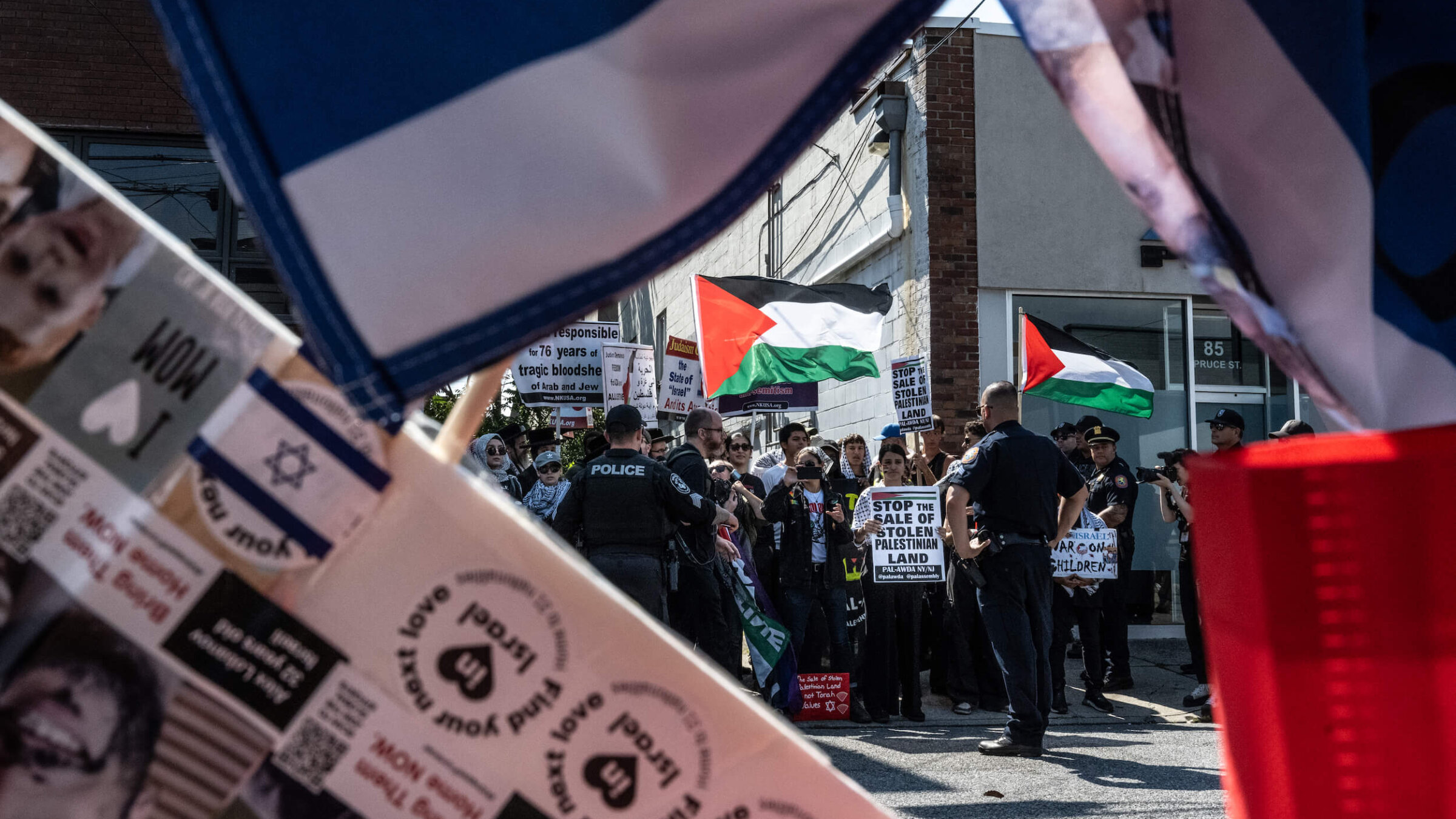
Pro-Israeli counter protesters face off with Pro-Palestinian demonstrators on Sept. 15, 2024 in Cedarhurst, New York. An Israeli real estate expo at a local synagogue brought out demonstrators on both sides of the issue. Photo by Stephanie Keith/Getty Images
Elliot Cosgrove May 12, 2026
Spring. The season of graduations and protests.
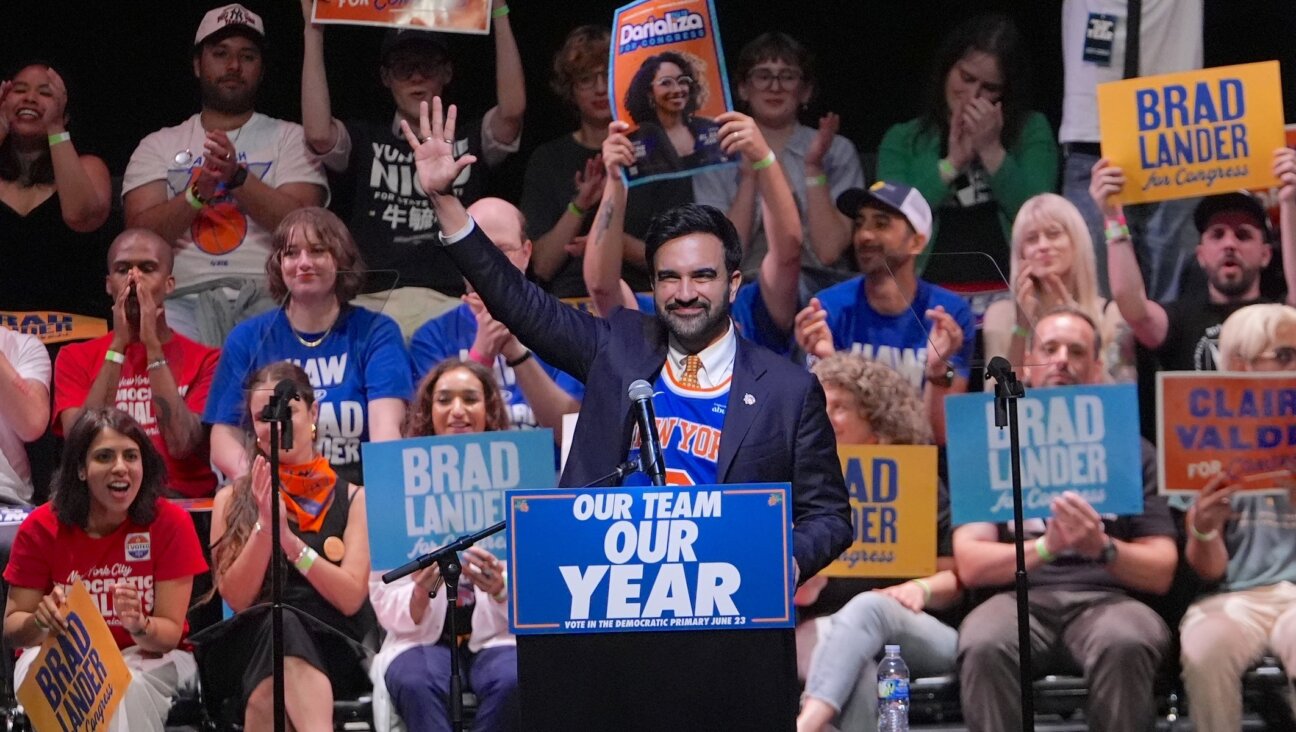
A tenured professor and faculty chair at my alma mater, the University of Michigan, recently used the commencement stage to denounce Israel’s war in Gaza — remarks that drew applause from some as others experienced them as alienating and unwelcome. At New York’s Park East Synagogue, a group of masked, hate- spewing demonstrators waving Hezbollah flags while protesting the “Great Israeli Real Estate Event.”
If the settings of these incidents differ, one underlying question they raise remains the same: What are the ethics of protest? At what point does dissent deepen democratic life and moral accountability, and when does it begin to fray the trust, dignity and shared sense of belonging upon which a society depends?
While these tensions may be hard to resolve, I’d like to put forward three guiding principles for how best to engage on the subject of free expression in such a hot-zone climate.
Protest is essential
Protest is foundational to what it means to be both a Jew and an American.
Look to Abraham standing before God at Sodom and Gomorrah; Moses standing before Pharaoh; the prophets calling kings and nations to conscience; and Esther risking all for her people. All of their examples show that to be a Jew is to take note of the gap between the world as it is and as it ought to be, and then to summon the moral courage, communal will, and spiritual audacity to help close that gap.
Jews understand that to protest is a religious act. That’s why rabbis so often quote Abraham Joshua Heschel’s famous reflection after marching alongside Martin Luther King Jr. in Selma in 1965: “I felt my legs were praying.”
And as the United States turns 250 years old, it’s worth remembering that our country began with a protest movement. Since then, many of our country’s finest moments have emerged from moral protest — including the labor movement, the fight for women’s suffrage, and the Civil Rights Movement.
As Jews and as Americans, we are heirs to two traditions of protest.
So is self-interrogation
Where we draw the lines around acceptable protest says as much about us as it does about the protest itself.
A prime example of this: During my 25-plus years as a rabbi, no congregant has ever told me that the pulpit is no place for politics — so long as they agree with my politics.
I had little difficulty admiring the activist Greta Thunberg when she sailed across the Atlantic to raise awareness about climate change. I found it much more challenging to view her kindly when she joined a flotilla protesting Israel’s war in Gaza.
Similarly, the faculty speaker at Michigan’s commencement sounded pretty good when championing the university’s first Jewish faculty member and a curriculum more attentive to Black American history. It was only when he condemned Israel that many listeners, myself included, recoiled at his remarks.
None of us are the neutral arbiters of protest ethics we may imagine ourselves to be. Progressives who passionately defend buffer zones around abortion clinics but not around houses of worship should ask why one form of vulnerability warrants protection and another does not. Student activists who champion on-campus encampments protesting Israel’s actions in Gaza, but would never tolerate a white nationalist rally on campus, should ask where principle ends and preference begins. Conservatives who invoke the First Amendment to defend provocative speech they favor, yet denounce positions they dislike as treasonous or un-American, should examine where principle gives way to ideology. And activists who mobilize when civilians die in Gaza but remain deafeningly silent when tens of thousands of Iranians are murdered by their own regime must interrogate what moral framework governs that selective outrage.
Where we draw the lines — whom we applaud, what we excuse and what we denounce — reveals not only our principles, but also our loyalties, fears and tribal attachments. Moral seriousness requires the humility to examine ourselves before we protest — to check ourselves before we express ourselves.
Just because you can, doesn’t mean you should
As Jews, we believe in buffer zones — not just the kind debated at City Hall. The rabbis believed in moral buffer zones, a principle they referred to as living “lifnim mishurat hadin” — “beyond the strict line of the law.”
Rabbinic tradition in part explains the semi-somber period between Passover and Shavuot, in which we currently find ourselves, using precisely this idea. When 24,000 of Rabbi Akiva’s students died in one day, the Talmud teaches, they perished because they followed the letter of the law but failed to go beyond it and treat one another with respect — “kavod zeh lazeh.” They failed to embody the deeper demand of leadership: to live not merely according to what one is allowed to do, but by what one ought to do.
What might that mean for us today?
The answer: just because you have the legal right to express yourself doesn’t mean you should.
The Michigan commencement speaker may have been within his rights to voice his objections to Israel. But his decision to do so in that setting reflected a breathtaking failure of leadership, reminding us there is no direct correlation between tenure and wisdom, expertise and judgment. Like a teacher who hijacks a classroom to air political grievances under the guise of education, the speaker demonstrated an astonishing lack of discernment by alienating a sizable portion of the very students and families he was there to honor and congratulate.
Regarding the protests outside Park East Synagogue, the letter of the law may protect those who wave the flags of a terrorist organization, chant antisemitic slogans, or proclaim that the Jewish state itself should cease to exist. That such speech is protected does not mean it is right. It is, instead, intimidation masquerading as activism.
I was also deeply troubled by the response of New York Mayor Zohran Mamdani, who prefaced his condemnation of the protests by first denouncing the event itself. The mayor should have simply said: no house of worship should be targeted or intimidated, full stop.
To imply that the nature of the event somehow mitigated the harassment outside was not only irresponsible, offering moral cover for behavior that crossed the line from protest into menace, but also a troubling form of moral equivocation that shifted responsibility onto those being targeted — if not outright victim blaming. A peaceful protest calling for Palestinian self-determination alongside Jewish self-determination? As a liberal Zionist, that sounds like my kind of protest! But in an age in which there is a direct line between anti-Israel rhetoric and antisemitic violence, our mayor must do more than merely follow the letter of the law. True leadership begins where the letter of the law ends.
The issue is not whether dissent is permitted, but whether we are not losing the capacity for kavod zeh lazeh.
As the secular prophet of our time, Bruce Springsteen, has been reminding audiences across the country on his current tour: “America, from the beginning, was born out of disagreement. It was built on argument, on disagreement. We can argue about what course we thought the country should take while recognizing our common humanity, our dignity and, yes, our unity.”
Whatever our differences, the challenge before us is whether we can disagree without severing the ties that bind us — as Americans, Jews and human beings.
Did you know that only 2% of Forward readers donate to support our nonprofit newsroom? That 2% make it possible for millions to read the Forward without a paywall or subscription — removing any barriers to the full and fair Jewish story.
But while the Forward is free to read, it isn’t free to produce. Big stories — like deep dives into the antisemitism data, political scoops or reporting trips to college campuses — take months of research and fact-checking. All while we keep you informed of what you need to know each day.
— Rachel Fishman Feddersen, Forward Publisher & CEO
Support our mission to tell the Jewish story fully and fairly.