All American Jews should acknowledge Nakba Day — for Israel’s sake, and Palestine’s
We must acknowledge the truth of the past to begin building toward a peaceful future
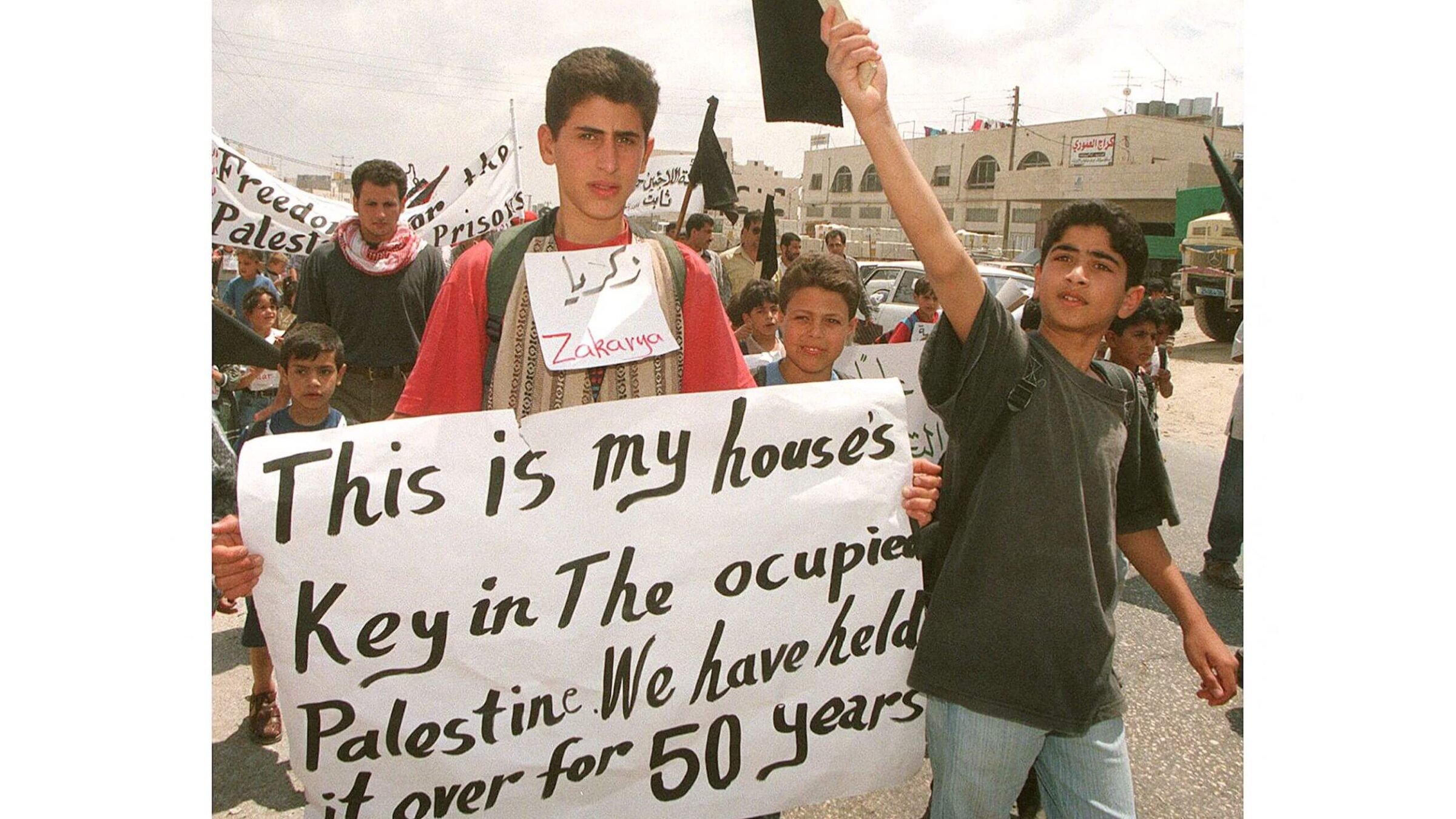
Young Palestinian refugees demonstrate at the Daheisheh refugee camp outside the West Bank town of Bethlehem on May 13, 1998. Some 500 schoolchildren joined a “march of the keys” to mark the 50th anniversary of the Nakba — “catastrophe” in Arabic — the exodus of 700,000 Palestinian refugees from their land upon Israel’s creation. Photo by Awad Awad/AFP/Getty Images

Hadar Susskind May 13, 2026
Many American Jews were raised with the word “Nakba” absent from our vocabularies.
We were taught, correctly, about the miracle of Israel’s founding; the refuge Israel provided after the Holocaust; and the flourishing of Jewish life in our ancestral homeland. What went unmentioned was the other side of that joy: the Nakba, meaning “catastrophe” in Arabic, the name by which the displacement and dispossession of hundreds of thousands of Palestinians during the creation of the state of Israel is known through the Arab world.
For Palestinians, the Nakba is the defining experience of their collective life — carried in family histories, in refugee camps and in the enduring statelessness of millions. It is living memory, not ancient history. The remarkable story of Israel’s creation is real, essential and worth celebrating. But it’s time that all Jews — Zionists alongside anti-Zionists — acknowledge that it was never the only story.
Acknowledging Nakba Day — an annual commemoration on May 15 — can feel uncomfortable, even threatening. There is a fear within much of the Jewish community that recognizing Palestinian loss will in some way undermine Jewish claims to self-determination, or feed efforts to delegitimize Israel.
I understand that fear. I lead a Jewish organization with Zionist roots; I feel this tension in my daily work and life. But I also believe this fear is misguided.
When we deny or minimize the full history of 1948, we deny not just the humanity and pain of the Palestinian people, but also our own honest understanding of today’s reality. For Jewish leaders struggling to understand why younger American Jews won’t simply follow their lead when it comes to support for Israel, this is part of the answer.
When we avoid learning and teaching about the Nakba, we do not make Palestinian loss disappear. Rather, we simply reinforce the perception that we are unwilling to confront this essential part of Israel’s story.
And when we expand our historical understanding we do not weaken our connection to Israel, or that of our children. On the contrary, we strengthen it. A relationship built on selective memory is fragile and incomplete. One grounded in truth — even uncomfortable truth — is far more honest and resilient.
The best reasons to commemorate Nakba Day are the moral mandate to recognize the truth, the value of opening a door to allow for transformational relationships.
Two truths can coexist. It is true the establishment of Israel was a moment of profound liberation for the Jewish people, and it is equally true that it was a moment of profound loss for Palestinians. Holding both facts is not easy. To do so challenges the binary narratives many of us were raised with. But maturity — personal and communal — requires sitting with complexity rather than retreating from it.
Embracing that complexity carries real world implications.
The dismissal of Palestinian grievances is already harming Israel, degrading security and imperiling the country’s future as an integral part of the Middle East. That rejection salts the soil in which deep relationships between Israeli Jews and their Arab neighbors might otherwise take root.
Durable peace will not come from either side insisting that their narrative is the only legitimate one. It will come — if it comes at all — from mutual recognition of history, suffering and shared humanity.
For Jews and Jewish organizations to acknowledge Nakba Day can be one small step in that direction. Doing so would signal a willingness to listen, learn and take Palestinian perspectives seriously. That is an expression of respect that any shared future requires.
To American Jews who find this proposal uncomfortable: It is time for some courage. The easy path is silence. That silence will bring us more isolation, and hamper our capacity to foster relationships grounded in trust with Palestinians. The harder path is to expand our understanding, starting with a more complete and honest account of the past.
Jewish tradition gives us a framework for exactly this kind of engagement.. We regularly recount our own moments of vulnerability, exile and moral failure. We imagine ourselves as slaves departing Egypt and remind ourselves of the ethical obligations that follow. Applying that same ethic in the present day does not betray our story. It honors it.
Commemorating Nakba Day recognizes that the past shapes the present. It embraces intellectual and moral honesty. It affirms that Palestinian lives and histories matter and must coexist alongside Jewish lives and history.
In a time of deep polarization — within the Jewish community, between Israelis and Palestinians, and across American society — the temptation is to retreat into camps, to draw sharper lines and to insist on simpler stories. Giving in to that temptation will not lead us to a future of peace, justice, and mutual dignity.
Instead, we need to complicate our narratives. We need to listen more than we speak. And we need to find ways to honor the humanity of those whose experiences do not mirror our own. Recognizing Nakba Day on May 15 is a good place to start.
Did you know that only 2% of Forward readers donate to support our nonprofit newsroom? That 2% make it possible for millions to read the Forward without a paywall or subscription — removing any barriers to the full and fair Jewish story.
But while the Forward is free to read, it isn’t free to produce. Big stories — like deep dives into the antisemitism data, political scoops or reporting trips to college campuses — take months of research and fact-checking. All while we keep you informed of what you need to know each day.
— Rachel Fishman Feddersen, Forward Publisher & CEO
Support our mission to tell the Jewish story fully and fairly.