On a new Israeli TV show, the secret lives of Orthodox Jewish atheists
‘Behasture’ sheds light on the stories of religious non-believers who risk everything if they leave
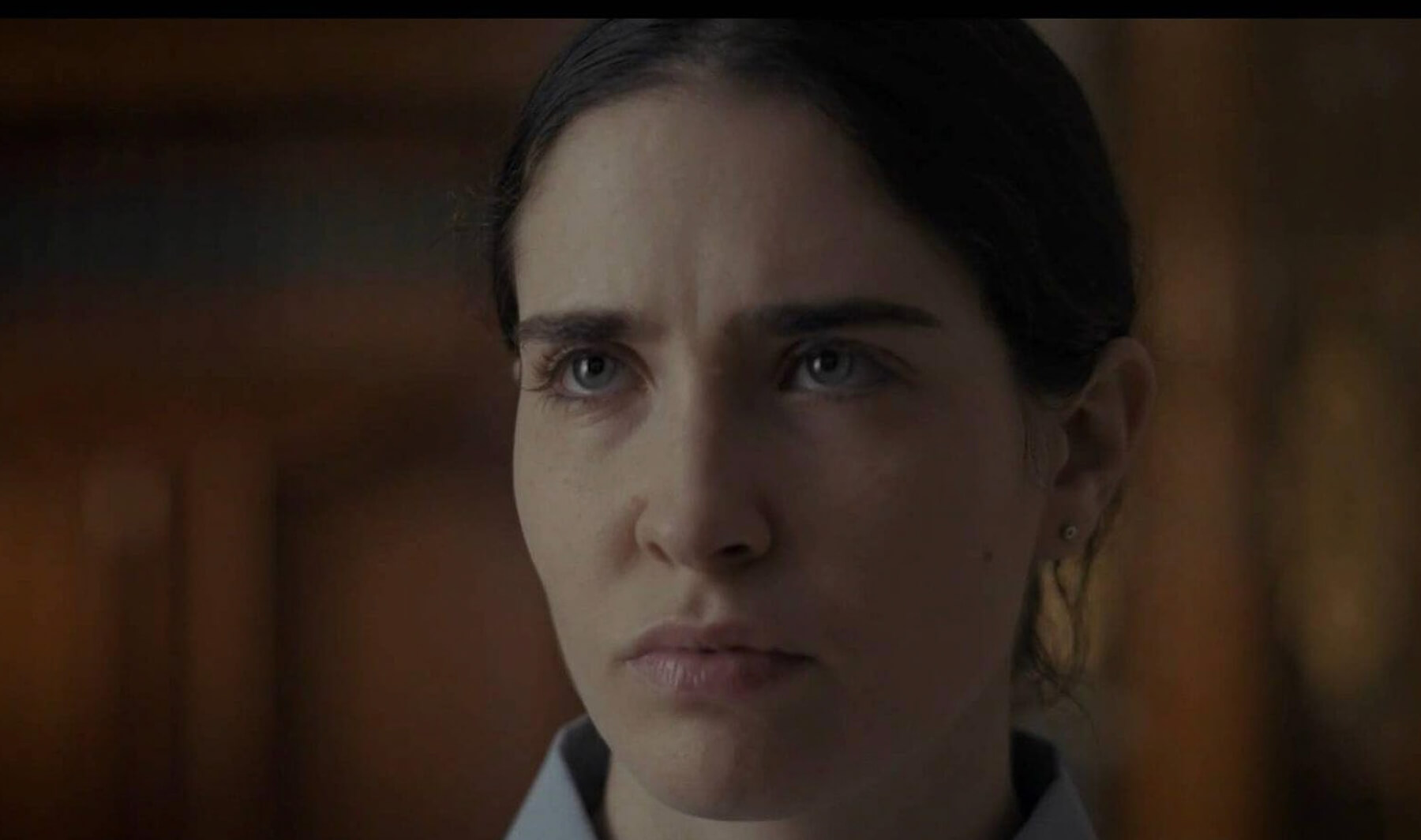
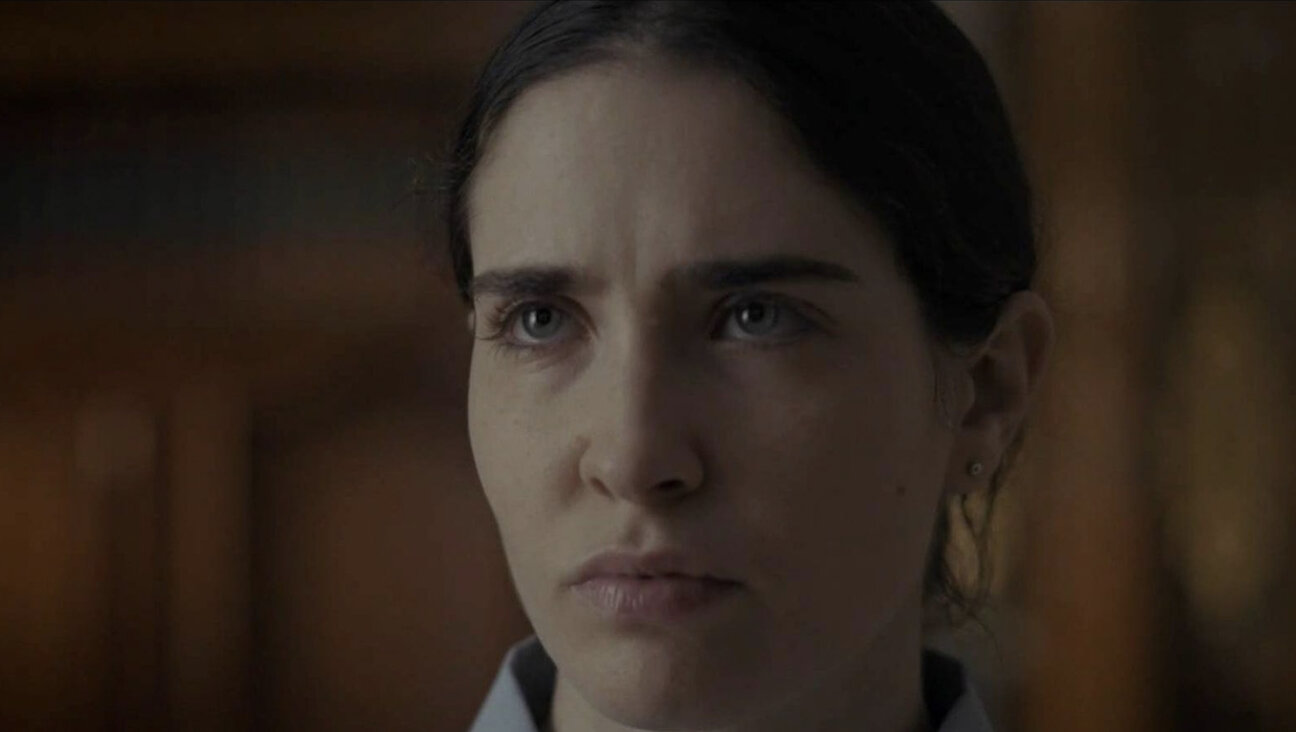
Neomi Harari in the Israeli TV show ‘Behasture.’ Photo by Kan
When we think about “off-the-derech” Jews, those who have left Orthodoxy behind, we tend to think of rebellious youths in their teens and 20s, those who party and do drugs to shed the religious yoke. But there’s another category of Jews who’ve left the fold, ones who’ve lost their faith and yet remain Haredi. First documented in “The Impostors Among Us,” a 2011 article published in Ami magazine by the pseudonymous Raphael Borges, this category of “duplicitous, heretical infiltrators” are now the subject of a new Israeli TV show from Kan, Behasture, which translates to “In Hiding.” The show’s English language title is Ambiguity.
Set during the height of the COVID pandemic, Behasture opens with Rochal’e intentionally catching the virus to gain access to a quarantine apartment. Accompanied by her mother, we see her enter a space for Haredi women dressed in full modesty garb. However, the moment her mother exits the compound, the transformation begins. The women remove their sheitels and frumpy dresses to reveal their hidden secular selves. Men emerge from adjoining rooms. They’re all secret heretics, and this compound is their Ir Miklat, their safe refuge.
While the article in Ami called these Jews “fifth columnists,” on their secret Internet blogs, they usually refer to themselves as “in the closet” or “orthoprax.” In Israel, they are called “anusim” (forced ones), inverting the term used for crypto-Jews, who believed in Judaism but were forced to act Christian. By staying in their Orthodox communities, the anusim become ghosts going through the motions of Haredi life; no one can truly see them, and no one knows their true thoughts. Secret apartments like the one featured in Behasture are the only places they can be themselves.
Although their belief in God has fallen away, they remain deeply culturally Haredi. They say traditional blessings before eating or drinking, and give dazzling Torah sermons while holding shrimp up to their mouths. As viewers, we get a voyeuristic peek into this liminal space which straddles the boundaries between Haredi and secular. There’s something surreal, uncanny even, about watching a character with a beard and curly peyos but without a yarmulka, or a woman in a tank top strumming her guitar to Hasidic niggunim.
The theme song that opens each episode, the Shabbos standard “Lecha Dodi,” sung soulfully to the tune of “The House of the Rising Sun,” represents this blend of secularism and holiness. Singing happens frequently at the compound where the men and women sing heartfelt Hasidic melodies, dance together and enjoy treyf, relishing in their small freedoms. At the head of this secret family are Yossi Zuchmir and Aviva, who serve as father and mother figures.
The story of Aviva, the matronly woman who plies everyone with delicious food and emotional support, is explored in just a handful of scenes. Zuchmir, however, plays a central role in each episode and is perhaps the show’s most intriguing character. He hasn’t believed for a long time, but he refuses to leave the Haredi world. Instead of dealing with the family issues at home that a life of secrets causes, he’s having an affair with another woman at the compound: Gitty, his Rebbe’s wife.
Zuchmir finds meaning in these in-between spaces and exults in his small community of anusim who treat him as their Hasidic Rebbe. He mourns the members of the compound who leave for the secular world, and fails to see the tragedy in a life full of secrecy and lies. When a fellow member’s teenage daughter wants to join the anusim, Zuchmir trills about the prospect of a “father-daughter” duo, even as the girl’s father warns her off this torturous path.
In Ayala Fader’s 2020 landmark study, Hidden Heretics, which explores the lives of these secret non-believers, the author identifies two areas that lead to doubt: social issues, and intellectual ones. While these categories sometimes intersect, they are usually split along gender lines. Men, who are socialized around Talmudic debate, usually tend to frame their doubt as a more intellectual, text-based journey. The doubts of women, who are barred from reading the Talmud, are often a reaction to the crushing burden placed on wives in the Haredi community, or sometimes to covered-up sexual crimes.
In Behasture too, the male characters’ doubts stem from intellectualizing; one character even references Spinoza. Their issues come only after they lose their faith. The women, on the other hand, face challenges in their patriarchal homes: Michal joins the compound to escape her abusive husband; Sarah is forced to admit to her husband that she’s both a secret atheist and a lesbian; Gitty’s arc accurately portrays the cover-up of sexual abuse in the Haredi community and the trauma that follows.
One scene in particular highlights the intense intellectual socialization men receive in yeshiva. When Gitty’s husband discovers she’s having an affair with Zuchmir, his reaction isn’t one of heartbreak, but of legalistic contextualization. According to Halacha (Jewish law), a woman who cheats is forbidden to her husband. He quotes rabbinic texts to prove that halachically, she isn’t believed to have had an affair, even though there are pictures of her and Yossi together. “You are still muttar (permitted) to me!” he insists desperately.
The show’s authenticity, and its deep understanding of anxieties over Jewish law, stems from its co-creators. Yossi Madmoni is a veteran of Haredi drama, while Avi Tfilinski lived as a secret atheist himself for 12 years even as he remained an esteemed rabbi and head of a yeshiva. After he left, he faced the very consequences all anusim fear: He lost contact with his children for seven years, before eventually reconnecting.
These severe social consequences — losing your entire social circle and even your relationship with your children — are the primary reasons Hidden Heretics identified for why anusim stay in the community. Economic dependence is another strong factor, as Haredi schooling doesn’t offer secular education and graduates rely on jobs they couldn’t find outside the Haredi community. Finally, the cultural attachment to the separate insular community can be too strong. Leaving for the secular world can be as jarring as moving to a new country.
Perhaps because of the story of Avi Tfilinski’s own tragic exit, there are no uplifting stories of escape where a shining secular world embraces the poor anusim. Instead, we see the vast cultural gulf between the two communities. In one episode, we meet Henry who leaves his wife and child to make a new life for himself in Tel Aviv. There, however, he stumbles on the societal expectations and cultural norms of the secular world. Yossi Zuchmir berates him for attempting to leave, saying, “Idiot, our girls are a thousand times better than theirs.”

The show demonstrates the extremes some will go to stay in the community and keep their family. Shmuel Eizner, the scion of a Hasidic dynasty who goes by the name “Donald Trump” to protect his identity, is caught by his father, the famed Admor of Yashi. His father then reveals that he too once had doubts. He calls it a family curse and explains his moments of disbelief as psychotic episodes, for which he takes Zyprexa. In a horrifying scene, he convinces “Donald” to take these same anti-psychotics.
If the cast of characters in Behasture can feel overwhelming, that’s because each episode focuses on a new character in the compound, and in 45 minutes, there’s isn’t enough time to give everyone’s stories the space they deserve. The showrunners try to solve this issue by grafting on two continuous plotlines throughout.
One plotline involves Yossi Zuchmir, who funds the compound and various anusim events using loans from the criminal underworld. Yehuda, an especially harsh loan shark, beats him up and threatens to expose his secret life to the other Haredim. Guns and violence, however, feel quite out of place in the anusim’s quieter world of shame, secrets and identity shifts. Although there’s a certain lack of courage in shying away from portraying quieter, less melodramatic stories, this plotline does demonstrate the inability of an uneducated Haredi man to make money outside approved channels.
The second plotline is clumsier and involves a romance between Rochal’e and “Donald Trump.” Throughout the show, we’re often pulled away from stories exploring the deep psychology of a character to watch a scene of Rochal’e and “Donald” awkwardly failing to flirt. One wonders why so much time is spent on this contrived story of young love instead of the much more fiery affair between Zuchmir and Gitty, his Rebbe’s wife.
There are other flaws too. While the main characters look like authentic Haredim, costumed with meticulous accuracy, many of the side characters look like caricatures with obvious fake beards and ill-fitting hats. The show also attempts to neatly resolve the characters’ troubles with a deus ex machina finale that feels both contrived and unearned.
Even so, Behasture does an incredible job at highlighting a hidden community on the edges of the Haredi world. Given the popularity of Haredi TV shows like Shtisel and Shababnikim, we can expect to see this show gracing our American screens with English subtitles soon.
The show demonstrates many of the observations about this community that Ami exposed 15 years ago and that Fader made in Hidden Heretics. In one interview, the co-director Tfilinski estimates that there are 30,000 anusim currently living this double life. Let’s hope that those 30,000 in the closet feel seen by Behasture and empowered in their difficult decision to leave or remain in those secret gray areas.
Why I became the Forward’s Editor-in-Chief
- Alyssa Katz, Editor-in-Chief

You are surely a friend of the Forward if you’re reading this. And so it’s with excitement and awe — of all that the Forward is, was, and will be — that I introduce myself to you as the Forward’s newest editor-in-chief.
And what a time to step into the leadership of this storied Jewish institution! For 129 years, the Forward has shaped and told the American Jewish story. I’m stepping in at an intense time for Jews the world over. We urgently need the Forward’s courageous, unflinching journalism — not only as a source of reliable information, but to provide inspiration, healing and hope.
Support our mission to tell the Jewish story fully and fairly.