Is this Apple TV thriller hasbara — or societal critique?
The Israeli show ‘Unconditional’ is more than meets the eye
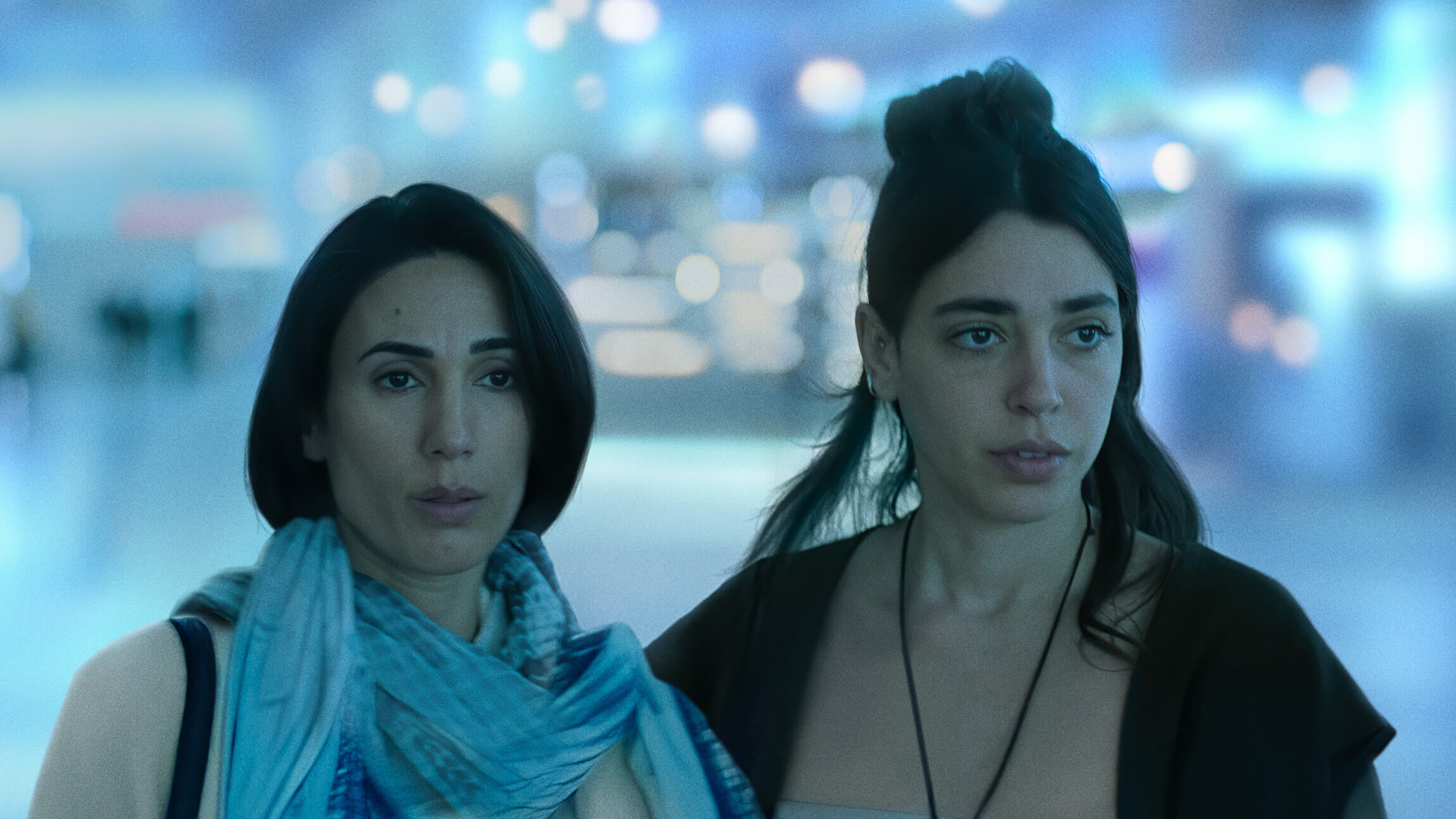
Orna (Liraz Chamami) and Gali (Ronn Talia Lynne) in AppleTV+’s Unconditional. Courtesy of Apple TV
By PJ Grisar May 8, 2026
Apple TV’s new thriller Unconditional has the trappings of so much streaming content.
A young woman disappears into hostile territory. Her mother, already juggling a family health crisis, does her own sleuthing to get her daughter back. People die, twisty alliances emerge. It’s all part of the suspense boiler plate, and it sizzles just enough to keep your interest. What makes the show, airing May 8, different from every other show is the early response.
Sight almost entirely unseen, the internet was in an uproar. The show is Israeli, and the announcement trailer showed the character Gali (Ronn Talia Lynne) in her IDF uniform. Pro-Palestine accounts were quick to shout “hasbara” or “overt ziopropaganda” for a show whose premise is ostensibly a sympathetic story of an Israeli taken prisoner by the evil, Putin-era Russian state. (The trailer makes no mention of Palestinians or a war in Gaza. The show doesn’t either.)
The online response alone proves the challenging optics for anything Israeli, but the show actually has quite a bit to say about the Jewish state’s propaganda apparatus — within the country and without.
On a layover in the Moscow Airport, Gali and her mother, Orna (Liraz Chamami), are taken in for questioning. Security claims to have found drugs in Gali’s backpack — an echo of the Naama Issacher affair from 2019 — and she’s summarily sentenced to seven years in a Russian jail.
Orna returns to Israel and hires a PR handler to plead Gali’s case. Together they curate a specific image to sell to the state media.
Gali is a “happy, good-hearted girl. She served in the army, like everyone” and even extended her service, Orna says in radio and television interviews. The file photo for news segments is exactly what so many outside of Israel would object to: Gali in uniform. In Israel it tugs heart strings. Abroad, it makes the abductee a war criminal who had it coming.
It’s probably not giving much away, given that the hands behind this show are the creators of Hatufim, which became a hit in the U.S. as the antihero-forward War on Terror commentary Homeland, that Gali is not a perfect victim. This is a strange sort of hasbara, if one Israel often produces, the kind that’s peopled by problematic characters operating in the society’s gray zones. (See streaming hit Fauda, following a morally-dubious undercover unit made up of trigger-happy adulterers exploiting their Palestinian contacts.)
What’s surprising, given the premise, is how much time the show spends not in Russia or Israel, but in India, where Gali and Orna were touring before their fateful missed connection in Moscow. It’s here we’re given entree into the Ugly Israeli abroad, a stereotype that is growing increasingly common thanks to reports of poor behavior — stealing money from temples, creating chaos in hospitals and restaurants — in the global East. (On the flip side, many Israelis, like a couple at a noodle shop in Vietnam, are being harassed by other tourists for no reason other than their country of origin and some feel the need to hide their identity while traveling.)
Gali sings the praises of an Indian gastropub that will give you dysentery. “We are so lucky because for the last three months the kitchen has been condemned by the health department,” she smirks. “But yesterday some truck driver hit a wild boar, so they gave them an exemption. So it won’t be a waste.”
In a later episode, one of Gali’s companions wisecrack about the pestilential heat and jibe that prisons in India are particularly atrocious. (This must ring alarm bells for those aware of Israel’s carceral system for Palestinians.)
Russia is equally backward. Unlike in Israel, “not everyone here is happy to work with a woman,” a Russian arms dealer weighs in. If you didn’t get it, these countries are backward. Israel has its problems, but at least it has women in power!
Watching, I was reminded of social media posts by Indians complaining about racism and drug use from IDF veterans on the so-called “Hummus trail.” One post by AJ+ said the soldiers come there to “detox” from “carrying out a genocide in Gaza.”
Unconditional is under no illusions that Israelis can be a disruptive presence. If anything, it pushes the concept to new places. These Sabras ruin mindfulness workshops and start shoot-outs in hotel lobbies. It’s not great for the brand.
But then again, we live in a climate where simply acknowledging the existence of Israelis — as seen in a recent ballyhoo surrounding author R.F. Kuang — can prove controversial or politically-loaded, no matter how neutral the depiction.
Why Apple would give their imprimatur to an Israeli project today, when public opinion of the Jewish state has fallen off a demographic cliff, is a valid question likely explained by the positive reception of another Israeli import on the streamer, the show Tehran, about an IDF hacker stuck in Iran. From within the silos it’s hard to tell if audiences will cancel their subscriptions, as some have threatened.
Maybe, like Gali’s uniform, the show is a Rorschach. BDS types may boycott, yet the show seems to echo many of their talking points about Israel’s overzealous campaign in Gaza after Oct. 7 — at least by way of metaphor.
In a late episode, Orna tells her government companion Rita (Evgenia Dodina) about a time a classmate broke Gali’s arm, and the teacher excused his actions because his mother was in the hospital.
“You’re exactly like the teacher,” Rita tells Orna. “You give me a thousand excuses for Gali. ‘It’s because of me. It’s not her fault. Poor thing.’ It doesn’t matter she didn’t understand what she was getting into, and it doesn’t matter she didn’t mean to.”
Orna says it’s different with Gali — because it’s her daughter. One can overlook a lot when it’s your family, or, for that matter, your country.
Did you know that only 2% of Forward readers donate to support our nonprofit newsroom? That 2% make it possible for millions to read the Forward without a paywall or subscription — removing any barriers to the full and fair Jewish story.
But while the Forward is free to read, it isn’t free to produce. Big stories — like deep dives into the antisemitism data, political scoops or reporting trips to college campuses — take months of research and fact-checking. All while we keep you informed of what you need to know each day.
— Rachel Fishman Feddersen, Forward Publisher & CEO
Support our mission to tell the Jewish story fully and fairly.