Marx Brothers fans rejoice: There’s a recording of Harpo speaking
A tape of a benefit concert marks the only time the silent brother let himself be recorded speaking in performance
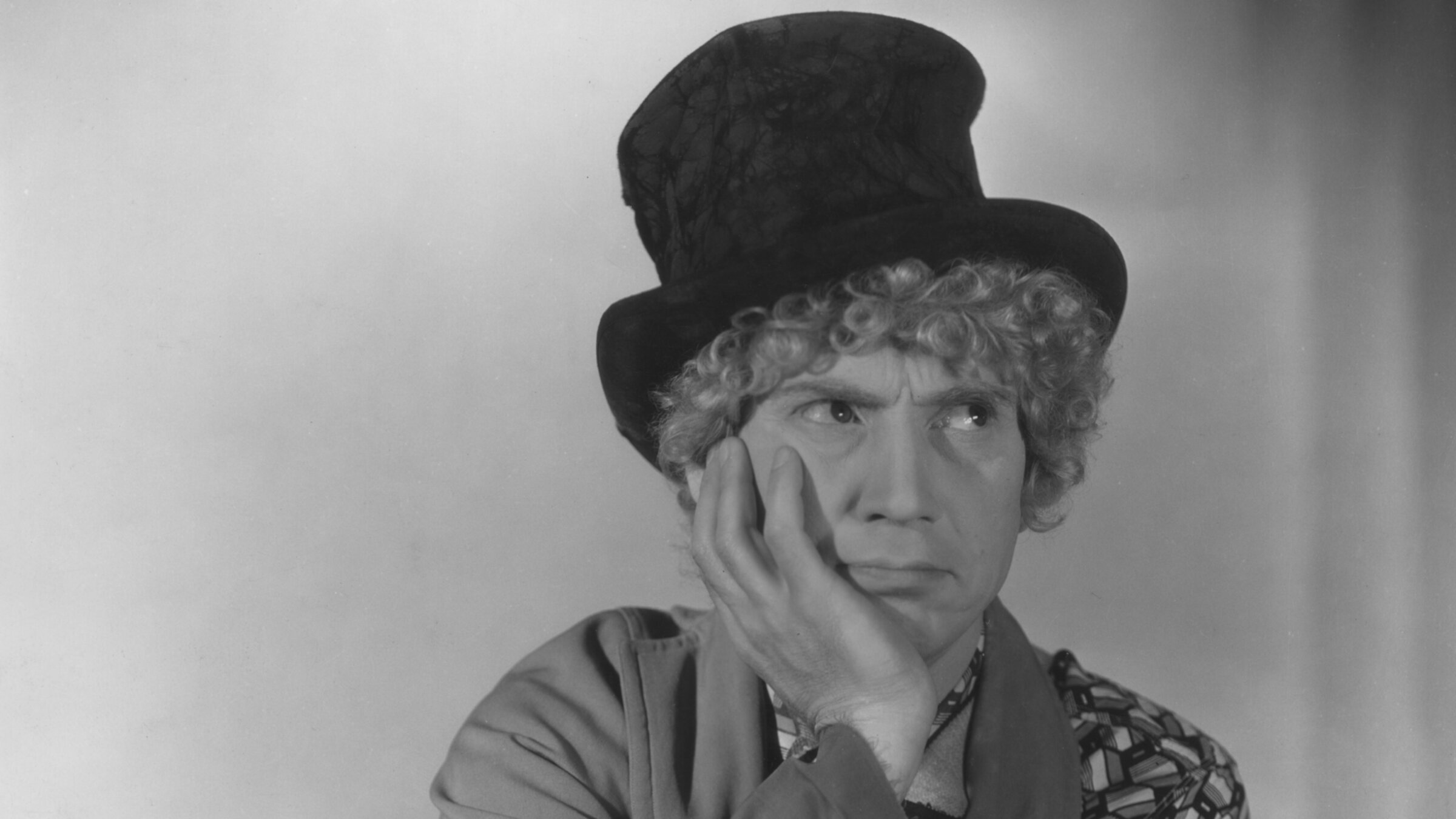
Harpo Marx, circa 1935. Photo by FPG/Archive Photos/Getty Images

By PJ Grisar April 22, 2026
Harpo Marx’s wife, Susan Fleming, once remarked that, when you got him talking, you couldn’t shut him up.
The proof was there for those who chanced to see him on tour with his brothers in the 1930s and ‘40s, performing material they would later commit to film. If a crowd was good, he’d deliver what was known as “Red’s Speech,” a reference to the red wig he wore on stage.
The speech grew more verbose with each recitation, with input by Harpo’s friend, the critic Alexander Woollcott, a fount of $5 dollar words. It got so long, in fact, that Harpo would take it out in the form of a long script that spilled off the stage down the aisle.
“There’s always been this fallacy that Harpo never spoke on stage,” said Marx historian Robert S. Bader, author of Four of the Three Musketeers: The Marx Brothers on Stage and Zeppo: The Reluctant Marx Brother. When he did, he would often make a joke about the mute persona he adopted in 1914, opening his remarks with “as I was about to say in 1915.”
In 1964, Harpo was hitting the speaking circuit. He headlined events for the United Jewish Appeal, having grown more connected to his Jewishness after a 1963 trip to Israel. On these occasions, Bader said, Harpo “might have looked like a local councilman, just wearing a business suit,” and would sneak in a line from his bar mitzvah speech: “For 13 long years, I have toiled and labored for your happiness.”
Advised to retire from performing after a number of heart attacks, Harpo reasoned that, so long as it was for charity and he didn’t get paid, it couldn’t count as work.
That rationale led to Harpo’s appearance at benefits for a number of symphony orchestras. On March 20, 1964, he gave his final performance at a concert for the Riverside Symphony Orchestra in California, playing a suite of songs about the moon, an original composition and conducting a particularly manic take on Haydn’s “Toy Symphony.”
This time, Harpo not only spoke, giving a lively rendition of Prokofiev’s Peter and the Wolf, he did something unprecedented by allowing himself to be recorded with the understanding the public might someday hear it.
On June 5, 2026 a record of the evening will be released as Harpo Speaks! The Riverside Symphony Concert. It was announced on April 1, but it was no April Fools’ joke. It’s an outstanding artifact, and it was discovered quite by accident.
John Tefteller, the foremost collector of rare, Marx-related records, was looking for a copy of a 1963 concert with Harpo and comedian-musician Allan Sherman, recorded by Sherman’s son Robert. Looking in the tape box for Pasadena, Sherman instead found the Riverside tape. Oddly enough, Robert Sherman had no memory of recording — or even attending — the Riverside concert.
Bill Marx, Harpo’s son and the arranger of much of his music, says the man on the recording, telling the tale of “Peeduh,” the “boid” and the “huntahs,” is the one he grew up with.
“It was very, very low key,” said Bill Marx, now a celebrated pianist and Juilliard-trained composer, recalling his father’s voice. “I think I would have to say that he was about five or six notes lower than Groucho’s. It was easy to hear him speak. I suppose you could call him soft-spoken. He rarely if ever raised his voice in our house with my two brothers and sister.”
Instead, he would do something like wake his daughter in the middle of the night to play jacks.
Peter and the Wolf, written for young audiences, was a natural fit for Harpo, and it was his idea to do it. The version of the libretto, co-written by Harpo and Groucho, also features a topical joke for that election year of 1964: “Imagine the triumphant procession. Peeduh at the head, after him the huntahs leading the wolf, then Goldwatuh, Rockefelluh and Nixon.”
That Harpo was a patron of the symphony is no great surprise. He practiced the harp three hours a day and Bill Marx remembers his father’s love of French impressionist composers like Debussy and Ravel and Fauré. When Bill played records in his bedroom, without fail his father would knock on the door, ask what he was listening to, and commit to learning it — which he did.
“He just had a great learning thirst, and I had the privilege of watching this man appear in everybody’s life by doing things that he was compelled to do,” Bill Marx said.
As the narrator of Peter and the Wolf, Harpo is wonderfully expressive, evoking the storytelling of an old-time New York-born Zayde (dressed in his traditional costume at the concert, he donned a new accessory: reading glasses). He sounds quite a lot like Chico, his closest brother in age.
Restoring the tape took major work from audio restorer Joel Tefteller (John’s son) and audio engineer Nick Bergh. At one point, in his closing speech, Harpo walked away from the mic, making the original tape almost inaudible.
“He wasn’t used to looking for a microphone,” said Bader. “He didn’t have a lot of time in front of microphones. I don’t think anybody ever had to say ‘Harpo get closer to the microphone’ ever.”
Did you know that only 2% of Forward readers donate to support our nonprofit newsroom? That 2% make it possible for millions to read the Forward without a paywall or subscription — removing any barriers to the full and fair Jewish story.
But while the Forward is free to read, it isn’t free to produce. Big stories — like deep dives into the antisemitism data, political scoops or reporting trips to college campuses — take months of research and fact-checking. All while we keep you informed of what you need to know each day.
— Rachel Fishman Feddersen, Forward Publisher & CEO
Support our mission to tell the Jewish story fully and fairly.