Maestro Michael Tilson Thomas, celebrated conductor and Yiddish Theater royalty, dies at 81
The conductor led major symphonies and championed music education
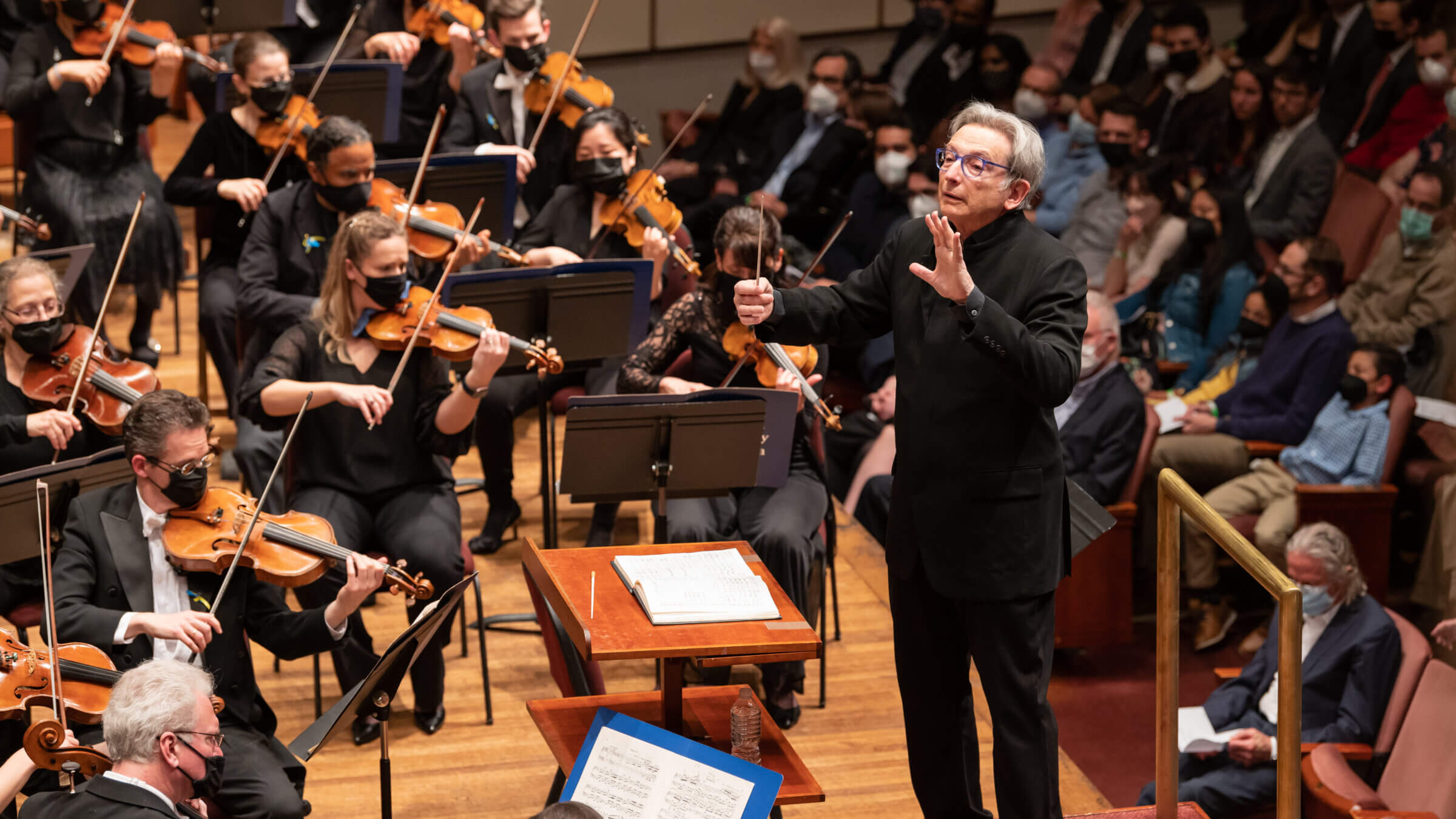
Michael Tilson Thomas conducts the National Symphony Orchestra and the Choral Arts Society of Washington. Photo by Kyle Gustafson / For The Washington Post via Getty Images
By PJ Grisar April 23, 2026
Michael Tilson Thomas, composer, conductor and longtime music director of the San Francisco Symphony, died Wednesday April 22. The cause was brain cancer. He was 81.
Thomas, the recipient of 12 Grammy Awards, a Peabody and Kennedy Center Honor, was born Dec. 24, 1944, the son of Ted Thomas, a stage manager and producer for Orson Welles’ Mercury Theatre and Roberta Thomas (née Meritzer), a middle school history teacher and a founding staff writer for Newsweek. On his father’s side, his grandparents were the legendary Yiddish Theater actors Boris and Bessie Thomashefsky.
“They were like Taylor and Burton, basically, of Yiddish theater,” Tilson recalled in a 2025 interview on CBS Sunday Morning. Their sex appeal, he told Lesley Stahl, sometimes got the pair in trouble.
Thomas was a musical prodigy, working with Igor Stravinsky and Jascha Heifitz as a young pianist. In his telling, no one wanted him to pursue the arts as a career.
“Nobody, absolutely nobody, wanted me to go into show business or into anything remotely connected with performing arts,” Thomas said. “They didn’t want me to be exposed to such vagaries of the uncertainty of being a show biz person.”
But Thomas made his mark in the world of classical music as a conductor, pianist and composer. In 1969, before he graduated from the University of Southern California where he studied piano, composition and conducting, he won the Koussevitzky Prize for outstanding student conducting at Tanglewood. Soon after, he became a pianist and assistant conductor for the Boston Symphony Orchestra.
Much like Leonard Bernstein, to whom he was often compared, Thomas’ reputation grew when, at 24, he stepped in to replace a more established maestro, taking the baton mid-performance from the Symphony’s music director William Steinberg in a 1969 performance in New York. (Steinberg took ill after conducting Brahms’ Second Symphony.) In 1971, not yet 30, he became music director of the Buffalo Philharmonic.
Thomas’ theater pedigree was in evidence in his conducting philosophy. He told The New York Times in 2014 that he tended “ to think of an orchestra more like a repertory theater company.”
Thomas was known for pushing boundaries within a sometimes stuffy orchestral world. He was openly gay when virtually no one else in classical music was. He strived to make the music accessible for everyone as a co-founder of the New World Symphony in Miami and, in the internet age, through his work with the YouTube Symphony Orchestra, whose members auditioned via video. Leading the San Francisco Symphony from 1995 to 2020, he highlighted the work of American composers through the American Mavericks Festival concert series.
Accomplished as an educator and conductor, Thomas was a prolific composer, often on Jewish themes. He wrote the 1990 cantata From the Diary of Anne Frank (he won a 2021 Grammy for a recording of the work) and 1995’s Shówa/Shoáh, which lamented both the tragedy of the Hiroshima bombing and the Holocaust.
In 2005, Thomas paid tribute to his theatrical forebears in Thomashefskys: Music and Memories of a Life in the Yiddish Theater, which debuted at Carnegie Hall, and later aired on PBS. He was a regular on public access television, hosting the series Keeping Score, which explored the work of composers and geared toward school-age audiences.
Thomas, who was diagnosed with brain cancer in 2021, gave his final performance on April 26, 2025 at the San Francisco Symphony in honor of his 80th birthday. He was aware the performance would be his last, describing it as a “generous and rich” coda.
“At that point, we all get to say the old show business expression,” Thomas wrote on his website. “‘It’s a wrap.’”
Did you know that only 2% of Forward readers donate to support our nonprofit newsroom? That 2% make it possible for millions to read the Forward without a paywall or subscription — removing any barriers to the full and fair Jewish story.
But while the Forward is free to read, it isn’t free to produce. Big stories — like deep dives into the antisemitism data, political scoops or reporting trips to college campuses — take months of research and fact-checking. All while we keep you informed of what you need to know each day.
— Rachel Fishman Feddersen, Forward Publisher & CEO
Support our mission to tell the Jewish story fully and fairly.