NYC mayor ‘speaks’ to constituents in Yiddish — and a host of other languages he does not know
New Yorkers have received robocalls in Yiddish that use Mayor Eric Adams’ voice — transformed by AI
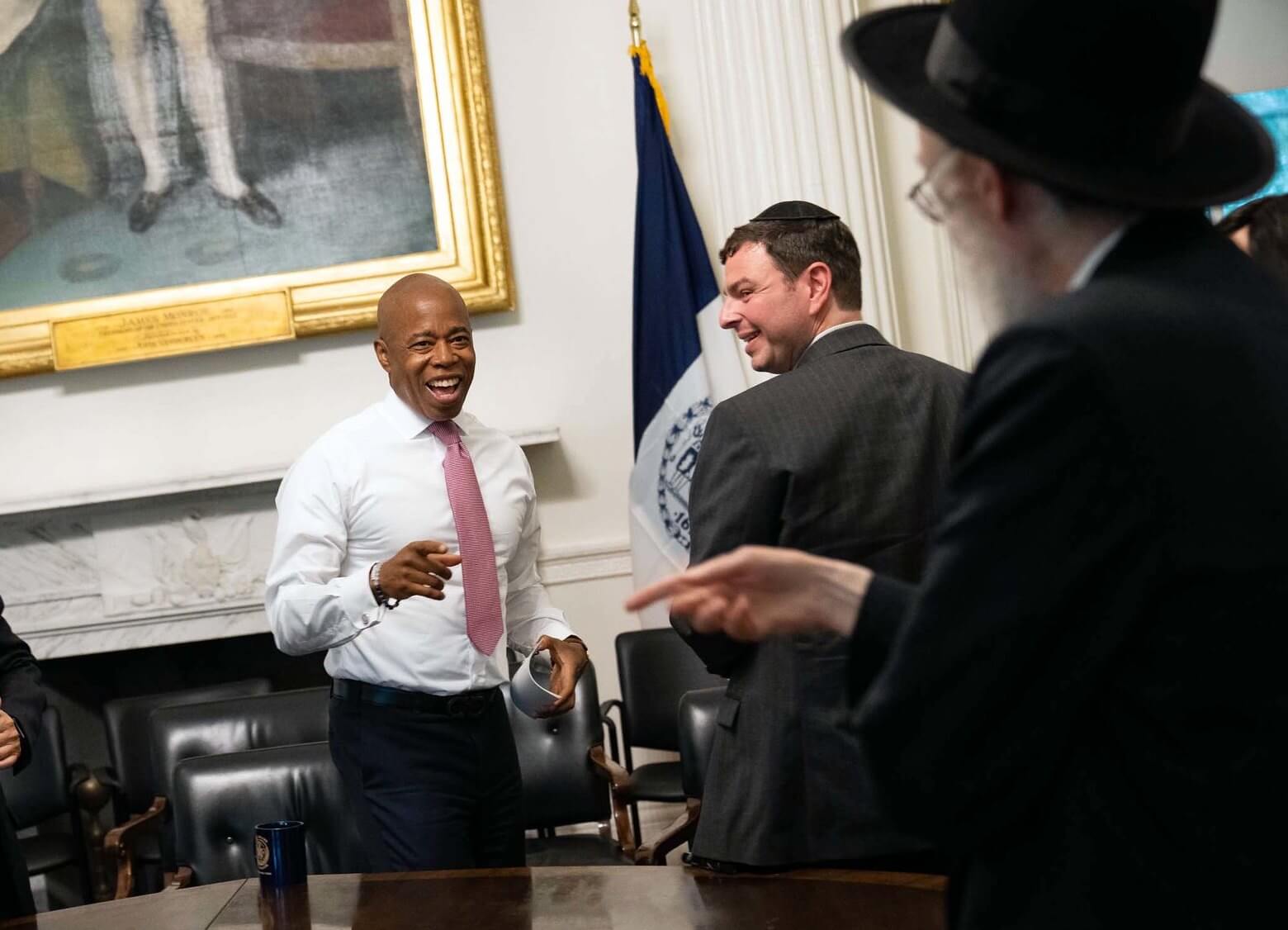
NYC Mayor Eric Adams with a Yiddish-speaking reporter during an ethnic media roundtable on Sept. 19, 2022. Photo by Ed Reed/Mayoral Photography Office

By Jacob Kornbluh October 17, 2023
New York City Mayor Eric Adams doesn’t speak Yiddish, but many New Yorkers are getting calls from him in the language.
Adams told reporters on Monday that he’s using “some amazing technology” to bridge language barriers with constituents. “We were able to send out calls in Yiddish in my voice telling people about job placements,” he said.
The effort, which began in recent weeks, is led by Matthew Fraser, the city’s chief technology officer. City officials did not immediately respond an inquiry about how frequently Adams has made the robocalls, and in how many languages, but Adams mentioned a few of them. “People stop me on the street all the time, they say ‘I don’t know you speak Mandarin,’” he said.
Connecting to Hasidic New Yorkers
Adams, who received significant support from Orthodox voting blocs in the 2021 race for mayor, had criticized city government for failing to communicate well with the city’s fast-growing Hasidic community, where Yiddish is the first language. He lambasted, in particular, efforts to reach out to Yiddish speakers during the height of the coronavirus pandemic, when some Hasidic communities flouted the city’s guidance and emergency rules.
“We should have used credible messengers,” he said at the time, and collaborated “with trusted newspaper, radio, and digital media outlets.”
About 10% of the city’s 1.1 million Jews are Hasidic, according to a 2011 survey by the Jewish Community Relations Council of New York. Some of Adams’ closest aides are Orthodox, who are fluent in Yiddish.
Adams also acknowledged on Monday widespread worries that AI voice technology can be misused. It’s now possible to use a person’s voice, without authorization, to craft a message in almost any language. But Adams said the potential of AI to help non-English-speaking New Yorkers access government services should still be appreciated.
“There are so many New Yorkers that would pick up their phone when they hear a robocall, and they don’t know what the robocall is saying,” he told reporters. They may miss important information, he said, like there’s a job fair down the block.
“I’ve got to run the city, and I have to be able to speak to people in the languages that they understand, and I’m happy to do so,” Adams added.
The city also recently launched an AI chatbot on the Department of Small Business Services’ website. It’s designed to provide small business owners with information on city regulations and other inquiries.
I’m personally matching all gifts to the Forward, up to $36,000. Can I match your gift now?

Hello, fellow Forward reader! I’m Joel Brown, a Forward reader and supporter for more than 15 years, and currently the chair of the board of directors.
I’m an avid Forward reader because it ticks so many of my essential boxes: excellent journalism, Jewish focus and diverse viewpoints. In today’s political climate, what I most appreciate is the Forward’s independence — made possible by the generosity of its membership.
The Forward is committed to bringing you unbiased, nuanced Jewish news. From my position as board chair, I see an exciting future as we expand our position as the definitive independent voice of contemporary American Judaism.
— Joel Brown, Forward board chair
Support our mission to tell the Jewish story fully and fairly.