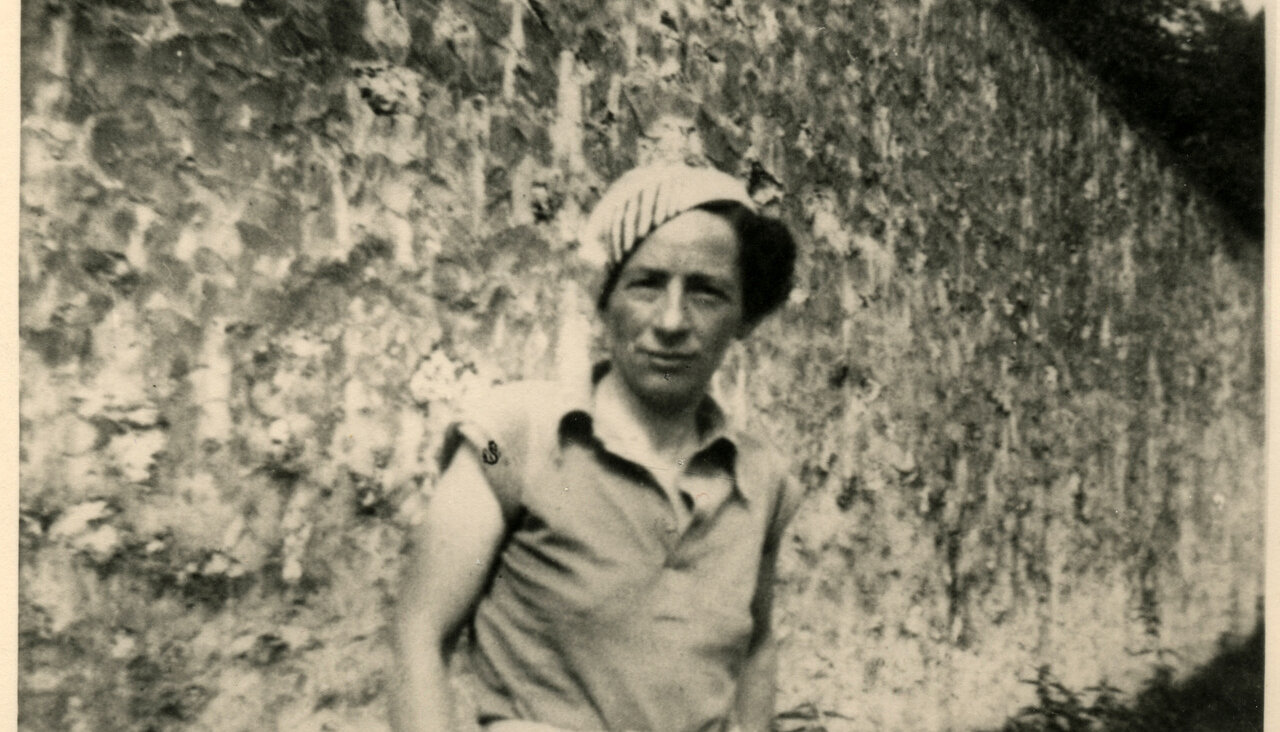
Stumbling across Jewish history in a vintage store
Abram Krol, a Polish-Jewish artist, explored his experience of Judaism and the Holocaust in his art
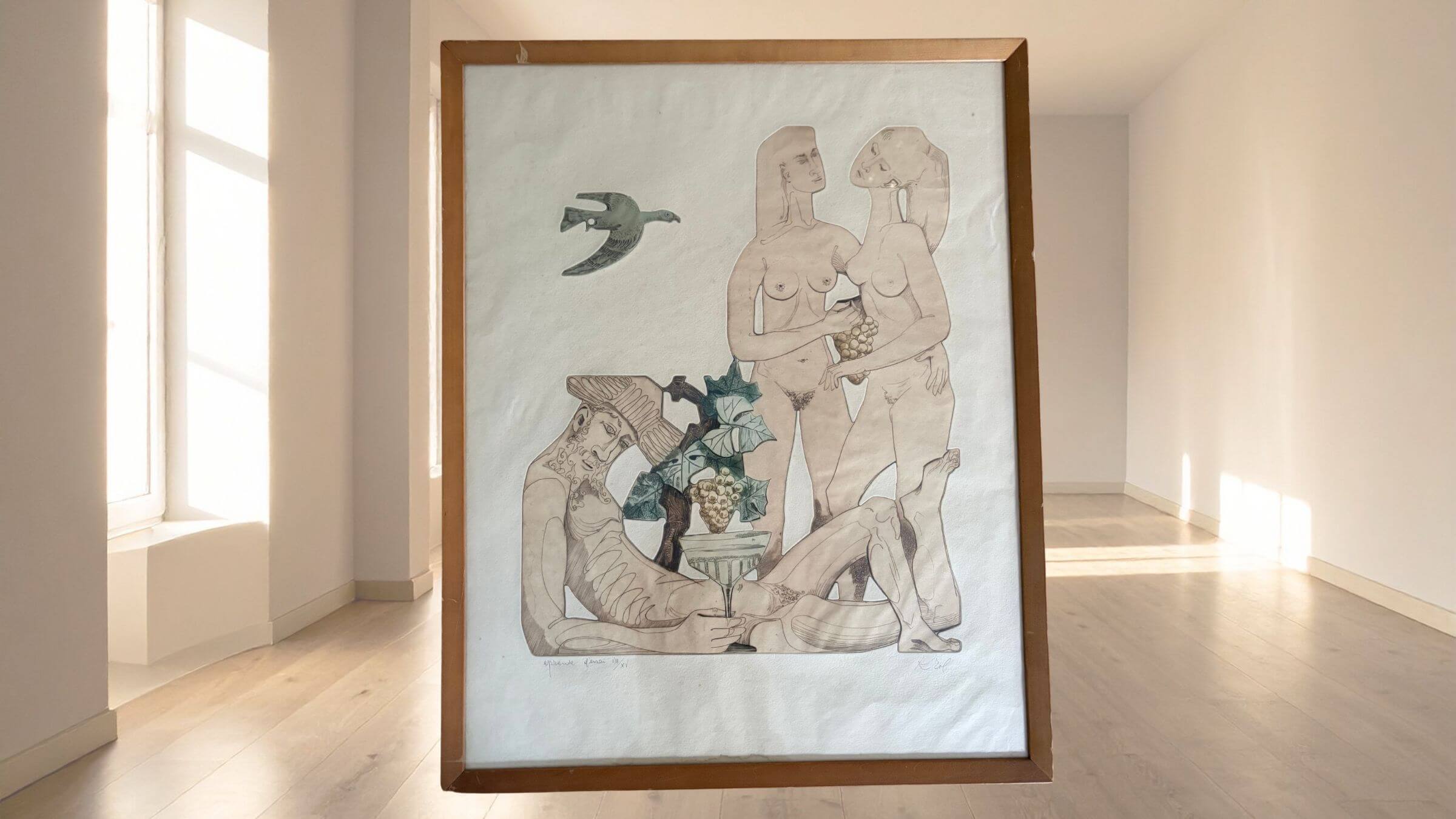
An epreuve d’essai of “Les Filles de Loth” by Abram Krol (1919-2001). Image by Abram Krol / Mira Fox

By Mira Fox April 17, 2026
I have never lived alone. I’ve never even lived with only my partner, at least not for all that long. We’ve always had roommates. And that means we’ve always had roommates’ stuff.
Honestly, I’ve loved this. I mean, I’ve had my issues with individual roommates, ranging from minor nits to major clashes. But generally, I have liked the benefits of living with people, which I’d summarize as: friendship, finances and furniture.
This time in my life is drawing to a close soon, however, as my partner and I prepare to move into our own place. And it’s time to figure out what my tastes are. Sure, I’ve accrued some things — a rug my grandfather braided, a bookshelf a Harvard School of Design student made and abandoned in my grad school apartment. But I’ve never bought a couch. And I’ve never had to fill a big wall, much less a whole apartment, with art.
As a culture writer, this task feels especially laden with meaning — I feel like my taste is on trial. I like abstract art, yet, at least within my budget, so many abstract paintings look like the visual equivalent of Muzak. I want my art to be meaningful, personal, to tell a story about who lives here and what they value. I would love my furniture, too, to be an interesting statement, but ultimately, we need something to sit on. I’m less willing to just fill walls.
Which is why I was so thrilled, finally, to be stopped in my tracks by a piece of art on the website of Johnny Cakes Design, an interior design store in Providence. An engraving, it depicts a naked man, slumped on the ground, his head hanging over a glass of wine, his beard carved out of spiraling lines. Two women, holding a bunch of grapes, stand over him, embracing. The description said the artist, Abram Krol, had lived through the Holocaust, but little else.
The store was closed, but I called to ask if I could get in to see it that afternoon — I was irrationally certain someone would buy it any second — and Britt Machado, the owner, told me she could let me in.
Machado had listed the piece online as “Epreuve d’essai,” but, she told me, she’d learned that is simply a French term for a test print, part of the process of engraving. She didn’t know too much else about it; she had purchased it at an auction in either upstate New York or Connecticut. I bought it and quickly discovered that, while Krol is relatively obscure in the U.S. — though MoMA has one engraving of a mandril monkey — in France, he’s a well-known member of the School of Paris, artists who made the capital an art center in the 20th century.
Born in 1919, Krol grew up in a Hasidic family in Poland. But when he was 12, his father, a noted Talmudist, had a spiritual crisis and became a devoted atheist, completely upending their lives. Krol moved to France at 19 to study to become a civil engineer, as his mother pushed him to do, but ended up joining the French foreign legion in 1939 — as a way to avoid Poland’s draft — and landing in Avignon.
He began to take painting classes, but World War II was coming and Krol was tipped off about the impending danger for Jews as France was occupied by the Nazis. He assumed a false identity and took a job in a factory.
The main biography of Krol that I could find, a French website written by his son, Andre, gives little detail about how Krol survived the Holocaust, or how he felt; after noting Krol took a false identity, it jumps to his first exhibition, in Paris in 1946, and then to the 1950s, when his career took off.
But his artwork gives hints of how the Holocaust affected him. In 1953, Krol made an engraving in memory of his parents and his brother, who had perished in concentration camps. A book of engravings and poems, La Fiancée du septième jour (The Seventh-day Bride), includes a poem that longingly captures the rhythms of the Jewish rituals Krol performed in his childhood. He writes of walking in the footsteps of his ancestors, of Yom Kippur prostrations and the feeling of the leather straps of the tefillin. But in the next poem, fire has consumed the village.
“The knees that carried me, wandering, are charred, and the ash of their flesh is scattered across the flowery fields of Europe,” Krol writes, in French. “May we meet again.”
Much of his work grappled with biblical themes. A Haggadah that intimately depicts a Jewish family crouched on the ground, searching for the final crumb of bread before the holiday begins, and a series of ceramic works shows Hasidic men reading Torah. From 1967 to 1971 he worked on a series of 187 engravings depicting the entire Torah, one per chapter, producing starkly textured, minimalist images of Adam and Eve intertwined, Sarah with a pregnant Hagar.
He seems to have been trying to understand his father’s shift from Hasidic scholar to atheist intellectual, a time he references obliquely, writing only that “I owed it to my childhood” to return to the stories of the Bible. Or perhaps he was trying to connect with the family he had lost.
Through my research, I’ve discovered that the print I now own became a work titled “Les Filles de Loth,” or “Lot’s daughters.” (It was a test for printing his engravings with multiple colors; the final product, which adds a striking rust-colored sun, is held at the Paris Museum of Modern Art.)
It depicts one of the most uncomfortable moments in Genesis, an incestuous scene in which Lot’s daughters — believing humanity to be destroyed after God smites the city of Sodom — get their father drunk and have sex with him in order to, they believe, ensure the continuation of the human race.
It is, I think, a testament to the artist’s ongoing interrogation of his relationship with Judaism, and with morality at large, as it grapples with one of humanity’s strongest taboos — incest — juxtaposed against the threat of extermination. What is right and wrong in the face of something so horrifying?
“During his final years, whenever he was asked why he had embarked on a career as an artist, he explained that it was to counter the malevolence of the Nazis, who had sought to eradicate the Jewish people and every trace of their existence,” writes Krol’s son, the only mention of the Holocaust’s impact on his father. “Of his immediate family — his parents and brother — who had all perished in the camps, he was the sole survivor; he wished to leave behind a lasting testament to their time on earth.”
Looking at my print, itself an unfinished experiment, I see Krol’s continued engagement with the question of what to do with Judaism, and his refusal to discard a piece of his identity, however turbulent his relationship with it. It is a symbol of an ongoing, lived quest to understand, like Judaism itself. It has, after all, already inspired me to chase down Krol’s life’s work, pore over his poems and dwell on each scene of the Torah that he engraved.
That feels like the perfect centerpiece for my new home. Even if my mother’s first response to seeing it was, “Wow, they’re really…naked.”

Did you know that only 2% of Forward readers donate to support our nonprofit newsroom? That 2% make it possible for millions to read the Forward without a paywall or subscription — removing any barriers to the full and fair Jewish story.
But while the Forward is free to read, it isn’t free to produce. Big stories — like deep dives into the antisemitism data, political scoops or reporting trips to college campuses — take months of research and fact-checking. All while we keep you informed of what you need to know each day.
— Rachel Fishman Feddersen, Forward Publisher & CEO
Support our mission to tell the Jewish story fully and fairly.