My artist grandmother nearly made aliyah. I don’t know what she’d think of Israel today
A painting she made after the 6 Day War could be a clue
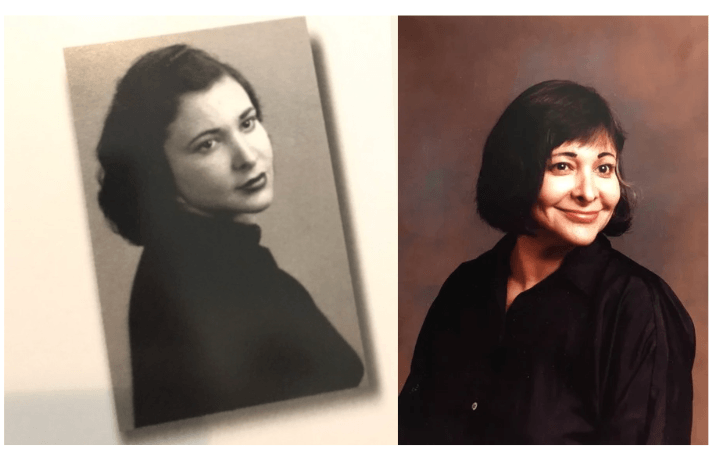
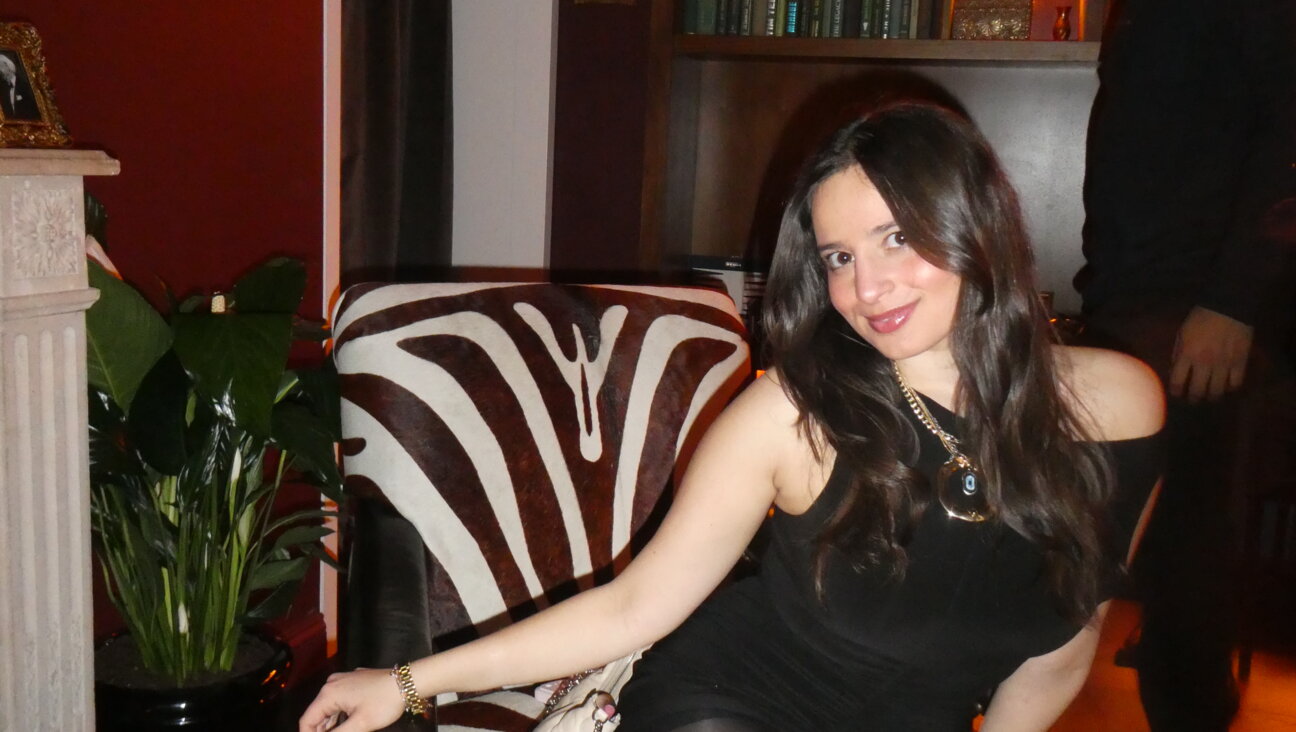
The author’s grandmother in the 1950s and 1980s Courtesy of Kayla Silberberg’s family
By Olivia Haynie May 8, 2026
With Mother’s Day coming up, I can’t help but think of my maternal grandmother, who passed away six years ago. And whenever I start thinking about my grandmother, my mind almost always turns to her art.
My grandmother, Kayla Silberberg, had a brief period where she showed her work in art shows in California, selling a few pieces, but most of her paintings from the ‘60s and ‘70s decorate my parents’ house. The majority of her art is multi-colored and not concerned with realism, the objects and figures often disproportionate, the people always bending in ways that implied a lack of a skeletal system. Only a few of her pieces are literal, and it was mostly early work. However, after she’d stopped painting in the ‘70s due to a career change and a reported lack of inspiration, she acquiesced to my mom’s request that she do a realistic sketch of me. (And she even did two!)
I’ve always been particularly fascinated with a painting she did of Israel in 1968. She compressed the country’s geography, the Western Wall practically attached to the Dome of the Rock, separated from a body of water by a handful of small buildings. The water is divided by barbed wire and on the other side, in the piece’s foreground, is a desert landscape, covered by bushes with orange-yellow flowers and multi-colored cacti. There also appears to be a person in the very front, their back turned to the viewer, wearing some type of full-body garment, the tie around their head waving in the back. A similarly shaped figure in what is more clearly a tallit floats near the Western Wall.
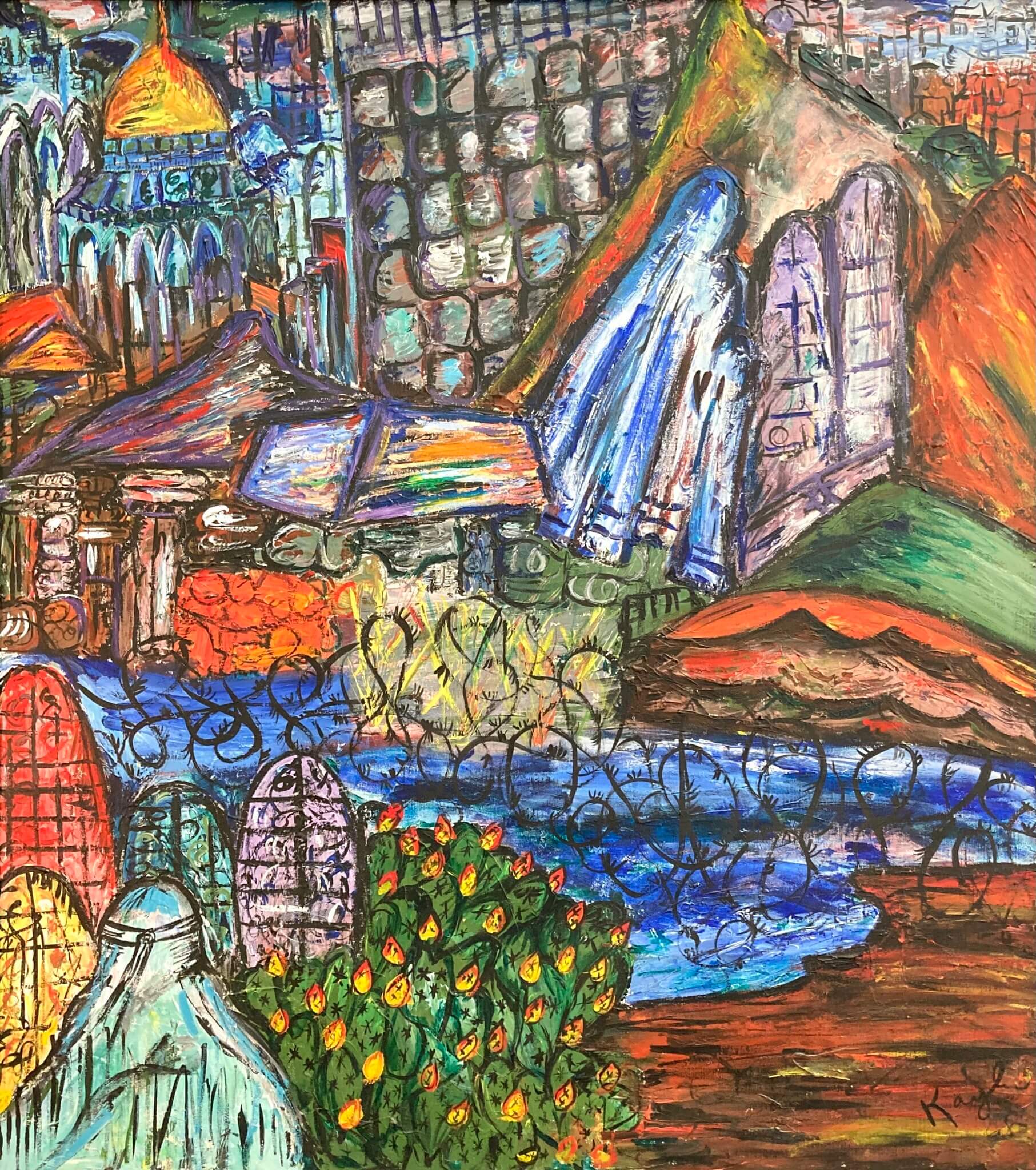
When I asked my mom about the barbed wire, she didn’t know what the impetus was for my grandmother to put it there. We’re not certain that our interpretation — that the foreground is Palestinian territory — is accurate. Is there anything to say about how she painted the figures on either side of the barbed wire in very similar shapes? Is the fact that she painted it one year after the Six-Day War relevant to why she painted it?
These weren’t conversations we had with my grandmother when she was alive, and these could very well be modern projections. My fascination with interpreting the work is more a reflection of the historical moment I’m living in than trying to guess what my grandmother would say about Israel today.
I actually have almost no memories of talking to my grandmother about Israel, with the exception of the story of her and my grandfather’s near attempt to immigrate there sometime in the 1960s. (The story goes that when the immigration office told my grandfather, who held a computer-engineering degree, that Israel already had too many engineers, my grandfather was so insulted that he abandoned the plan.)
It wasn’t that my grandmother was apolitical — one of her paintings is titled “Feminism,” a cryptic collage of male and female faces emerging from a colorful cloud. And no one could ever say she lacked strong opinions. It was just one of those conversations we never got around to.
I was 17 when my grandmother died, just on the cusp of being interested in talking about world events with the adults in my life. I imagine that just a couple years later, I would’ve developed more of a consciousness for talking about heavier topics.
That feeling has grown stronger since I moved to New York almost two years ago. My grandmother grew up in Sheepshead Bay, Brooklyn, in a duplex that had her immediate family on top and her grandparents on bottom. The only real story I have of this time in her life is that she used to tell her Orthodox parents she was going to be with her aunt on Shabbat nights, when actually she was sneaking out to go on dates with boys. When I visited Coney Island for the first time last summer, I wondered if she’d often come there herself, and tried to imagine what it would have been like in the ‘40s and ‘50s.
While talking about this story with my mom, she assured me that I was not alone in this. Her grandmother Chaia was 14-years-old when she immigrated to New York from the Pale of Settlement — the area that the Russian government restricted Jews to — in the early 1900s. My mom told me she never asked Chaia about her experiences before and during her immigration.
It’s not just my grandmother I wish I’d been able to have a relationship with as an adult. There’s also my paternal grandfather, who died when I was 14. I think about the conversations I could’ve had with my cousin Reverend Dr. Katie G. Cannon, the first Black woman ordained in the Presbyterian Church of the United States, if she’d lived just two more years, after I took my first sociology and religious studies classes. What would I have spoken about with my grandmother, who had a later career as a college guidance counselor, if she had lived to see me go to Penn? Or if she had been around for my start at the Forward, which she read every week while it was in print?
I’ve previously written about the project I worked on with my parents, where I recorded conversations with them about all the objects in our home (minus the modern appliances). Through that, I got answers to questions I would’ve never thought to ask about my parents’ lives and had many conversations about my grandmother’s art. But these were mostly surface level observations. And none were about the Israel painting, which ironically had to be moved to storage to make room for my grandmother’s other belongings after she died.
Although I wish I’d had the idea for the project while all four of my grandparents were still alive, I still have the chance to ask my paternal grandmother questions about her life that I haven’t thought to ask before. Ultimately, it doesn’t really matter what made Kayla paint Israel the way she did. The fact that her paintings bring up so many emotions and questions for me tells me that she still lives on within my heart.
Did you know that only 2% of Forward readers donate to support our nonprofit newsroom? That 2% make it possible for millions to read the Forward without a paywall or subscription — removing any barriers to the full and fair Jewish story.
But while the Forward is free to read, it isn’t free to produce. Big stories — like deep dives into the antisemitism data, political scoops or reporting trips to college campuses — take months of research and fact-checking. All while we keep you informed of what you need to know each day.
— Rachel Fishman Feddersen, Forward Publisher & CEO
Support our mission to tell the Jewish story fully and fairly.