A Palestinian and an Israeli bereaved in violence make the case for peace
“The Future Is Peace” authors Aziz Abu Sarah and Maoz Inon found a shared path after Oct. 7 by focusing on the emotional work needed for progress
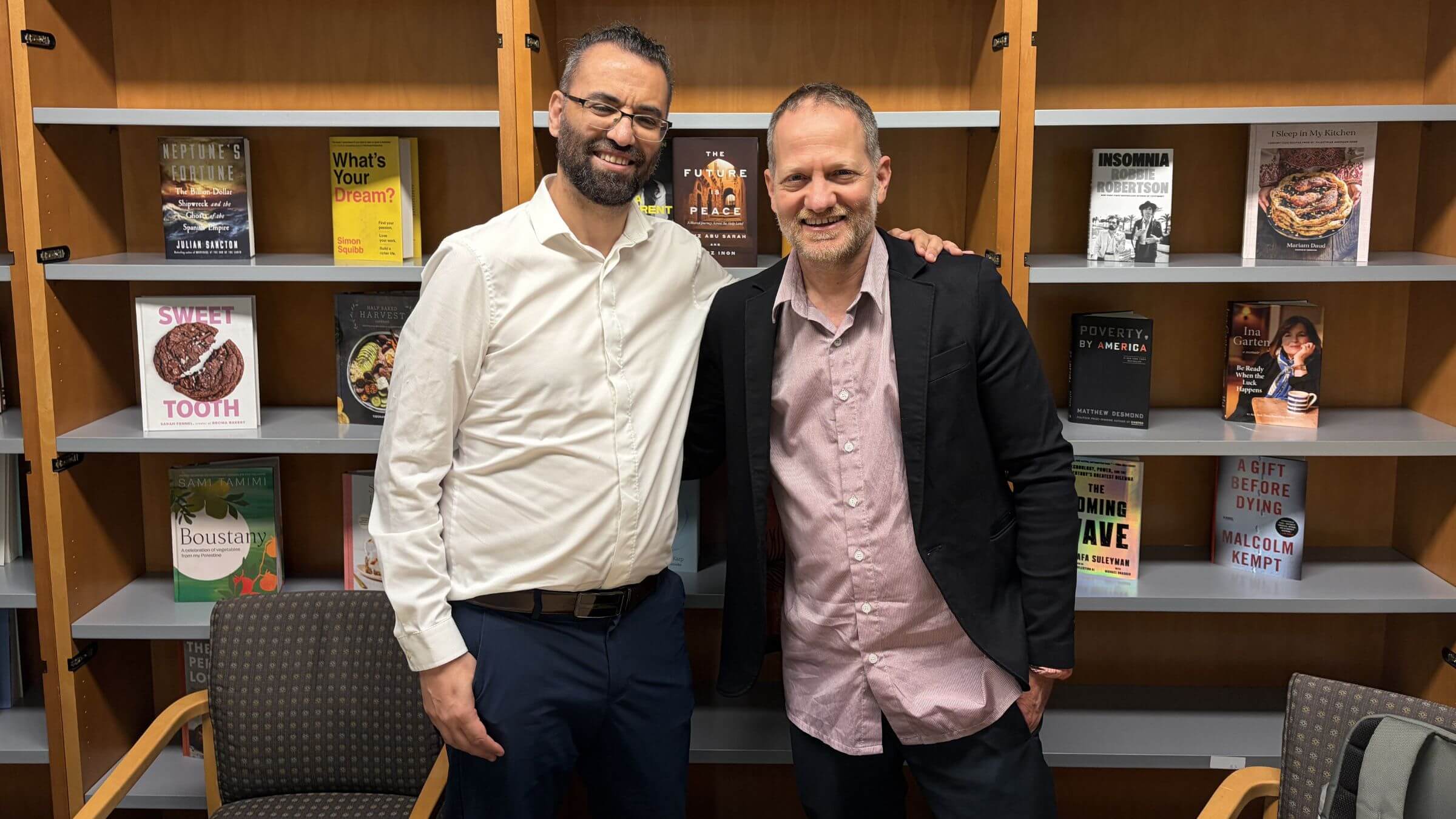
Aziz Abu Sarah and Maoz Inon in Manhattan, April 15, 2026. Photo by Simone Saidmehr
By Simone Saidmehr April 16, 2026
Aziz Abu Sarah and Maoz Inon have a message that can sound utterly preposterous as violence hardens as the main mode of communication between Israelis and Palestinians: The Future Is Peace, the title of their new book.
They are dead serious — and bring their own grief and healing to the cause.
On October 7, 2023, Inon’s parents, Bilha and Yakovi, were killed by Hamas terrorists in their home in Netiv Haasara near the border with Gaza. Decades earlier, Abu Sarah’s brother, Tayseer, was killed by Israeli forces following a year-long detention for alleged stone throwing.
You might recognize Abu Sarah and Inon from the winter Olympics, where the world watched as they carried the torch together—the first Israeli and Palestinian duo to ever do so — or from photos of them embracing the Pope, a picture of brotherhood.
Their book takes readers on an eight-day journey through the region, from the streets of East Jerusalem, where Abu Sarah grew up, to the farmland in the kibbutz that Inon’s father tilled. Along the way, they meet other bereaved families and friends who have been touched by the conflict. They found that the resistance to engaging with the other side’s narrative came from a fear of erasing one’s own.
Agreement, they concurred during an interview in Manhattan, is not a prerequisite. “I think what we bring in The Future Is Peace is that we show first you don’t have to agree on everything. It doesn’t matter if you are pro-Israel, pro-Palestine, there will be things you will disagree with, there will be language you will not be happy with, there will be things that you think we got wrong,” said Abu Sarah.
For them, non-consensus is the beauty of the book — and their relationship with one another. “Relationships which have no disagreement, by the way, are boring,” he added. “We often quote Pope Francis, who said, ‘The only place that has no disagreement is a cemetery.”
Inon suggests the skeptical reaction to peacemaking is a coping mechanism. “You’re protecting yourself from wanting to believe. You think no one knows how to take you there.” He added, “We talk along the journey about the importance of dreaming. What we realized is that when you don’t dream, the others, the extremists, are dreaming for us, and then their dream is our nightmare.”
Parallel paths to peace
Abu Sarah’s experience living under the occupation and growing up in the West Bank led him to pursue anti-Israel activism.
At age 10, he watched his “protector,” the sibling he shared a bed with each night, succumb to his wounds from injuries sustained during his time in an Israeli prison. “All I knew was that someone had killed my brother, and I wanted to hit back,” he says in the book.
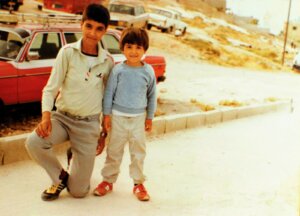
Following his death, and during the years spent living under occupation, Abu Sarah sought revenge. Eventually, when he realized it would be difficult to get a job without speaking Hebrew, he enrolled in a Hebrew language class — the first time he had ever met an Israeli who was not a soldier at a checkpoint.
As he began connecting with his teacher and classmates, he slowly let down his guard. Getting to know Israelis beyond the context of occupation gave him a new perspective and sparked his interest in peacebuilding. Eventually, he founded Mejdi Tours, leading dual-narrative trips across Israel with a Jewish counterpart, explaining landmarks through the lens of their respective communities.
Inon made his own journey to connecting across the divide, starting long before Oct. 7. As so many young Israelis do, he and his wife, Shlomit, had traveled the world after their army service. He realized that he had developed friendships with people in far-flung countries but hadn’t managed to make a single Palestinian friend back home.
Passionate about tourism as a means of connection, Inon decided to open a guesthouse in Nazareth, the largest Arab city in Israel. When he first came to Nazareth, many were skeptical of him. “There were many rumors that I was a Mossad agent, or Shin Bet, even worse,” said Inon. Over time, he began to build relationships and trust in the Palestinian community.
The murder of his parents could have been the end of his mission. Instead, Inon recommitted himself to it. Just days after Oct. 7, Inon and his siblings publicly stated that they did not seek revenge against the Palestinian people for the atrocities committed that day. He even hosted a memorial service in Nazareth so that his Palestinian friends living in the city could attend.
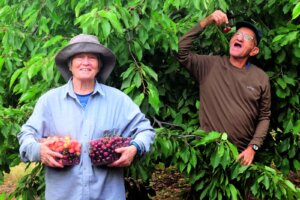
While they had lived somewhat parallel lives, with both men working in the travel industry as a means for peace, Inon and Abu Sarah met only once, several years before Oct. 7.
After Abu Sarah learned of the death of Inon’s parents, he decided to reach out. Inon’s immediate empathy was striking to Abu Sarah, for whom forgiveness of the other side took years. A friendship and partnership began. “I lost my parents on Oct. 7, but I gained Aziz as a brother,” said Inon.
I asked them what moments of tension have been like in their relationship. Inon said the two have managed to find common ground over shared values. But for a long time, he struggled to get on board with the value of justice, which is a priority for Abu Sarah.
“I kept telling Aziz, I don’t know how to bring justice to Tayseer or my parents. I remember President Biden saying that when Israel assassinated Nasrallah, justice was being done. But with the same bomb, 300 civilians were killed. So will it now be legitimate for them to avenge the death of … their innocent loved ones?”
Eventually, after discussions with religious leaders, Inon came around to embracing the idea of justice. He discovered that of the 613 mitzvot in Judaism, the only two that are mandated are justice and peace. “After learning that, I said, ‘Aziz, from now on, I can have justice within the values that I believe.’”
Another disagreement they’ve faced: Abu Sarah’s love for country music — Inon can’t stand it.
A different kind of solution
Inon and Abu Sarah can seem almost radical in their commitment to dialogue. To some, their approach may feel detached from reality. They know that most Israelis and Palestinians do not think the way they do. But to them, the belief that violence is inevitable is far more difficult to accept.
“Loss, instead of making us want to walk away, makes us more convinced that this is the only path, “ said Abu Sarah. “Really, if we give up, then what we should do is go get a gun and shoot at each other. Because what’s the alternative? You either believe we can solve this by sitting and working it out, or you believe we have to kill each other, and we refuse to believe that alternative.”
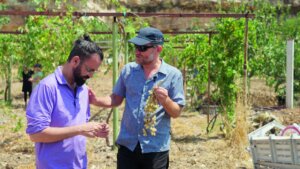
Notably, only one page of the book is devoted to discussing a solution to the conflict in the literal sense. “Here are shelves of practical solutions, chapter after chapter about borders, about water resources, about Jerusalem, about refugees, about security arrangements,” said Inon, laughing about the Israel-Palestine section that has become a fixture of many bookstores following the Gaza war. For them, the book is less about prescribing a specific political outcome and more about laying the emotional groundwork needed to get there.
Abu Sarah and Inon did not want to close themselves off by endorsing a single political solution. “We don’t want to be in a box,” Inon said, explaining that neither of them feels strongly tied to one specific outcome.
“Our values are human dignity, security and safety for everyone, recognition of everyone … People want to argue with us, two states, one state, three states, monarchy. That’s less the issue. If that agreement is based on those values,” said Abu Sarah. “Then we’ll be fine, regardless of the political ‘blah, blah, blah,’ if it’s not, you can have the nicest drawn map, and it will fail.”
Mocking the peacemaker
While both men had been engaged in peace work long before Oct. 7, that day and the war in Gaza that followed changed the landscape. Colleagues and friends told them they could no longer find it in themselves to care about the suffering of the other side.
“Palestinian friends would say … this happened because of what they’ve been doing to us … Then I would talk to Jewish friends who would tell me, ‘I used to sympathize with you Palestinians, but from now on, I just don’t care,’” Abu Sarah said. “The moment you do that, part of your humanity dies. I prefer to have the pain of feeling than to kill that part of me that maybe makes it easier.”
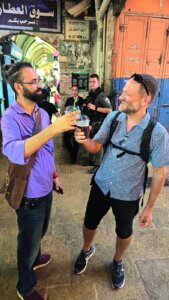
Abu Sarah said that when he tells people he is a peacemaker, they are incredulous. “They go, ‘Oh, well, how is that going?’ Like in a mocking way.” He compared it to those working to find a cure for cancer. “If you’ve met a cancer researcher who’s trying to develop vaccines… you would respond to someone who is trying to make vaccines, saying, ‘God bless you.’”
“Peace has been done many times. A cancer vaccine has not,” he remarked, laughing.
Inon recalled a memory of his father shared during his parents’ shiva. Every night, his siblings sat around the table listening to him — the manager of the kibbutz’s farm — talk about his day.
“He would share the catastrophe in the fields,” Inon said. “The floods, the drought, the wildfire, the insects. Every day there was something new.”
But he always had faith in next year’s crop.
“He would say that next year, he will sow again. It doesn’t matter how devastating this season is,” he continued. “He will learn from his mistakes. He will consult with other farmers … and next season, he will sow again — not with prayers, not just believing, but knowing that next year will be better.”

Did you know that only 2% of Forward readers donate to support our nonprofit newsroom? That 2% make it possible for millions to read the Forward without a paywall or subscription — removing any barriers to the full and fair Jewish story.
But while the Forward is free to read, it isn’t free to produce. Big stories — like deep dives into the antisemitism data, political scoops or reporting trips to college campuses — take months of research and fact-checking. All while we keep you informed of what you need to know each day.
— Rachel Fishman Feddersen, Forward Publisher & CEO
Support our mission to tell the Jewish story fully and fairly.