Monitored phone calls and fear of arrest: What life looks like for Iran’s Jews now
Iran’s Jewish community is facing increased surveillance and loyalty pressures, leaving loved ones abroad in fear
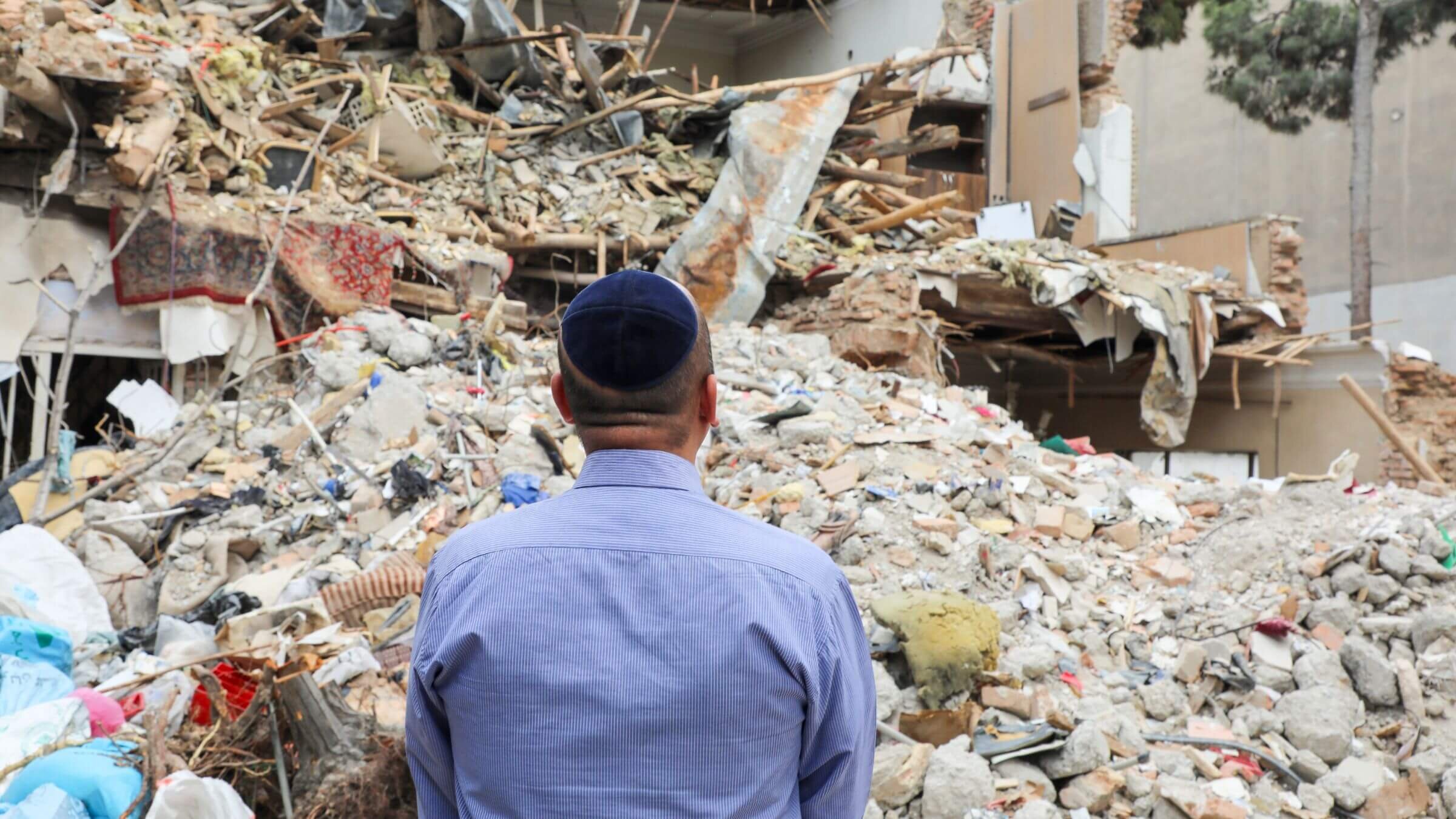
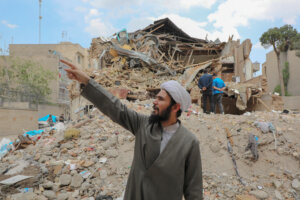
An Iranian-Jewish man looks at the ruins of a synagogue destroyed during recent U.S.-Israeli strikes on April 20 in Tehran, Iran. Photo by Majid Saeedi/Getty Images
By Simone Saidmehr April 30, 2026
Amid the war in Iran, one Iranian Jewish woman who lives in the United States, but whose family remains in Iran, has been wracked with fear. Before the ceasefire, she spoke with her parents once a week for exactly one minute — both because of the exorbitant cost, about $50 per minute, and because of the fear of surveillance.
During one call a few days into the war, she said, something felt off.
“I could see that something is so wrong. It’s as if someone was there,” the woman, who moved to the U.S. in 2008, said in an interview with the Forward. “It seemed like my mom was actually reading from a note.”
She later learned that the Islamic Revolutionary Guard Corps had come to her parents’ home, questioning why they frequently called an American number. They instructed her parents to download Bale, an Iranian messaging app widely believed to be monitored by authorities, before making any further calls.
“It’s a spy app, and everyone knows that,” the woman said with a wry laugh. Her parents refused. Instead, they were told to call their daughter and read from a script while IRGC members watched.
“Basically, they said to prove that you are with us and not with Israel, read this when you call her,” the woman said. “After that day, they didn’t call for a long time.”
Eventually, she learned that her parents had fled to a safer part of the country to escape bombardment.
Her family are among the estimated 10,000 Jews who still live in Iran, in the largest Jewish community in the Middle East outside of Israel. Once numbering around 120,000, the community has dwindled significantly since the 1979 Islamic Revolution, when life for religious minorities fundamentally changed. Today, Jews who remain in Iran must carefully navigate life under the regime, publicly expressing loyalty to avoid being falsely accused of Zionist espionage.
Amid Iran’s war with the U.S. and Israel, that pressure has intensified.
With an ongoing internet blackout, communication is limited and closely monitored. To understand what life is like for Iranian Jews today, I spoke with several people in the U.S. who remain in sporadic contact with family members inside Iran. Everyone interviewed requested that they not be identified, fearing repercussions for either themselves or their families.
A synagogue vigil for the Supreme Leader
On April 16, Tehran’s Yusef Abad synagogue held a memorial for Ayatollah Ali Khamenei, who was killed on the first day of the war. The event was attended and reported on by several state-affiliated media channels, filming as participants from Iran’s Jewish community shared their appreciation for the deceased Supreme Leader.
Inside and around the synagogue, posters featuring photos of Khamenei were displayed alongside Farsi slogans like “Unity of Iran’s faiths against aggression — condemnation of the attack on the Tehran synagogue by the child-killing Zionist regime and criminal America” and “The Jewish faith is separate from Zionism.”
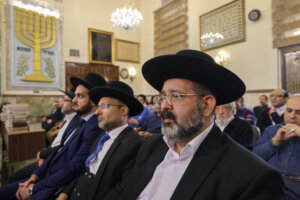
Regime media pointed to the vigil as evidence of Jewish support for Iran’s theocratic government. But experts say that interpretation misses the reality.
Beni Sabti, an Iranian-born analyst at Tel Aviv’s Institute for National Security Studies, said displays like the synagogue vigil are often a matter of survival. Jews who remain in Iran are frequently compelled to demonstrate loyalty to the regime — and opposition to Israel — in order to avoid suspicion of having ties to Israel. Allegations of such ties have often led to imprisonment and executions following the Islamic Revolution in 1979.
To protect the community, Jewish leaders — especially rabbis — often participate in pro-regime events, including memorials for senior regime figures. In some cases, Iranian rabbis have even sat alongside members of Hamas and Hezbollah to pay their respects to senior IRGC commanders responsible for funding and training terror groups across the Middle East.
The regime exerts significant pressure to stage these displays, Sabti said, “because it’s good for them to show the world, ‘You see, we don’t oppress anyone.’”
Beyond public displays, much of Iran’s economy is tied to the state — what officials often describe as a “resistance economy.” In that system, some say, expressions of loyalty can become intertwined with economic survival.
The woman who left Iran in 2008 said one of her relatives was once pressured to confiscate land from dozens of people and transfer it to the government in order to keep his job — a loyalty test she says was especially harsh because of his Jewish identity. “In the job interview, they told him, you have a Jewish background, so you have to first prove how far you will go,” she explained.
Since the 12-Day War between Israel and Iran in June 2025, the situation has grown even more tense. More than 30 Jewish Iranians were reportedly detained during that conflict because of alleged contact with Israel. While some Jewish community members were arrested during the wave of anti-regime protests that occurred at the beginning of the year, Sabti said he has not heard of a similar wave of arrests during the current war.
Still, the fear remains.
Synagogues as shelter
Some Iranian Jews have managed to stay in touch with relatives via landline phones, although calls are expensive and likely monitored. Most avoid discussing politics, using their limited time simply to confirm they are alive.
“After the 12-Day War, people really didn’t talk on the phone,” said the woman who moved to the U.S. in 2008. “We do talk, it’s not like they literally cannot, it’s just like they realized that the scrutiny was so high that no one has meaningful conversations.”
Even so, fragments of sentiment emerge.
One 25-year-old Iranian Jew from Los Angeles said his Jewish cousins in Iran cried tears of joy when they heard of the Ayatollah’s death.
He said his great uncle and cousin told him over the phone, “I don’t care, whatever the cost. If you can eliminate Khamenei, if you can eliminate Mojtaba, his son, if you can eliminate any threat… do it.” He added, “Most Persian Jews in Iran are happy, is what I hear.”
Amid the current ceasefire, a 64-year-old Iranian Jewish woman from LA said her Jewish friends in Iran have expressed relief. “They are happy that the situation is calm, but on the other hand, nobody is happy. They all want it to get finished,” she said, adding that they hope for “regime change.”
For Nora, an Iranian Jew living in New York, the war has come at a time of crisis for her family in Iran. She says her aunt has been focused on caring for her son, who is suffering from bone marrow cancer. Because the family keeps kosher, her aunt has had to leave the house — even during bombardments — to ensure he has food and other necessities.
Around three weeks into the war, her house in Tehran was destroyed after a nearby police station was struck. She briefly moved into a local synagogue; now, she lives with another Jewish family who opened their home to her. Her son remains too sick to leave the hospital.
A synagogue destroyed
Nora’s aunt is not the only Iranian Jew to find shelter in a synagogue. Sabti heard from another Jewish family inside Iran that Jewish communities have been using synagogues as bomb shelters throughout the war. He recalled doing the same during his youth at the time of the Iran-Iraq war that began in 1980.
Beyond using the space for physical safety, synagogues have also become a place for Jews to be together during the difficult time. “They come just to gather there, passing the time, meeting and having a little bit better time together,” he said.
For members of the Rafi’ Nia synagogue, a 150-year-old religious institution in Tehran, this sense of comfort has disappeared. On April 6, the community gathered there for Passover services. The next morning, they learned the building had been destroyed by an Israeli strike.
The Israel Defense Forces said that the target of the strike was not the synagogue, but rather a top commander from Khatam al-Anbiya, Iran’s military emergency command. But Iranian media suggested that the IDF had intentionally targeted the building. The head of the synagogue made a statement condemning the attacks and wishing the Iranian regime success in the war.
The woman who immigrated in 2008 had visited the Rafi’ Nia synagogue during Passover around 10 years ago. She described it as a beautiful old building. Seeing images of its destruction brought back painful memories of her family’s past.
She and her family were forcibly converted to Islam around 70 years ago, she said, with one uncle publicly hanged after he refused to convert. Her family continued practicing Judaism in secret — celebrating Shabbat behind locked doors and in her grandmother’s basement, always afraid.
She believes her family became a target for conversion after the synagogue in their area was destroyed, leaving them without formal affiliation to a recognized religious institution. On two occasions, she said, the IRGC raided their home during Jewish holidays, searching for evidence of religious practice. When they found a menorah, her father was detained. “When my dad came back, he was a ghost.” She fears that members of the destroyed synagogue could now face a similar vulnerability.
In Iran, certain religious minorities, including Jews, are constitutionally recognized. But she says that their protection is closely tied to existing institutions.
“When we talk about the lack of protection, it has a very nuanced meaning. In Iran, this doesn’t mean that the synagogues cannot exist, but it means that the existing synagogues are the only legal protection that Jews do have,” she said. “Good luck with rebuilding that place. Good luck with asking for a new synagogue.”
Sabti said the regime has already used the synagogue’s destruction as propaganda, publicly condemning the attack while reinforcing the state narrative of religious inclusion. “The head of the Islamic clerics condemned Israel and paid condolences to the Jews,” he said. “Everyone pays condolences and says, ‘Oh, sorry, we are in this together’ … but everyone knows that the other one also is lying.”
An American Jewish detainee
For one Iranian American Jew, the war has made a dire situation worse.
Kamran Hekmati, a 70-year-old Iranian American from Great Neck, New York, traveled to Iran in June 2025 and was detained during the 12-Day War. According to advocates, his alleged crime was traveling to Israel 13 years earlier for his grandson’s bar mitzvah.
Kieran Ramsey of the Global Reach advocacy group, who represents Hekmati’s family, said in an interview that Kamran being the Iranian regime’s only Jewish American prisoner puts him in a particularly precarious position. “There can be risk of retribution or reprisals against him at any moment,” Ramsey said, “from prison guards or other prisoners…his identity certainly puts him at higher risk.”
On March 16, almost three weeks into the war, Secretary of State Marco Rubio designated Hekmati as wrongfully detained, a status that allows the federal government to deploy all possible levers — diplomatic, legal, and economic — to secure his release. Ramsey says that change in designation is helpful, but only goes so far.
His organization is now pushing for the release of all American prisoners in Iran to be an integral part of the U.S.-Iran negotiations to end the war.
“Our hope is that Kamran Hekmati and the other Americans that are being held are put to the front of the list in terms of issues to decide, and not as a deal sweetener,” he said adding, “We know the U.S. negotiators have a list of American names. We know Kamran is at the top of that list…. We also know there are some very rational actors inside the regime, and we are trying to convince them that you have a no-cost way to open doors. Use Kamran as that no-cost way.”
The last time the woman who emigrated in 2008 visited Iran was two years ago. Even then, she worried that photos taken of her in the U.S. wearing a Jewish star necklace might draw the regime’s suspicion.
Now, she believes whatever space existed for quiet concessions from the Iranian government to Jews may disappear. The regime’s efforts to retain a firm grip on the Iranian people following January’s massive anti-regime protest wave and the war pose new risks.
“Just because of everything that has happened… I’m sure that any type of like ‘OK, let this go,’ ‘Let this person go,’ will end,” she said.
“Now I know that I could not go back,” she added. “I really feel if the Islamic Republic stays — and they probably have a good chance of staying — I feel like I lost Iran.”
I’m personally matching all gifts to the Forward, up to $36,000. Can I match your gift now?

Hello, fellow Forward reader! I’m Joel Brown, a Forward reader and supporter for more than 15 years, and currently the chair of the board of directors.
I’m an avid Forward reader because it ticks so many of my essential boxes: excellent journalism, Jewish focus and diverse viewpoints. In today’s political climate, what I most appreciate is the Forward’s independence — made possible by the generosity of its membership.
The Forward is committed to bringing you unbiased, nuanced Jewish news. From my position as board chair, I see an exciting future as we expand our position as the definitive independent voice of contemporary American Judaism.
— Joel Brown, Forward board chair
Support our mission to tell the Jewish story fully and fairly.