Netanyahu deploys AI videos as political weapon, aimed at voter fears of Arab power
As opposition leaders ready to run against him, the prime minister and Likud mock them as supposedly controlled by Arab politicians
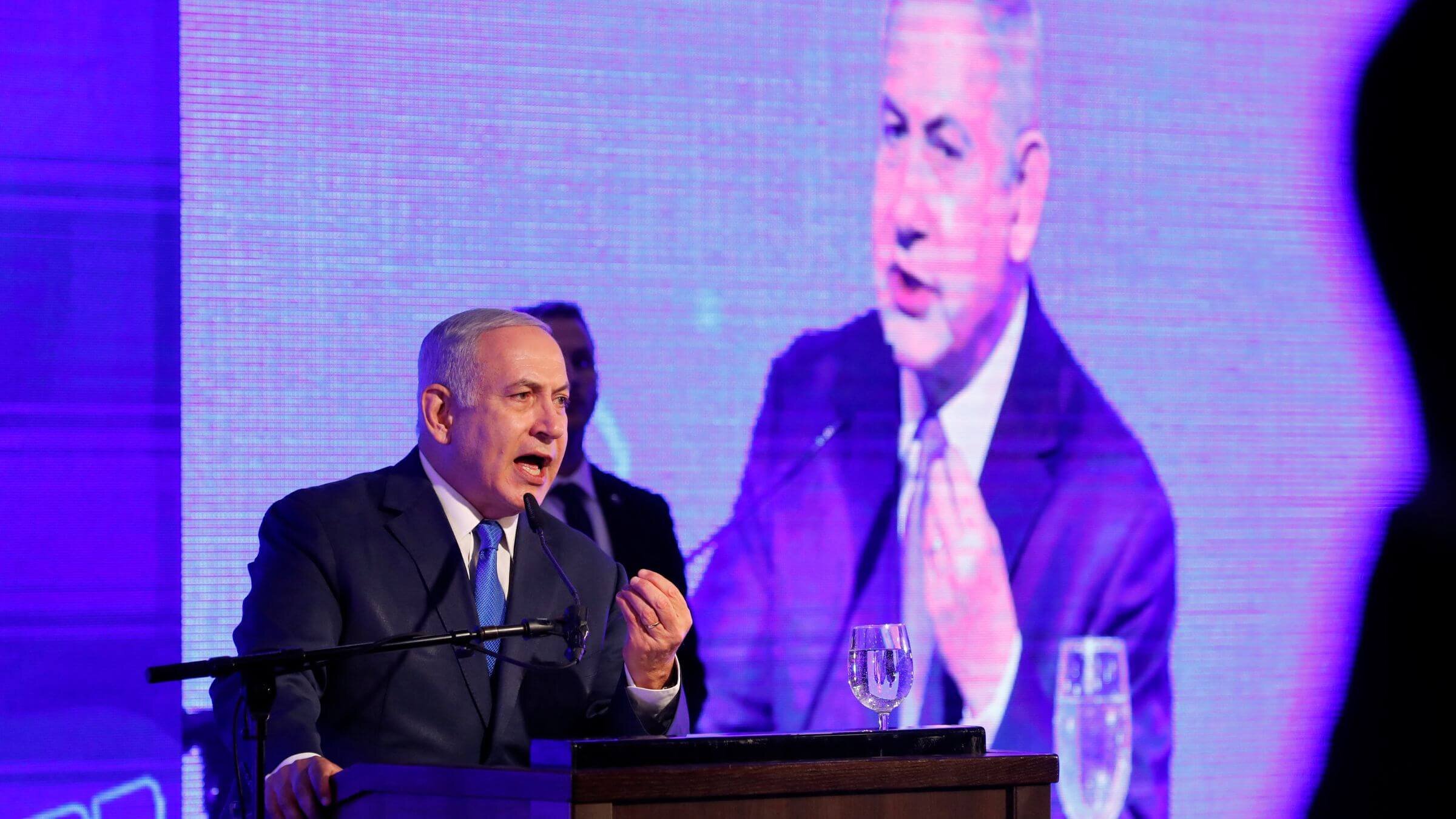
Israeli Prime Minister Benjamin Netanyahu delivers a speech before lighting a stylised-menorah during the start of Hanukkah, the Jewish festival of lights, in Ramat Gan in the suburbs of the Mediterranean coastal city of Tel Aviv on December 2, 2018. Photo by Jack Guez/AFP via Getty Images
By Simone Saidmehr May 7, 2026
As election season in Israel heats up, Israeli Prime Minister Benjamin Netanyahu and members of his government are deploying a charged weapon against their political opponents aiming to overthrow them: AI-generated viral videos.
In recent weeks, Netanyahu and key allies have taken to social media to post satirical content on their social media accounts, depicting their leading opponents, Yair Lapid and Naftali Bennett, as being controlled by Arab-Israeli puppetmasters.
One viral video posted by the prime minister last week, with over a million views, is captioned “taking off the masks.” It shows a smiling Bennett and Lapid embracing before peeling off their faces to reveal those of prominent Arab-Israeli political leaders Mansour Abbas and Ahmad Tibi.
מורידים את המסכות pic.twitter.com/IgFDWXp96N
— Benjamin Netanyahu – בנימין נתניהו (@netanyahu) April 29, 2026
After Bennett and Lapid announced in April that they would run jointly against Netanyahu in the upcoming fall elections, Israeli political Twitter flooded with AI-generated content on this theme, which goes for the jugular on a political vulnerability for Bennett: his past inclusion of Abbas’ Arab Ra’am party in his governing coalition.
One image posted by Likud, Netanyahu’s party, featured Bennett and Lapid depicted as children sitting obediently in the back seat of a car as Abbas drives. The photo is accompanied by the caption: “In any case, Bennett and Lapid will go again with the Muslim Brotherhood, the terrorism supporters.”
גם ביחד זה ברור – הנהג הוא מנסור.
לא משנה איך השמאל מחלק את הקולות שלו.
בכל מקרה בנט ולפיד ילכו שוב עם ברית האחים המוסלמים תומכי הטרור. pic.twitter.com/iYFIZQ8QhJ
— הליכוד (@Likud_Party) April 26, 2026
These AI videos reflect a growing post–Oct. 7 trend in Israeli politics: accusing one’s political opponents of being aligned with Arab parties as a way to delegitimize them.
Dr. Arik Rudnitzky, a researcher in the Arab Society in Israel program at the Israel Democracy Institute, said the trauma Israelis experienced after Oct. 7 has left a profound mark on the Jewish public. That fear, he said, is now being actively mobilized in political messaging.
“The post–Oct. 7 discourse is so influential in Israeli politics that it dictates everything,” Rudnitzky said. On Tuesday, Finance Minister Betzalel Smootrich went as far as to say that Naftali Bennett’s decision to include the Islamist Ra’am party in the 2021-2022 government was worse than the Netanyahu government’s failures tied to Hamas’s attacks on Oct. 7. This, despite the fact that Mansour Abbas has said that Netanyahu tried to court him into joining his coalition in 2021, though Netanyahu has denied this.
According to Rudnitzky, the implicit message is that Israel’s Arab parties are dangerous. The argument is that they are not Zionist (and some Arab parties are even explicitly anti-Zionist). In the aftermath of Oct. 7, while some Arab-Israeli political leaders condemned violence from both Hamas and the Israel Defense Forces on civilians, they stopped short of referring to Hamas as a terror organization. Some also failed to condemn the murder of Israeli soldiers on that day.
Now, Netanyahu’s government has taken to framing the choice for voters as existential. “Either you are with the most experienced prime minister in Israel’s history, or you are willing to gamble and put Israel at risk by electing Bennett and Lapid,” said Rudnitzky.
The use of AI by Israeli politicians, Rudnitzky added, makes that message more visceral. “It looks real, it goes straight to the back of your mind, and it hits a nerve.”
Bennett, for his part, has tried to distance himself from this narrative, stating after he announced that he would be running against Netanyahu, “The Arab parties are not Zionist, and therefore we will not rely on them.”
But the videos are taking their toll. Earlier this year, Bennett filed a police report after the Likud X account posted a doctored image that depicted Bennett celebrating with Arab leaders, with the men all raising their clasped hands in celebration. Bennett called the image “malicious forgery.”
Other politicians have deployed similar messaging tactics — against Netanyahu. In February, Avigdor Liberman, a right-wing critic of the prime minister, posted an AI-generated image of Netanyahu holding hands with Abbas in front of a bouquet of heart-shaped flowers, captioned: “Happy Valentine’s Day.”
יום אהבה שמח❤ pic.twitter.com/Sel1CkURFn
— אביגדור ליברמן (@AvigdorLiberman) February 14, 2026
In response, Netanyahu posted an actual photo of Lieberman meeting with Abbas with the caption: “Lieberman published a doctored AI photo of the PM holding hands with Mansour Abbas. So, Avigdor, here’s a real, unedited photo of you and Mansour Abbas.”
Lieberman then shared 10 posts of Netanyahu meeting with various Arab leaders since the 1990s, including former PLO Chairman Yasser Arafat and current Palestinian Authority President Mahmoud Abbas.
According to Rudnitzky, such wrestling-ring attacks have become normalized since Oct. 7, aimed at Jewish politicians and voters. “This is not about delegitimizing Arab voters,” he said. “The target is Naftali Bennett — not Mansour Abbas.”
A controversial pragmatist
Arab parties have long represented Israel’s Arab minority in the Knesset but historically remained outside governing coalitions. For decades, this arrangement — Arab parties supporting from the outside or remaining in opposition — was broadly acceptable to both sides. Arab politicians often avoided joining coalitions for ideological reasons, while Jewish parties largely viewed their inclusion as politically untenable.
That changed in 2021, when Abbas made history by joining the winning coalition led by Bennett and Lapid. That decision positioned him as a pragmatist, willing to work with Jewish parties to secure gains for Arab citizens.
In the aftermath of Oct. 7, Abbas issued the most explicit condemnations of Hamas among Arab Israeli political leaders. He has also said that “the state of Israel was born as a Jewish state, and it will remain one,” a rare acknowledgment of Israel’s identity in those terms. Still, no Arab-majority party in Israel defines itself as Zionist.
While it is considered to be the most moderate of the Arab parties in Israel, Abbas’ Ra’am is an Islamist party that emerged from the Islamic Movement in Israel and the Shura Council — organizations tied to the Muslim Brotherhood. Abbas has increasingly sought to distance the party from those groups and has denied any affiliation with the Brotherhood.
Forming a governing coalition in Israel requires at least 61 seats out of 120, and several polls have suggested that any viable opposition to Netanyahu would likely need Arab party support to reach that threshold. But reliance on Arab parties to form a coalition has become more contentious since Oct. 7.
According to the Democracy Index poll, 72% percent of the Jewish public in Israel opposes the inclusion of Arab parties in the governing coalition. Opposition extends beyond the right: 43% of centrist voters and 20% of left-wing voters also oppose such coalitions. Support has declined significantly since before Oct. 7, when roughly 36% of Jewish Israelis backed including Arab parties in government, compared to just 27% today.
Hence the opening for Bibi and his video blitz. “We’ve seen an escalating political discourse over the past several years. There are no more holy cows,” said Rudnitzky. “If you want to mobilize the entire Jewish public and you know that you are in an inferior position in the polls … this is the way to take the demons out of the bottle.”
Did you know that only 2% of Forward readers donate to support our nonprofit newsroom? That 2% make it possible for millions to read the Forward without a paywall or subscription — removing any barriers to the full and fair Jewish story.
But while the Forward is free to read, it isn’t free to produce. Big stories — like deep dives into the antisemitism data, political scoops or reporting trips to college campuses — take months of research and fact-checking. All while we keep you informed of what you need to know each day.
— Rachel Fishman Feddersen, Forward Publisher & CEO
Support our mission to tell the Jewish story fully and fairly.