I’m an Orthodox student in NYC. I’m grateful Mamdani vetoed the school buffer bill
I learn from debating with my classmates, not from having their speech silenced
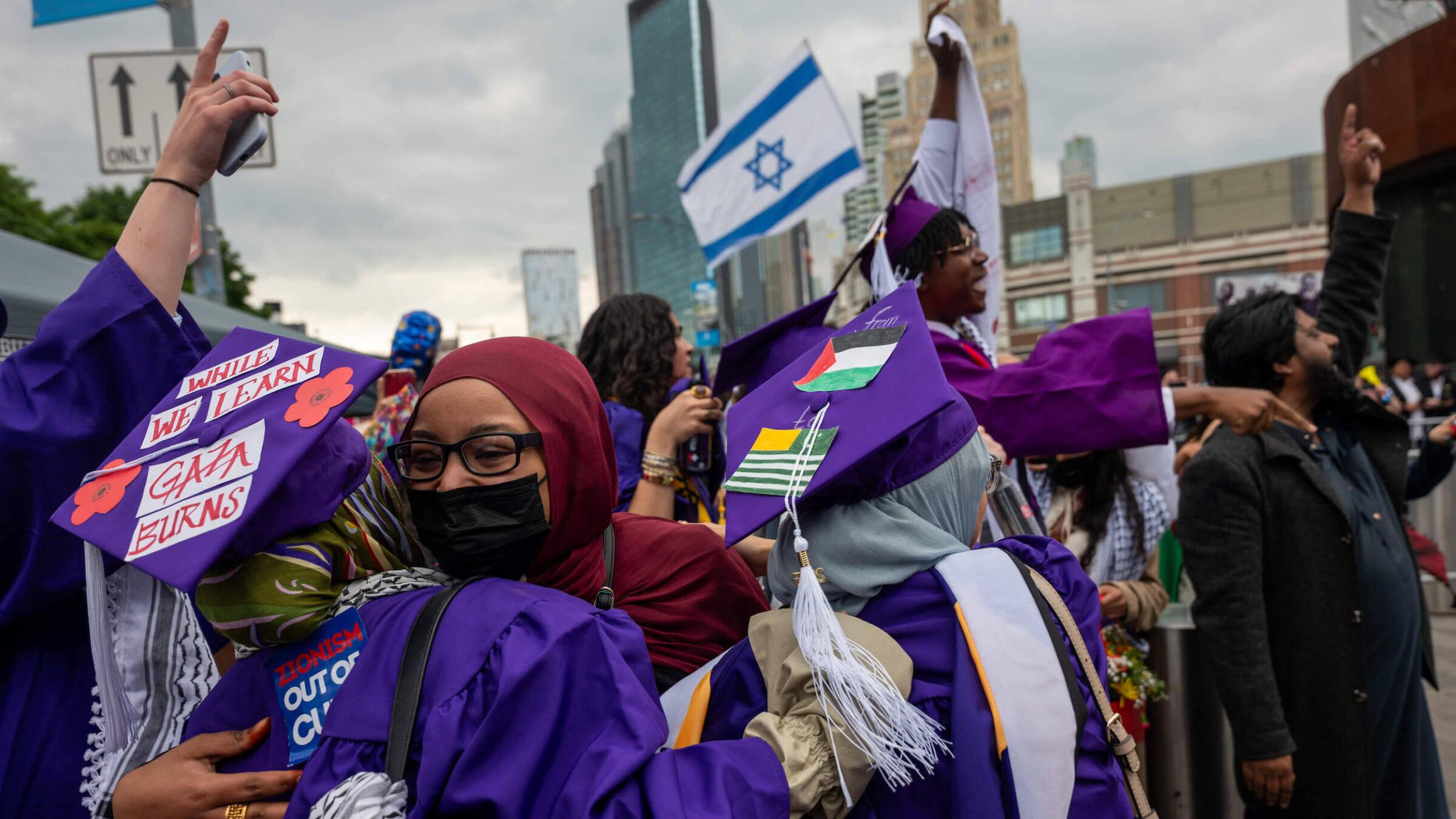
Police, supporters of Israel, and demonstrators in support of Palestinians gather outside Barclays Center for a graduation ceremony for Hunter College students on May 30, 2025. Photo by Spencer Platt/Getty Images
My classmates at Manhattan’s Hunter College regularly gather to protest in a plaza at the southwest corner of East 68th Street and Lexington Avenue. This winter, that intersection hosted many protests against Immigration and Customs Enforcement — protests that felt more urgent because, for many Hunter students and their family members, detainment and deportation are very real threats.
Seeing how committed my classmates were to fighting back against injustice made me proud to be a New Yorker, and a student at Hunter.
Detractors often portray college protesters as liberal elites, comfortably removed from real-world issues. That’s not the case at Hunter. That’s part of why, as an Orthodox Jew deeply involved with Jewish life on campus, I’m glad that Mayor Zohran Mamdani vetoed a bill that would have established security perimeters disallowing protests near educational facilities.
On campus, there has been much discussion around City Council Intro 175-B, which the council passed by a 30-19 vote in March. Students suspect that these policies are in place not to protect us but rather to shield the Israeli government from criticism. Internal discussion among Jewish students has been varied. Some students say the bill is necessary to protect us, while others agree with the progressive views of a majority of Hunter’s politically active students, and want their voices to be heard.
Either way, Jewish students are not a monolith, and I am distrustful of politicians and bills which claim to speak for all Jews as a bloc.
I proudly wear a kippah and tzitzis to campus every single day. Friends jokingly call my accent a “generic northeastern yeshivish,” interspersed with Aramaic and Hebrew terms. Before you know my name, you know I’m a Jew. And I feel complete confidence in saying that Hunter is a good place to be Jewish.
My non-Jewish friends and professors have respected my identity and perspective. That isn’t to say that protests related to Israel and the Gaza war haven’t been contentious or charged: they have been. But when I pass my friends who wear kaffiyeh in protest of the destruction in Gaza, they still dap me up.
That image — of a kippah-wearing Jew and a kaffiyeh-clad Arab student greeting in the hallway — encapsulates my experience at Hunter.
Yes, some protesters have crossed lines. At a protest during my freshman year, a protester displayed a banner with an AK-47 and red block letters saying: “BRING THE WAR HOME.” I thought the goal was ending wars abroad, not bringing them home. I was appalled, as were many other students across the political spectrum.
But I believe it’s the responsibility of New York City’s colleges and universities, relying on the input of their students, to address these issues. They can make informed decisions about which applications to approve or deny, take their own safety measures, and, as a last resort, oversee necessary disciplinary action.
Hunter is capable of promoting free expression and dialogue, along with security measures to protect students when necessary. There’s nothing to gain from imposing heavy-handed restrictions on my university and my classmates that would suppress their speech. And there’s much to lose.
Hunter is a bastion of free thought, somewhere my classmates and I can immerse ourselves in different perspectives, and learn through dialogue and debate. It’s somewhere you can espouse unpopular opinions, as long as you have the ability to defend your argument.
Notably, 175-B — which still may be passed, as the council has launched an effort to overturn Mamdani’s veto — contains a carveout for labor protests, allowing these protests to move inside security barriers. I agree that these protests should continue unencumbered by barriers or buffer zones on our campuses. But I don’t see why they should be the only ones. Encountering ideas that differ from your own should be thought-provoking, even thrilling. It should be what college is all about.
So when people back home on Long Island ask me how I’m dealing with antisemitism at Hunter, my answer is another question: “Do you mean anti-Zionism or antisemitism?”
Many Hunter students are staunch or outspoken anti-Zionists, opposing Israel’s right to exist. That perspective is challenging for students with a deep attachment to the Jewish state. It took several difficult conversations with honest and principled anti-Zionists before I began to understand that their logic and perspective is as informed as any other.
In my experience, anti-Zionism and antisemitism are not the same. My peers are entitled to their First Amendment rights, and when they exercise them, everyone benefits in the long run. Engaging outlooks that make us uncomfortable is the best way to learn and grow. I’d rather speak with my classmates face to face than confine their ideas to the perimeter of a buffer zone.
Antisemitism is an extremely dangerous issue in New York City, and Jews in America are rightfully on high alert. But a policy platform of censoring free speech will not disincentivize rogue incidents of hate violence. Those are the most imminent physical threat to American Jews, and I have done my best to make sure Hunter’s social justice community understands that. This line of open communication is what keeps Jews safe at Hunter, and 175-B threatened to sever it.
The NYPD told the City Council in February that its existing authority is enough to handle protests. 175-B went beyond that authority, erecting barriers with the stated goal of protecting Jewish students like me. But as a Jewish student, I believe they would have violated the First Amendment rights of all students — Jewish and non-Jewish alike. The bill, rather than creating new security for students like me, seemed poised to isolate the Jewish community: no one wants to debate someone whom they see, fairly or not, as participating in the restriction of their rights.
And truthfully, I have experienced far more antisemitism on the streets and subways of New York than I ever have on Hunter’s campus. It is no small thing that I am safe at Hunter, and I would speak out if I was not.
With this veto, the mayor recognized that our community and our city did not need this crackdown on expression. We need the opposite. The United States, and New York in particular, have been a haven for Jewish life and culture for more than a century. Our community will never achieve safety and security by allying ourselves with those who treat civil and constitutional rights as dispensable.
I don’t always agree with everything protesters have to say, but it isn’t my place, or the City Council’s, to legislate where and how they say them.
I don’t want to see roadblocks or barriers on 68th and Lexington. I want to see Hunter students exercising their right — and fulfilling their duty — to speak out against injustice and tyranny. I salute Mamdani’s decision to veto City Council Intro 175-B. It would have cost more in freedom than it could ever provide in safety.
I’m personally matching all gifts to the Forward, up to $36,000. Can I match your gift now?

Hello, fellow Forward reader! I’m Joel Brown, a Forward reader and supporter for more than 15 years, and currently the chair of the board of directors.
I’m an avid Forward reader because it ticks so many of my essential boxes: excellent journalism, Jewish focus and diverse viewpoints. In today’s political climate, what I most appreciate is the Forward’s independence — made possible by the generosity of its membership.
The Forward is committed to bringing you unbiased, nuanced Jewish news. From my position as board chair, I see an exciting future as we expand our position as the definitive independent voice of contemporary American Judaism.
— Joel Brown, Forward board chair
Support our mission to tell the Jewish story fully and fairly.