Reform Judaism helped craft the Voting Rights Act. Its evisceration gives Jews a new mission
The erosion of the ‘crown jewel’ of the Civil Rights Movement requires a new era of moral courage
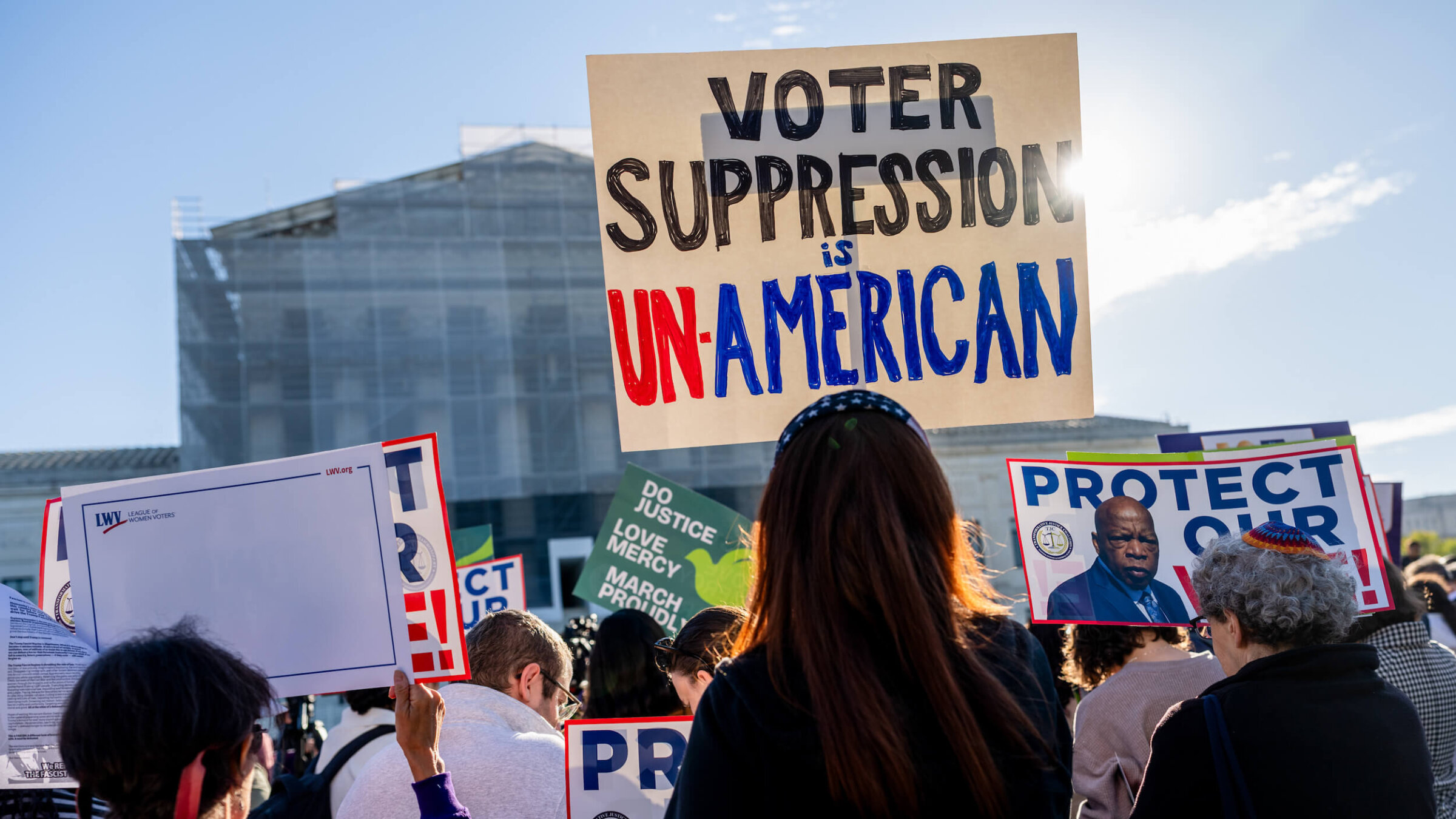
Demonstrators protest in favor of the Voting Rights Act outside the Supreme Court on Oct. 15, 2025. Photo by Eric Lee/Bloomberg/Getty Images
Last week, the Supreme Court further gutted what is left of the Voting Rights Act of 1965. The Court’s ruling was terrible for the country, and particularly for communities of color whose votes will be diminished by this decision. But the ruling touched another, very personal nerve because the Voting Rights Act was partially drafted in my office, the Religious Action Center of Reform Judaism.
The RAC is a longtime hub of civil rights activity. From the earliest days after our 1962 dedication, Reform movement staff with the RAC worked alongside the staff of other civil rights and public interest organizations, including the Leadership Conference on Civil Rights. The era’s social justice luminaries, our movement’s leaders among them, would gather around our conference table to discuss, debate and craft policies to address racial injustices — including legislation that became the Civil Rights Act of 1964 and Voting Rights Act of 1965.
Many American Jews have no idea of our community’s connection to the law’s origins, rooted in a Jewish commitment to working across lines of difference and in an understanding that our safety is in solidarity with other marginalized communities who experience bigotry. But as Jews, we all know that we can only flourish in a true democracy in which every voice is heard, because every vote counts equally.
For decades, section two of the Voting Rights Act helped ensure that voters of color had a fair opportunity to participate in the political process. By narrowing how states can use race data to draw electoral maps, the Court’s ruling will dilute the voices of communities of color, and further weaken a law often called the “crown jewel” of the Civil Rights Movement — one that was the product of a moral struggle in which people of many faiths, including Jews, risked their lives.
Rabbi Dick Hirsch, the founder of the RAC marched with Dr. Martin Luther King Jr. in Selma because he understood that American Jewish safety is tied to the health of American democracy. During Freedom Summer, Andrew Goodman and Michael Schwerner — two white, Jewish men — were murdered alongside James Chaney, a non-Jewish Black man, while registering voters in Mississippi. Goodman and Schwerner did not see voting rights as someone else’s issue, but understood fighting for them to be a Jewish obligation.
That understanding is rooted in Jewish tradition. The Talmud teaches that “a ruler is not to be appointed unless the community is first consulted.” The VRA, which was reauthorized repeatedly over the decades by bipartisan majorities in Congress, was a crucial step to ensuring that communities of color were fairly consulted on the issues that affect their lives.
For decades after Reconstruction, Black representation in Congress was negligible and at times effectively nonexistent. That began to change only after the VRA became law. Today, there are more than 60 Black members of Congress, the highest number in American history. That progress was not inevitable. It was the direct result of legal protections that ensured fair access to the ballot.
By making it easier for states to defend discriminatory maps under claims of partisanship, the Court has weakened one of the most important tools to ensure fair representation. The result will be fewer fair Congressional maps — an effort well underway, in the wake of the decision, in states like Tennessee — less representative institutions, and a political system that reflects fewer voices.
Some will argue that this is simply the normal push and pull of constitutional interpretation, but history suggests otherwise. When democratic norms weaken, minority communities are among the first to feel the consequences.
For American Jews, this progression is not theoretical. Our security and prosperity, in this country as others, have depended not only on physical protection, but also on good laws, functional institutions and a system of checks and balances that uphold equal rights and reject discrimination.
George Washington recognized this in his 1790 letter to the Jewish community of Newport, Rhode Island, in which he promised that the United States would give “to bigotry no sanction, to persecution no assistance.”
In recent years, we have seen how fragile those protections can be.
Antisemitism has risen sharply, often alongside forces that divide Americans along racial, ethnic, and political lines. Efforts to weaken voting rights, undermine trust in elections and concentrate power do not occur in isolation. They are part of a broader pattern that threatens the pluralistic democracy on which Jewish life in the U.S. depends.
When the Court took a major piece out of the VRA in 2013’s Shelby v. Holder decision, Justice Ruth Bader Ginsburg famously warned in her stinging dissent that the Court’s decision was “like throwing away your umbrella in a rainstorm because you are not getting wet.” Today, the rain has not stopped. If anything, it is falling harder.
We must persevere through this storm. The path forward will not be easy, but it is clear.
In legislatures, we must push for stronger protections, among them state-level voting rights acts and renewed federal legislation. In the courts, advocates must continue to challenge discriminatory practices wherever possible. And at the ballot box, citizens must exercise their right to vote with renewed urgency.
For the Jewish community, this is a moment to organize. Through initiatives such as the Reform Movement’s 2026 Every Voice, Every Vote campaign, Reform Jews and our allies are working to expand access to the ballot and defend the democratic system that has allowed our community to thrive. This is how we put our values into practice.
Democracy requires participation, vigilance and a willingness to defend the rights of others. It demands that we act against all wrongdoings, not only when our own rights are directly threatened.
For Jews, that responsibility is part of our tradition and our history. As Rabbi Hirsch famously observed at the RAC’s dedication, “our forefathers did not rest with the issuance of general pronouncements from the detached heights of Mt. Sinai. They descended into the valley of reality.”
The Supreme Court decision is not just another technical shift in election law. It is a setback for American democracy, and for those of us who understand that democracy is not just a system of government but a moral commitment.
The question is whether we will meet this moment.
Democracy will not defend itself.

Hello, fellow Forward reader! I’m Joel Brown, a Forward reader and supporter for more than 15 years, and currently the chair of the board of directors.
I’m an avid Forward reader because it ticks so many of my essential boxes: excellent journalism, Jewish focus and diverse viewpoints. In today’s political climate, what I most appreciate is the Forward’s independence — made possible by the generosity of its membership.
The Forward is committed to bringing you unbiased, nuanced Jewish news. From my position as board chair, I see an exciting future as we expand our position as the definitive independent voice of contemporary American Judaism.
That’s why I’m paying it Forward, by matching $36,000 of reader gifts. It’s an investment in the Forward’s newsroom, to continue telling the American Jewish story with truth and independence.
— Joel Brown, Forward board chair
Support our mission to tell the Jewish story fully and fairly.