How Joanna Stern gets it done — with some help from AI
The author of ‘I Am Not a Robot’ enlisted some high-tech help to make potatoes for Seder
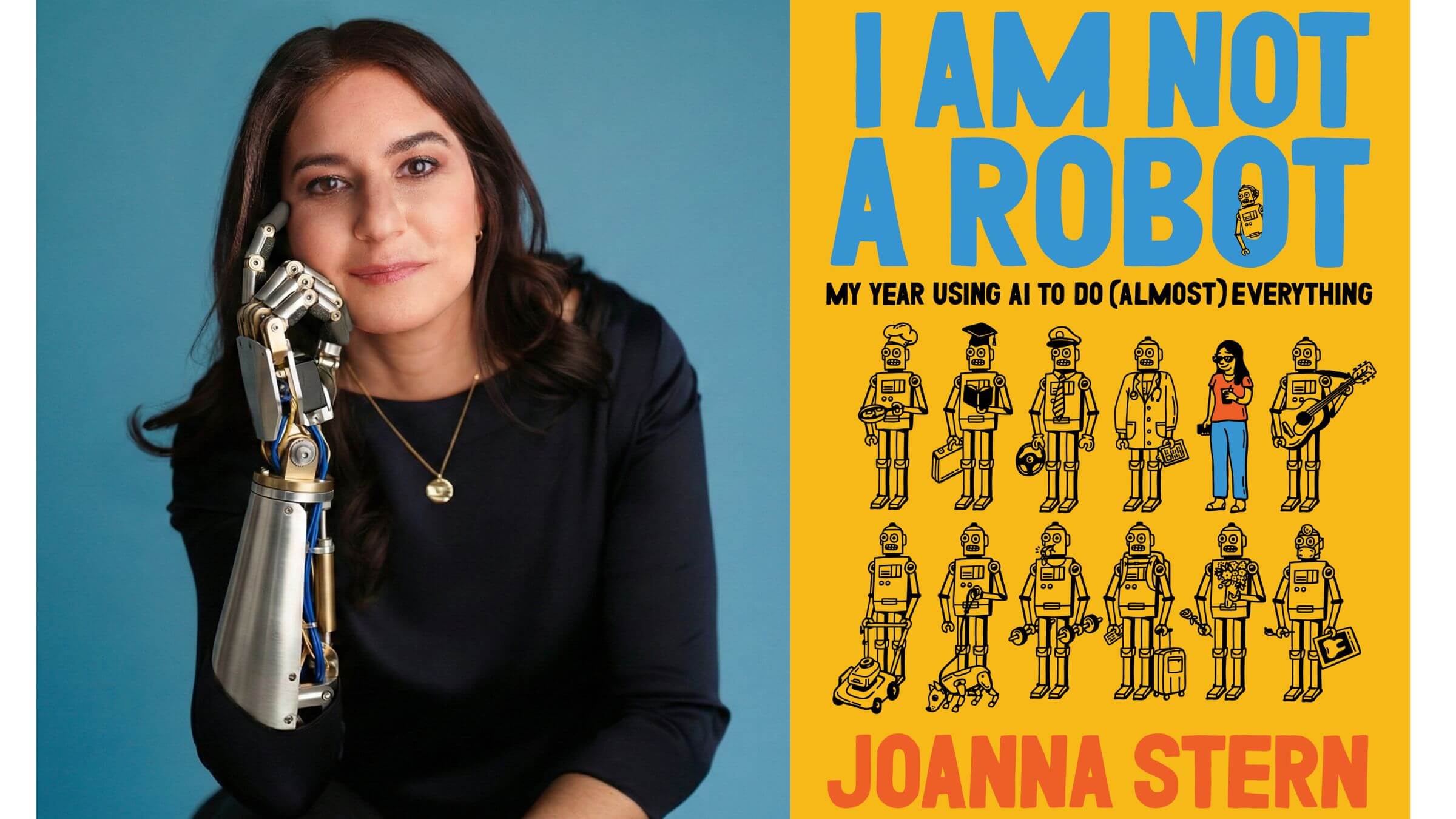
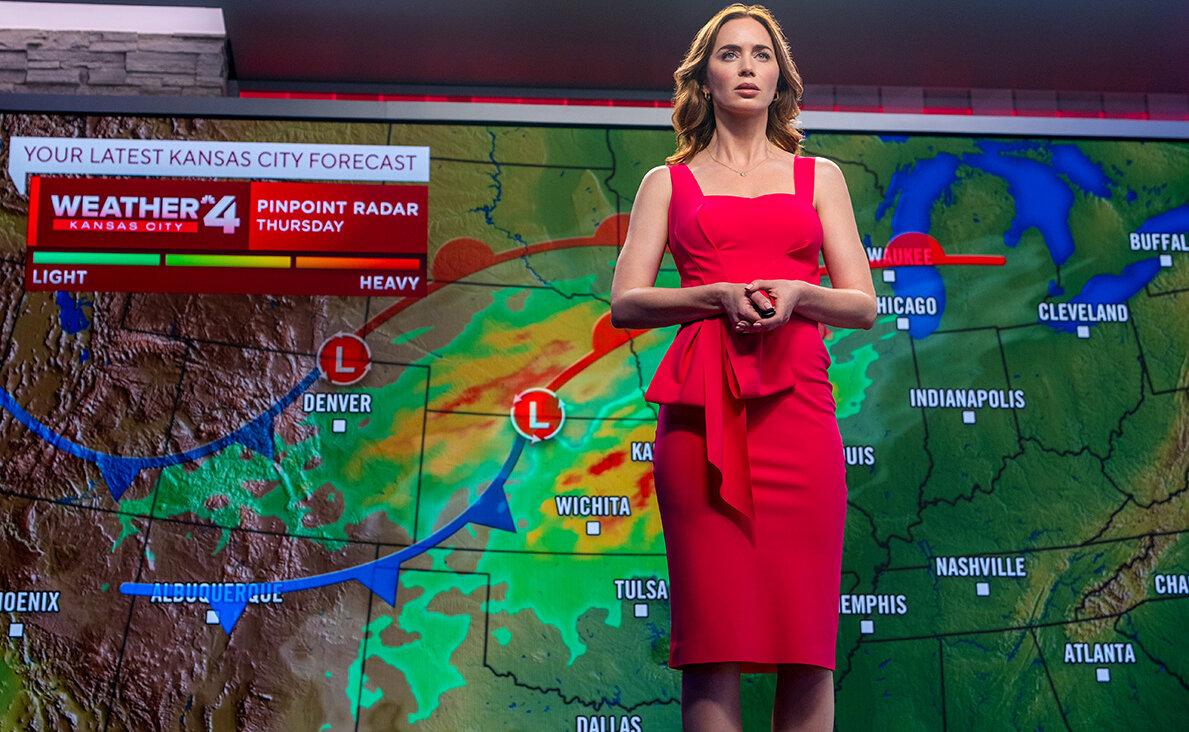
Joanna Stern chronicled a year of living with AI. Image by Kenny Wassus edited with Google Gemini and Harper Collins

By Dan Friedman May 12, 2026
Early in the morning on the day of the first Seder this year, I got on a train to New Jersey with a bag of potatoes and a cunning plan to outsource their cooking.
I was on my way to interview journalist and tech-maven Joanna Stern. In her new book, I Am Not a Robot: My Year Using AI to Do (Almost) Everything, she notes, while using the Posha AI cooking robot, that “robots won’t kill us with lasers, they’ll kill us with salt.” Together we would see whether Posha was up to some Seder food preparation that would sustain rather than poison both the Stern and the Friedman tables.
Stern, 42, for 12 years the consumer tech reporter at the Wall Street Journal, spent a year saying yes to a series of AI experiments. Some of those experiments — the AI boyfriend (with consent from her wife), the AI therapist (with advice from her therapist), the AI research assistant (she dispensed with her human assistant) — were generative AI. Others, like the Posha, lawnmower and Waymo driverless cars use different types of AI which Stern helpfully identifies at the outset.
Stern was in the process of starting up her new media company, which she had not even yet officially named “New Things.” In 2025 she had lived her life with AI and the book about the experience was coming out in May 2026, super speed for the publishing industry. As a fellow Solomon Schechter alum of sorts (she was a student, I was a teacher, a decade apart, different schools), I didn’t want to bother her too much in the hectic period as she published and publicized a book, launched a new media outlet and recorded a number of videos in partnership with NBC. So we got together on a morning when otherwise we would just have both been prepping in different kitchens in different states.
For the potatoes we enlisted the Posha, which looks like a microwave had a baby with a food processor. In the book Stern describes it like this.
“If you’re picturing a humanoid Gordon Ramsay, stop. Think giant countertop toaster oven, with a single pot and burner. The ‘robot’ lives in the system’s software, which controls stirring attachments, ingredient containers that dump food into the pot like a tiny automated dump truck, and a spinning spice rack that spits out seasoning in short, aggressive bursts. Bolted to the front is a small Android tablet.”
(“Bolted” is unfair, there’s a molded structure, but it still feels like an appliance rather than a window into the future of cooking.)
We chatted while cutting up ingredients — AI can’t shop or chop, it can only do “the fun stuff” — and then, while it was cooking we discussed the time that she’d spent with AI. She’d moved back to New Jersey to raise her kids close to her childhood home, but the world of the near future that she had been peering into didn’t seem like it was going to resemble much of what we knew in the last millennium.
I asked her whether, after her experiences of last year, she was in any way optimistic. She was cautious about AI: “There’s this completely Utopia version and there’s this completely Dystopia version and we’re somewhere gonna land in the middle.”
Viewed this way, our AI-driven robot future is a more extreme version of our already flawed human society. That’s borne out by the competing chapters in her book about medical AI intervention. She feels that dentists who use AI to read x-rays end up using the technology’s more precise analysis to up-sell procedures. In her chapter named “Machine Eyes and My Complicated Breasts,” Stern is more complimentary about a machine system for reading mammograms that is scrupulous, never tired and highly detail oriented. The AI found some objects that doctors might have missed but, in the end, it seems clear that she just trusts the medical system and breast radiologists more than American dentistry and dentists.
As we bemoaned AI’s abysmal ability to shop — and the utter inability of the 1X humanoid robot from Neo that she tested last year to either do the washing up or load the dishwasher (she has since tried another one, better at dancing than cleaning, alas) — we discussed how dramatically the new technology can reshape the landscape. After all, robots are already royalty in factories which are designed for their efficiency, rather than for uncertain and fragile fleshy water bags like us. If we designed homes so that machines could function optimally, perhaps they could chop, shop, clean, tidy, wash.
Stern was unconvinced, pointing out that other systems like Roomba or the automated driving system of Waymo had worked out how to navigate the human world quite effectively.
Relatedly, as it turned out, I wondered whether there were any of the experiments that she had continued because they had proved helpful. The AI boyfriend who lives in a particular iPhone, for example, she assured me had not been turned on for many months! (Tip for the top from Stern: “Don’t fall in love with a robot.”)
The one significant thing that Stern told me she continued to use regularly was the phone AI interface in the car. If she’s driving to an interview she will ask her AI to do research on her subjects, brainstorm what questions to ask and try different responses to their answers. I began to wish I had done a similar thing with Claude on the way to see her, but then again, actually reading her book, watching her videos and reading her columns gave me a richer, fresher way of responding to her in person. I was finding out who she was, not holding her to account.
We moved into the sitting room while Posha stirred and mixed and cooked. Stern’s video persona is an engaging mixture of curiosity, expertise and mild comic self-deprecation. Rather than the po-faced techies who open boxes and test stuff on YouTube, Stern is playful and has fun with the objects, subjects, and the video format. She has a fondness for the dumb and the pun that would definitely get labeled dad jokes if she were male.
Mostly, in her articles and videos she has explored the world of what is for sale but — especially after one interview with Apple execs about Siri, in which she said “You have more engineers, more money than any company, why couldn’t you make it work?” — she was called “Tech Mommy” because she knew her stuff, made it simple and held the child-like, big-eyed men of tech to account.
Sitting on her sofas — in the good room, nokh — Stern was more serious and thoughtful than her online persona. She was setting up a new business, with all the HR palaver that entailed; she was still doing the work of making videos and keeping on top of tech; she had to liaise with family about the Seder; she had her sick kid at home — not too bad, but feeling sorry for himself. He had been practicing and would be especially disappointed to miss out on the Four Questions at Seder, maybe he could FaceTime in to do it?
I wondered what sort of world we were making for our children. Beyond the collapse of entry level jobs — for the book Stern “hired a human reporting assistant [Maya Tribbitt] and then replaced her with an AI reporting assistant” — we decided we didn’t quite know. Stern, though, had been thinking about her chosen career recently. Yes, she had been thinking about it so she could position her brand for her new venture but she had also been reflecting on what she had achieved at the Journal: “Consumer tech is not really ‘what phone to buy’ or ‘what’s the best TV’ it’s now what are the impacts that it has. I wish I had worked more on that earlier in my career.”
So, if not the big future, a world shaped by AI, a world for the robots that we happen to live in, what’s next?
“The next step is wearable devices, the Meta Ray Bans take hands-free photos and videos. I wear them pretty much every day. Mostly just because they’re good sunglasses and then they have a camera so it’s easy to take family photos and videos.”
And also, “microphones in everything.” Stern gestured at some of the devices lying around, stand-ins for all the new devices that will need command interfaces: the best way to control them is verbally. For years we were told that our phones were not listening to us: “They don’t need to listen through our microphones. We have all this other data that we give them.” But now, Stern says, Alexa and Siri are just the thin end of the wedge. Everything will be miked and potentially listened to. “Now it’s like, ‘Oh, it’s so easy. We can easily do it.’… Whether or not they’re actually listening, they can.”
The alert went off on the cookbot and we took out the perfectly herbed potatoes from Posha. It had barely saved us time or effort but Stern, without prejudice, noted that there were certain longer, more complex recipes that the family enjoyed where it did, regularly, save her time. Stern put hers in a dish to take to her parents and I put mine in my aluminum tray for the train.
The allure of tech as we have known it until now is that it helps us to do what we want to do faster, quicker and with greater scope. At the moment, AI-driven robots like Posha or the Gabbo stuffed toy from Curio are in their infancy, finding their way in the human world. One of the endearing features of the humanoid robot that Stern tested was how helpless it was. Instead of a scolding, it needed support and love from Tech Mommy.
On the other hand Gabbo, the toy that talks to kids using some parental pre-programming and an uplink to ChatGPT, seems like it could be fun, or just pretty creepy. Stern gave one to her son Alex (aged 4) for Hanukkah and before it had a chance to become creepy, he decided that it was deeply annoying and destroyed it. (In the book, Stern adduces the dialog that led to the destruction and it is indeed warranted!)
But as the tech rapidly improves it will be harder to destroy both physically and emotionally. It’s not clear what impact they will have, but these robots are not going to be helpless, useless or destructible for much longer and, as always, Humpty Dumpty’s question resonates: “The question is, which is to be master — that’s all.”
We called a human-driven car to take me to the human-driven train. I took my tray and rode home with my robotically-cooked potatoes. That evening we tasted the respectably crisp, rosemary-herbed chunks and they were welcome at our feast celebrating liberation from bondage.
At Seders, we place ordinary but symbolic objects — eggs, oranges, glasses of wine — at the center of attention to force ourselves to ask uncomfortable questions about freedom: who has it, who lacks it, and what obligations come with it? The potatoes at this year’s Seder became a prompt to wonder not only about human freedom, but about our relationship to AI and the coming world of robots — and whether, in creating increasingly intelligent machines, we might surrender parts of our own humanity along the way.
Correction: A previous version of this article referred to the interactive plush toy as Gabba. It is, in fact, called Gabbo.

Did you know that only 2% of Forward readers donate to support our nonprofit newsroom? That 2% make it possible for millions to read the Forward without a paywall or subscription — removing any barriers to the full and fair Jewish story.
But while the Forward is free to read, it isn’t free to produce. Big stories — like deep dives into the antisemitism data, political scoops or reporting trips to college campuses — take months of research and fact-checking. All while we keep you informed of what you need to know each day.
— Rachel Fishman Feddersen, Forward Publisher & CEO
Support our mission to tell the Jewish story fully and fairly.