‘The Imagination Is the Body of God’
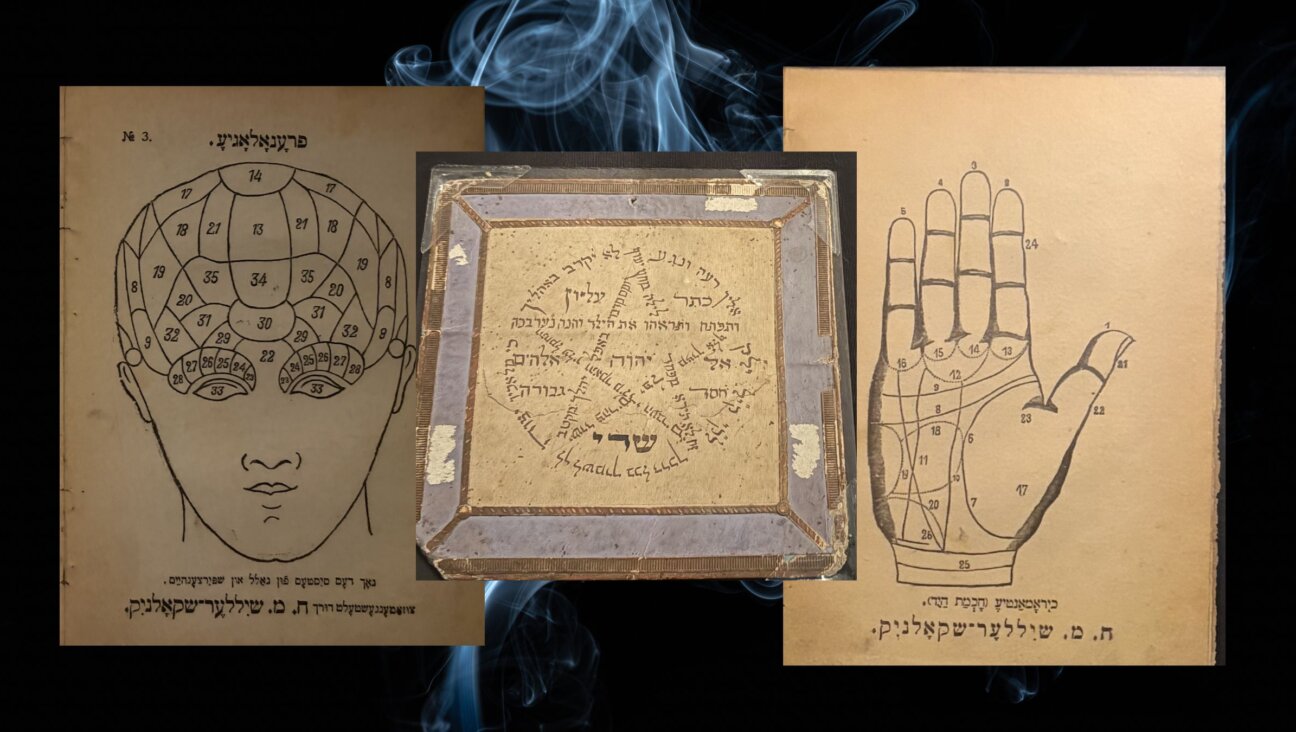
Graphic by Angelie Zaslavsky
This piece is crossposted from The Best American Poetry, where poet Eve Grubin is guest blogging this week. Read Grubin’s previous post here and her poetry on The Arty Semite here.
Yesterday I wrote that the biblical Eve lived in, as Goethe called it, “the poet’s trance.” But then the snake seduced her out of that place of passionate clarity.
Rabbi Moses ben Naḥman, otherwise known as the Ramban or Nachmanides, the leading Medieval Spanish scholar who later settled in Israel, commented on the following language from the text: “Let us make humans in Our image and in Our likeness” (1:26). He wrote that the word which means “Our likeness” in Hebrew, “kidmutanu,” finds its root in the word “dimyon,” which means “imagination.” Ramban suggests that human beings are defined by the power of broad imagination — God’s imagination was transferred to humanity, and Eve’s “poet’s trance” included what Keats called “the truth of the imagination.” Blake intuited Ramban’s insight when he wrote that “the imagination is the body of God” and “Imagination is evidence of the Divine.”
When Eve listened to the snake, she limited herself — she moved from continually experiencing the truth of the imagination to a restricted space where the connection between imagination and truth was obscured. Ironically, when she ate from the Tree of Knowledge of Good and Evil she narrowed her knowledge. The Kabbalah calls the tree, “the Tree of Doubt” — her eating from it brought uncertainty, hesitation, and scepticism into the world. And ultimately, shame.
I have been asking myself the question: How did the snake seduce Eve into narrow doubt and bewilderment? If Eve was so lucid, how did the snake manage to confound her? If her sensitivity to truths reverberated through her, and she felt the web of creation shudder every time she touched it, how could he obfuscate her perspicacious vision? If she gazed through a transparent film and witnessed the connections between the divine and the material, couldn’t she see through the snake? Tomorrow, I will look at the text, some commentaries, and a Robert Creeley poem to better understand how this happened.
I’ll end now with lines from Blake’s “Auguries of Innocence,” which embody the issues I will address in tomorrow’s post:
If the sun and moon should doubt,
They’d immediately go out.
To be in a passion you good may do,
But no good if a passion is in you.
I’m personally matching all gifts to the Forward, up to $36,000. Can I match your gift now?

Hello, fellow Forward reader! I’m Joel Brown, a Forward reader and supporter for more than 15 years, and currently the chair of the board of directors.
I’m an avid Forward reader because it ticks so many of my essential boxes: excellent journalism, Jewish focus and diverse viewpoints. In today’s political climate, what I most appreciate is the Forward’s independence — made possible by the generosity of its membership.
The Forward is committed to bringing you unbiased, nuanced Jewish news. From my position as board chair, I see an exciting future as we expand our position as the definitive independent voice of contemporary American Judaism.
— Joel Brown, Forward board chair
Support our mission to tell the Jewish story fully and fairly.