At the Venice Biennale, protests, self-mutilation and rage against Israel and Russia. Is anyone left to talk about the art?
Amid the din of controversy at the world’s most prestigious art expo, a contemplative Israeli artist struggles to be heard
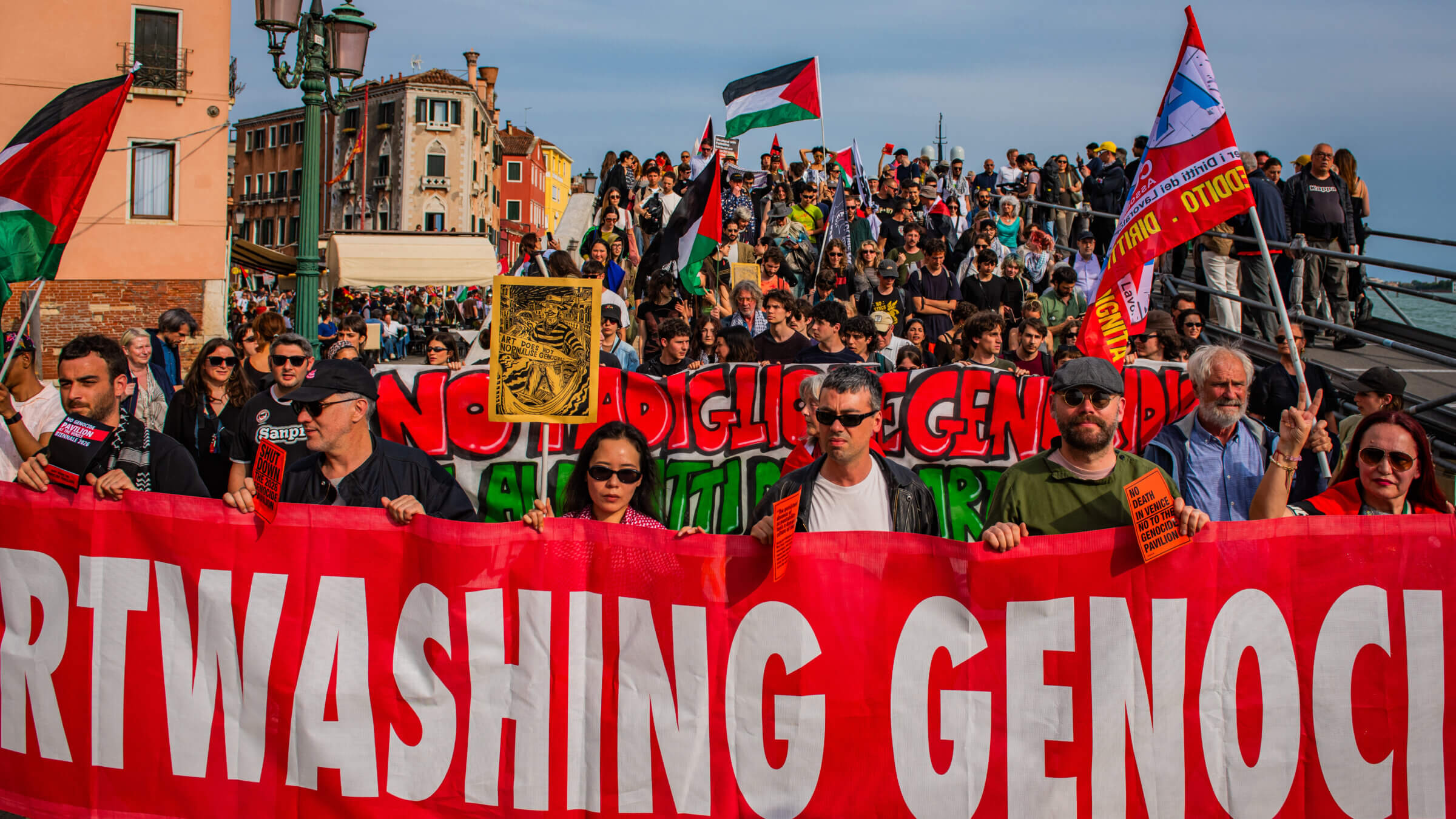
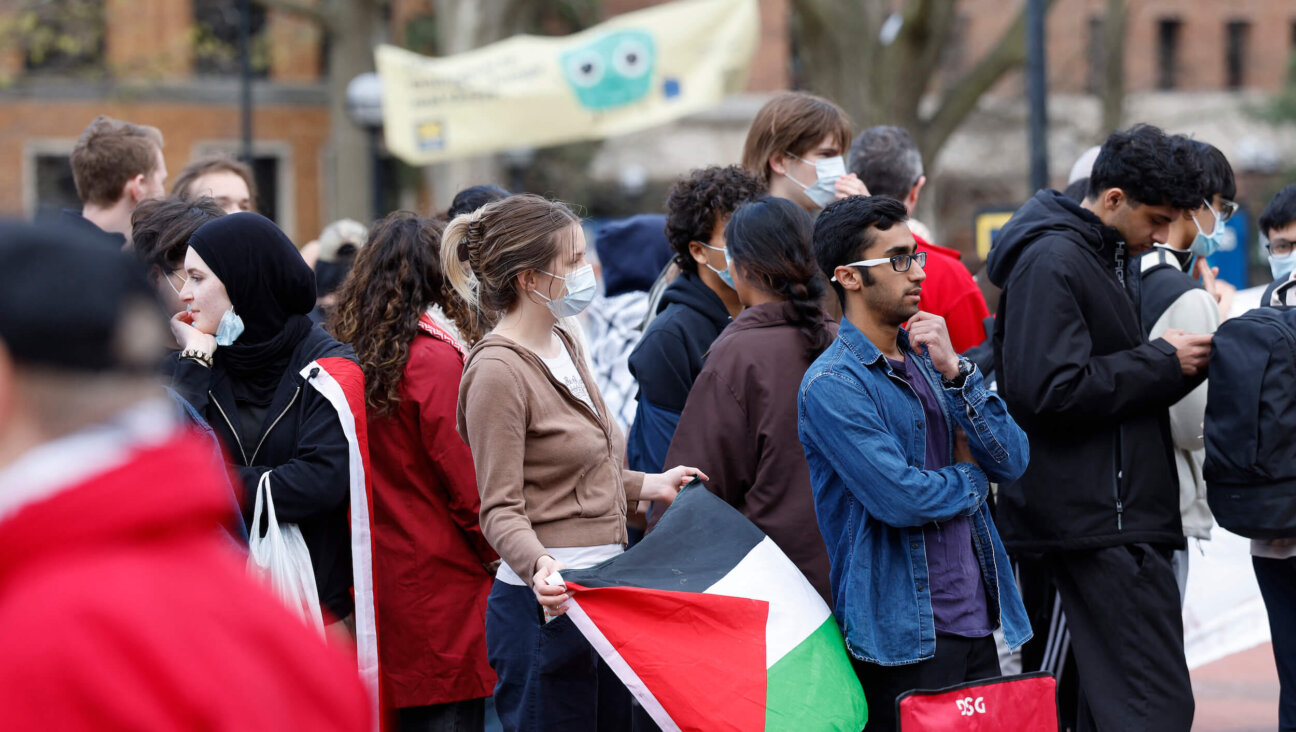
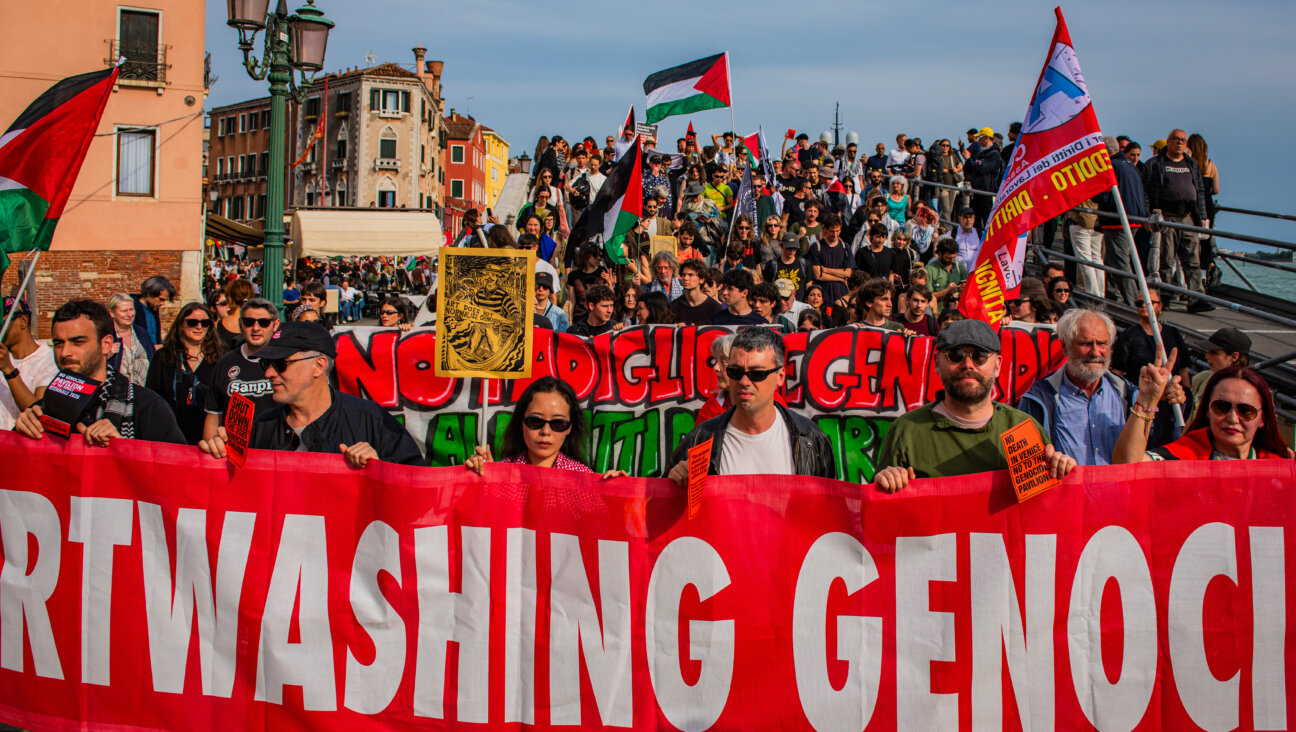
The Art Not Genocide Alliance (ANGA) protests the inclusion of Israel and Russia at the Venice Biennale. Photo by Simone Padovani/Getty Images
By A.J. Goldmann May 14, 2026
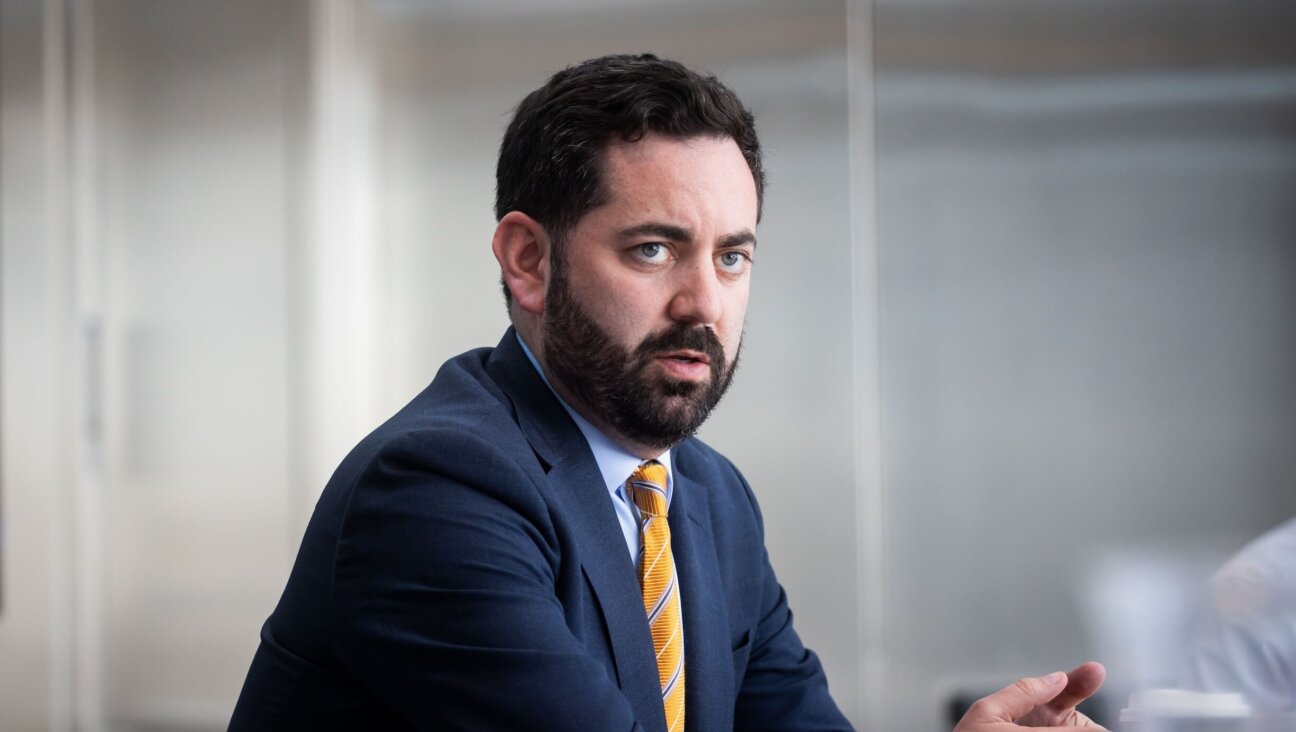
Belu-Simion Fainaru wanted very badly to talk about the water.
The Romanian-born Israeli artist had come to Venice with “Rose of Nothingness,” a quiet, ritualistic installation in Israel’s temporary pavilion at the Arsenale: water dripping into a rectangular black pool in a silent corner of the city’s former armory and shipyard, disturbing the stillness of the reflective surface, inviting visitors to focus on the movement from absence to presence — and back again to nothing.
There’s an explicit link to Paul Celan, above all to “black milk,” the central image of the German-speaking Romanian-Jewish poet’s “Todesfuge” (“Death Fugue”), one of his best-known works. The pool, with its dozens of circular ripples, evokes collective memory, ink and writing in the city where the Talmud was first printed.
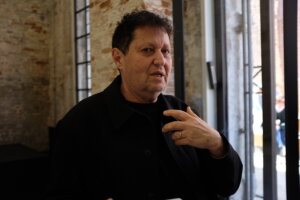
Yet by the time I reached Fainaru during the professional preview of the 61st Venice Biennale, he had been forced to defend his art’s right to exist. The Israeli Pavilion had become one of the pressure points of an exhibition that seemed to be losing faith in the structure that had sustained it for more than a century: the national pavilion, that quaintly anachronistic yet oddly durable relic of late 19th century world’s-fair patriotism. Fainaru had been asked, he told me, about Benjamin Netanyahu, The Hague, Vladimir Putin and Gaza, but rarely about the work he had come to Venice to present.
“You are a cultural reporter; I am an artist,” he said. He had not come here as a politician, but this year’s Biennale had treated him as one.
“What I see now,” the 66-year-old artist said, “is total politicization of art.” If this continued, he warned, art would become “very limited, very narrow,” and eventually “a very violent arena.”
The phrase stayed with me throughout the preview. This year, the Biennale has indeed become a violent, chaotic and scandal-ridden arena. There were barricades, strikes, legal warnings, shuttered pavilions, the resignation of the Golden Lion jury, and art performances and actions meant to disquiet and to shock.
L’Esposizione internazionale d’arte di Venezia was founded in 1895. It is now the most prestigious international contemporary art exhibition in the world, although it still bears traces from the era in which it was born, an age of imperial prestige and competitive cultural display. The Giardini, with its permanent national houses (owned by the countries they represent), is not merely a garden. It is a geopolitical map of cultural power and prestige.
This year, it often looked like that map was being torn up before the spectators’ eyes.
The Biennale’s 2026 exhibition, “In Minor Keys,” opened to the public on May 9 and runs through Nov. 22. It was conceived by the late Cameroonian curator Koyo Kouoh and completed after her death, with 110 invited participants in the central exhibition representing 100 countries. But when I attended, the curatorial project masterminded by Kouoh and implemented by her assistants was eclipsed by a series of interlocking controversies: the participation of Israel and Russia; a €50 million gift to secure Qatar’s arrival in the Giardini with a temporary structure built on the site of a future permanent pavilion; Iran’s last-minute withdrawal; and the anger and bewilderment directed at the American pavilion due to the global havoc the Trump administration is only too happy to unleash.
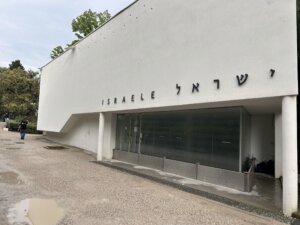
The Israeli Pavilion was not in its permanent building in the Giardini this year. That structure, built in 1952 by Zeev Rechter, remained closed, officially for renovation. (The pavilion also remained shut during the previous Biennale, in 2024; Ruth Patir, the artist representing Israel that year, installed her work but refused to open the pavilion until a ceasefire and hostage-release agreement was reached).
I had been told about sizable protests outside the temporary Israeli pavilion at the Arsenale, but by the time I arrived, all was calm. Two young carabinieri stood outside looking bored. Inside, I thought I spotted a plainclothes Israeli security guard, though the curators later denied that any such person was present. During my interview with Fainaru and his curators, Rabbi Ramy Banin of Chabad of Venice stopped by; he had supplied the klafim, the handwritten parchment scrolls, for the oversized black mezuzot, engraved with a stylized שַׁדַּי, that Fainaru had designed for the installation.
Fainaru was plainly relieved to be asked about the work. His installation is built around an Israeli irrigation system — technology devised to deliver water in places where it is scarce. In agriculture, he told me, such systems are used “to bring life in places that are not life.” In Venice, he had transformed that apparatus into “food for a spiritual dimension.”
The title, “Rose of Nothingness,” points to Celan’s evocative neologism Die Niemandsrose (“The No-One’s Rose”), the title of a 1963 volume that he dedicated to Osip Mandelstam as well as to the Kabbalistic understanding of nothingness not as nihilism but as a generative source.
“The origin comes from nothingness,” Fainaru told me. Presence emerges from absence; the visible world returns to abstraction.
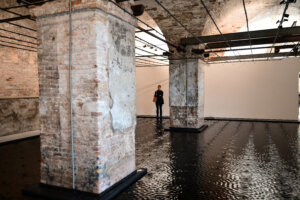
This isn’t Fainaru’s first Biennale. In 2019, he represented Romania, a country he left in 1973. He won the Israel Prize in 2025 and is a professor in the Department of Architecture at the University of Haifa. He is a founder of the Mediterranean Biennale, which showcases works by artists from Europe, the Middle East and Northern Africa; its most recent edition was held in Sakhnin, an Arab city in Israel, where he also helped create the Arab Museum of Contemporary Art. It’s impossible to read Fainaru’s résumé and conclude that he’s a lackey of the Netanyahu government.
Avital Bar-Shay, one of the two curators of the Israeli Pavilion, took me aside and told me many Jewish visitors had come inside and said “Kol hakavod,” telling the team they were proud that Israel was exhibiting. Some spoke of antisemitism in London and other cities that have seen an uptick in violence against Jews since the start of the Israel-Gaza war. “They said, ‘You are giving us courage,’” she recalled. For those visitors, the pavilion was not an assertion of Israeli power, hard or soft. Rather, it was a modest sign that Israeli and Jewish cultural presence had not been expelled from the international stage.
The evening I arrived in Venice, I met a Turkish curator who told me he had spearheaded a “massive demonstration” in front of the Israeli Pavilion earlier that day. Fainaru disputed the scale of the protest. “There were perhaps 30 or 40 people shouting loudly” and shaming those who entered the pavilion. “The majority wants to see art,” he asserted, adding that he found attempts to cancel progressive Israeli artists, like the filmmaker Amos Gitai (whom he called a friend) and him not only wrong but counterproductive.
“We totally are against boycotts, not just against Israel, but against any other countries,” he said. “Artist or scientist or academics. And I think we should strive to live in a better world, not a world of dispersion, of hate and exclusion. I mean, there’s enough violence in our world. We have to keep art as an open space for dialogue.”
Though I didn’t doubt Fainaru’s sincerity, I wondered what led him to accept the unenviable job of being Israel’s art ambassador at this point in time. Was it naiveté? Defiance? Although I am staunchly opposed to banning, cancelling and boycotting artists on the basis of nationality, it also strikes me as disingenuous to claim that the Israeli Pavilion at the 2026 Venice Biennale is just another gallery space.
Fainaru’s display is the official Israeli representation during a war whose devastation in Gaza has become, for many in the world — and especially in the art world — the defining moral scandal of our time. Whether one calls Israel’s conduct genocide, ethnic cleansing, war crimes or massacre, no honest account can defend the scale of destruction.
When I asked Fainaru whether he would also defend the participation of artists from Russia, Iran, Saudi Arabia or Qatar, he said yes. Artists from authoritarian or repressive countries, he argued, belong here. “The artists have the right to expose and to try to keep a dialogue with other cultures,” he said. “That’s the meaning of Venice Biennale.”
Clearly, many saw the situation differently.
On Friday, May 8, the final day of the professional preview, a strike for Palestine and workers’ rights brought much of the Biennale to a grinding halt. Roughly a third of the national pavilions were partially or fully shut and some works in the central exhibition were removed from display or covered. Beginning at 4:30 p.m., hundreds — possibly thousands — marched along Via Garibaldi toward the Arsenale with Palestinian flags and banners that read “No artwashing. No genocide pavilion.”
Watching the parade wind its way down the Fondamenta Arsenale, hearing their slogans and reading their signs hammered home the extent to which Gaza has become a devastating emblem of the failure of the liberal postwar order, where international law is invoked yet ignored and American power underwrites destruction, while other nations, especially in Europe, oscillate between guilt and paralysis.
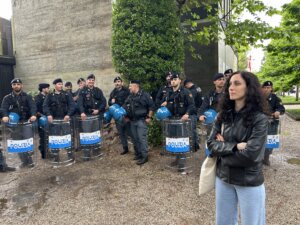
Even before it opened, this year’s Biennale was overshadowed by politics. On April 23, the five-member Golden Lion jury announced that it would not consider pavilions and artists representing countries whose leaders were charged with crimes against humanity by the International Criminal Court, a position that effectively rendered Russia and Israel ineligible. In response, Fainaru issued legal warnings to the Biennale, the Italian Ministry of Culture and the Italian prime minister’s office alleging antisemitism and nationality-based discrimination after the jury’s initial decision. According to the online art magazine Hyperallergic, the Biennale’s legal department warned jurors they could be personally liable for damages to Fainaru in the event of a dispute.
On April 30, nine days before the opening of the Biennale, all five members of the jury resigned. The Biennale then replaced its traditional Golden Lion with a “Visitor Lion,” to be voted on by ticket holders and awarded in November, at the end of the event, leaving many to wonder “What Did the Golden Lion Die Of?” to quote the title of a widely-circulated essay. Now perhaps more than ever before in the Biennale’s history, people are reassessing how much freedom art can ever claim when it arrives draped in a national flag.
In 2022, Russia’s curatorial team pulled out of the Biennale following the full-scale invasion of Ukraine. After skipping the 2024 event, Russia staged a bizarre and largely symbolic comeback this year with a pavilion that was only open during the professional preview and which has led the European Union to freeze a €2 million grant to the Biennale.
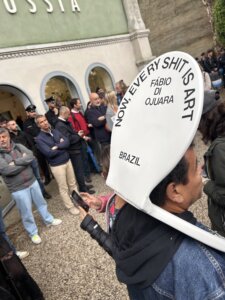
On opening day, the scene in the Giardini outside the Russian Pavilion was far more openly confrontational than anything else I witnessed at this year’s Biennale. There were riot police and carabinieri, demonstrators waving signs and trying to block people from entering the pavilion. Pussy Riot and members of the Ukrainian feminist group Femen protested with colored smoke, pink balaclavas and slogans like “Blood is Russia’s art” and “Disobey.” A Brazilian artist milled out outside with a toilet lid over his head that read “NOW, EVERY SHIT IS ART.”
When I squeezed past the protesters and entered the pavilion, I found very little going on: a few elaborately tangled clusters of flowers (“Why do flowers no longer smell?” the wall text queried forlornly), a man standing like a bodyguard and wearing a bunny mask, a DJ spinning records and a couple half-heartedly dancing.
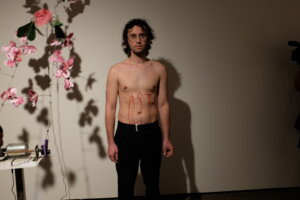
By far the most shocking act of protest I witnessed was on Friday morning, when Danila Tkachenko, a Russian artist who is a political refugee in Italy, entered the Scuola Piccola delle Zattere and used a scalpel to carve the word ART into his upper abdomen.
The 18th century palazzo houses a cultural institute that is funded by the Russian oligarch Leonid Mikhelson and owned by his daughter Victoria. Tkachenko’s grisly performance was intended to call attention to how, in the words of the journalist and curator Konstantin Akinsha, “money stained with Ukrainian blood feeds contemporary art in Venice.”
While Tkachenko stood next to a mechanical flower sculpture by Rachel Youn, blood trickling down to his belly, flummoxed ushers half-heartedly tried to clear the gallery. From a corner, a poker-faced Victoria Mikhelson looked on. She instructed the museum guards to do nothing. She clearly wasn’t going to give Tkachenko the satisfaction of being arrested.
And then there was the United States. In a year when Israel and Russia were treated as agents and emblems of world disorder, America remained oddly peripheral as a target, despite, well, everything. The U.S. Pavilion did not become a magnet for protest, although some artists and curators told me that they refused to enter on principle. For the most part, however, the art world’s revenge on America’s presence at Venice was limited to ridiculing this year’s Trump-approved artist, the sculptor Alma Allen.
Venice has always asked nations to appear through art. This year, they arrived damaged, accused, defensive, wealthy, frightened and enraged. The Biennale’s traditional structures — its garden of nations, its prizes, its diplomatic courtesies — did not collapse entirely. But they trembled.
And in the Israeli Pavilion, beneath the sound of black water falling into a pool, one could hear the tremor.
Why I became the Forward’s Editor-in-Chief
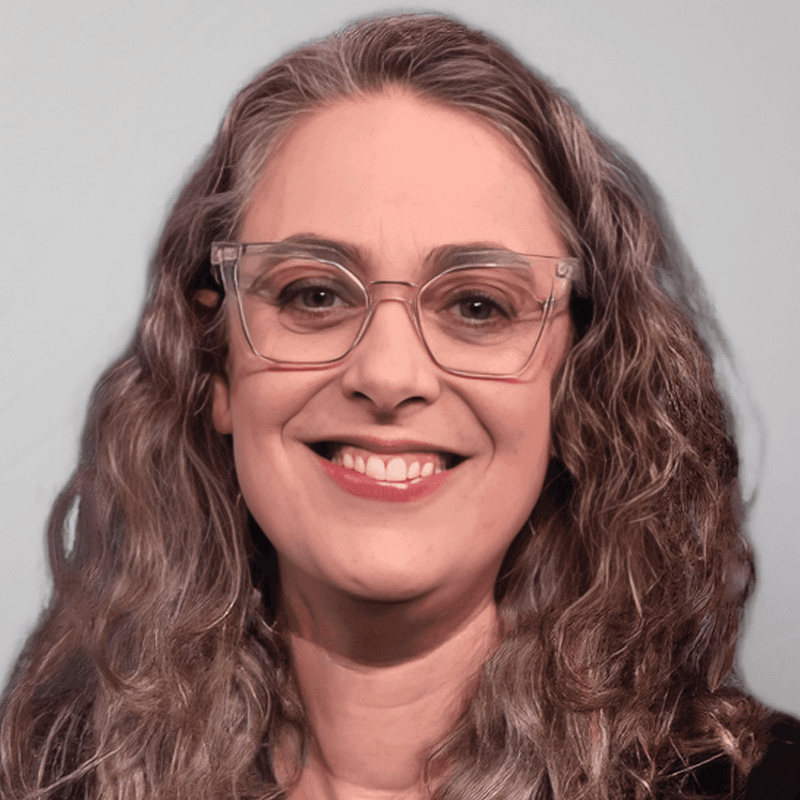
You are surely a friend of the Forward if you’re reading this. And so it’s with excitement and awe — of all that the Forward is, was, and will be — that I introduce myself to you as the Forward’s newest editor-in-chief.
And what a time to step into the leadership of this storied Jewish institution! For 129 years, the Forward has shaped and told the American Jewish story. I’m stepping in at an intense time for Jews the world over. We urgently need the Forward’s courageous, unflinching journalism — not only as a source of reliable information, but to provide inspiration, healing and hope.
Support our mission to tell the Jewish story fully and fairly.