New book details the long and winding road trod by the Beatles and Bob Dylan
‘Where the Music Had to Go: How Bob Dylan and the Beatles Changed Each Other – and the World’ examines the overlap between genre-defining musicians
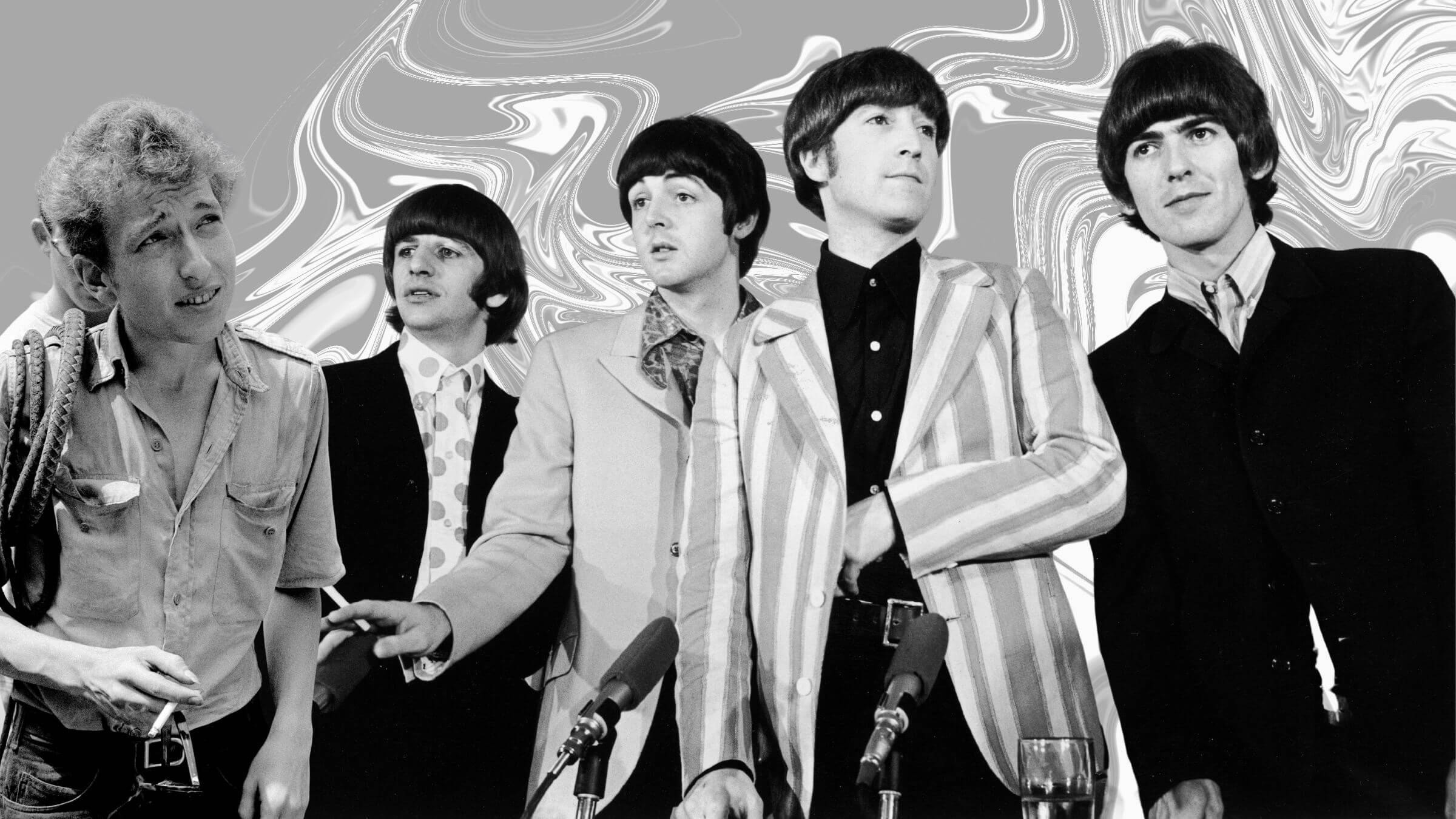
The Beatles and Bob Dylan may have influenced each other’s music and lyrics more than we know. Graphic by Getty Images / Mira Fox
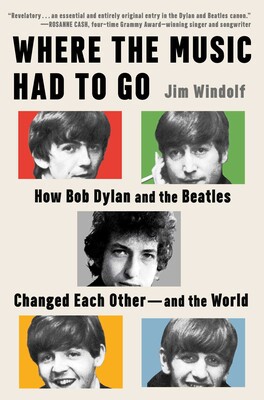
Where the Music Had to Go: How Bob Dylan and the Beatles Changed Each Other — and the World
by Jim Windolf
Simon and Schuster, 400 pages, $30
I ran into a neighbor the other day and we got to talking and he asked me what I was working on at the moment. I told him I was reviewing a new book about the Beatles and Bob Dylan – the first full-length treatment exploring the relationships between the Fab Four and the bard from northern Minnesota and their influence upon each other. My neighbor replied, “I would never have thought to put Dylan and the Beatles together. It seems like they existed in wholly different universes.”
That’s when I realized the full extent and significance of Jim Windolf’s Where the Music Had to Go: How Bob Dylan and the Beatles Changed Each Other – and the World. “Well then this book is for you – and for people like you who never made the connections between them,” I told him.
For some fans, the links between Dylan and the Beatles are and have always been readily apparent. From a young age, they all got bitten by the rock ‘n’ roll bug, particularly in the form of Little Richard. In his high school yearbook, Dylan wrote that his ambition was “to join Little Richard.” For the Beatles – and especially for Paul McCartney – Little Richard’s sound served as a template, powering “She Loves You” to the top of the UK pop charts via Paul’s version of what Windolf called Little Richard’s “vocal trademark, the rough falsetto whooooo.” When the Beatles played their final full concert at Candlestick Park in San Francisco in 1966, their last song was Richard’s “Long Tall Sally.” Windolf informs us that in the 1970s, Richard’s “Lucille” was the song Paul launched into while auditioning musicians. And in 1988, when the Beatles were inducted into the Rock & Roll Hall of Fame, George Harrison said in his acceptance speech on behalf of the group, “Thank you very much, especially all the rock ‘n’ rollers – especially Little Richard. It’s all his fault, really.”
Windolf – an editor at The New York Times who has published articles, reviews, essays and humor pieces in Vanity Fair, The New Yorker, New York magazine, Rolling Stone and other publications – digs deep into the archives to come up with some new and surprising biographical facts about his subjects, as well as offering some surprising interpretations of how Dylan and the Beatles addressed each other indirectly – and sometimes quite directly – in song.
By early 1964, the Beatles had worn out the grooves on Dylan’s first two albums by listening to them repeatedly while in Paris doing a concert residency. “We all went potty on Dylan,” Lennon later said. Three years hence, the Beatles released Sgt. Pepper’s Lonely Hearts Club Band, whose cover collage was chock-full of portrayals of artists, actors, thinkers, sports figures, comedians, gurus and other pop culture notables. As Windolf notes, standing tall above all others in the topmost row was a relatively diminutive figure in real life – Bob Dylan.
Dylan could not help but hear (and enjoy) the Beatles on his car radio while driving cross-country with friends. And the years following their introduction to each other’s music saw Dylan and the Beatles meet on a number of occasions, first brought together by their mutual acquaintance, journalist Al Aronowitz, who was also responsible for supplying the marijuana that turned a summit meeting into a riotous party. Windolf quotes Aronowitz saying that he was “a proud and happy shadchen, a Jewish matchmaker, dancing at the princely wedding I’d arranged.” (Yiddish also peppered Dylan’s vocabulary. Speaking of his “Ballad in Plain D,” a nasty song about a girlfriend’s sister, Dylan said years later, “That one, I look back at and I say, ‘I must have been a real schmuck to write that.’”)
The Beatles went on to attend two Dylan concerts at the Royal Albert Hall, and Lennon began writing songs that showed the lyrical and sonic influence of Dylan, including “You’ve Got to Hide Your Love Away” and “Norwegian Wood.”
Windolf makes a strong case that “Nowhere Man,” written by Lennon, was the first Beatles song having nothing to do with romance. “In this regard, he was catching up with Dylan, who had written and recorded dozens of songs on subjects other than love.” Windolf goes on to compare the title character of “Nowhere Man” to that of Dylan’s “Ballad of a Thin Man,” the latter’s clueless “Mr. Jones” sensing that “Something is happening here, but you don’t know what it is.”
This dynamic of exchange, with the Beatles responding to Dylan’s work, continued through the their final album, 1969’s Abbey Road, whose penultimate track, written by Lennon, was “I Want You (She’s So Heavy),” whose key phrase, “I want you / I want you so bad…” was lifted right from Dylan’s 1966 hit, “I Want You,” in which the refrain is, “I want you, I want you, I want you so bad.”
Dylan returned the favor, alluding to the Beatles in several songs. In his 1965 song, “Bob Dylan’s 115th Dream,” he sang, “I ran right outside and I hopped inside a cab / I went out the other door, this Englishman said, ‘Fab.’” And Dylan wrote another playful answer song called “Fourth Time Around” to the Beatles’ very Dylanesque song “Norwegian Wood” in 1966. In 2004, in concert in North Carolina, Dylan sang new lyrics to his song “Tears of Rage,” including the lines: “I’ve never been to Strawberry Fields / I’ve never been to Penny Lane,” mentioning two Beatles songs.
The relationship was not, however, perfect, and after years of seemingly drawing creative inspiration from Dylan, Lennon seemingly grew tired of or frustrated with him. In several early songs from his post-Beatles solo career, Lennon’s tone changed from respectful to dismissive. In the anti-war anthem, “Give Peace a Chance,” he referenced “Bobby Dylan” — slyly infantilizing him — in a litany of names of counterculture figures including Timothy Leary and Allen Ginsberg. In his song “God,” he announced that he “didn’t believe’ in “Zimmerman,” using Dylan’s birth name — a possible instance of Lennon’s lifelong case of generalized antisemitism rearing its ugly head.
Lennon explained the move thusly: “Because Dylan is bullshit. Zimmerman is his name.” (To be fair, Lennon also sang that he didn’t believe in “Beatles.”) But the possible antisemitism continued with Lennon’s response to Dylan’s gospel-era hit “Gotta Serve Somebody,” a nasty answer song called “Serve Yourself,” saying “there’s somethin’ missing in this God Almighty stew, and it’s your goddamn mother you dirty little git.”
(The greatest victim of Lennon’s antisemitism, however, was Beatles manager Brian Epstein, whom Lennon teased mercilessly for being gay and Jewish. Yet somehow, when it came time to hire a new business manager after Epstein’s death by accidental drug overdose, Lennon’s candidate was Allen Klein, who graduated from Weequahic High School in New Jersey in 1950, alongside his classmate Philip Roth.)
Despite the apparent rancor, during the lengthy January 1969 rehearsal sessions portrayed in the Peter Jackson documentary film, Get Back, the Beatles jammed on parts of many songs by other artists, none more so than the 15 by Dylan. By this time, the Dylan-Beatles center of gravity had shifted to George Harrison, who had spent the previous Thanksgiving holiday hanging out with Dylan and members of The Band in Woodstock, N.Y., where he started out co-writing songs with Dylan. (Windolf mentions an attempt by Dylan and Lennon to write a song together, but no tape or manuscript has ever surfaced.) When Harrison’s first solo album, All Things Must Pass, was released in 1971, the opening track was a Dylan-Harrison co-write, “I’d Have You Anytime.” And the album also included an early version of Dylan’s “If Not for You.”
At a press conference on the Isle of Wight, where he was to perform in August 1969, Dylan claimed that the Beatles asked him to work with them. “I love the Beatles and I think it would be a good idea to do a jam session,” he said.
While such a jam session never took place, Dylan did invite George Harrison to join him in the studio several times throughout the years. In 2021, Columbia Records released 1970, a three-disc archival set including the complete recording session from May 1, 1970, when Harrison joined Dylan at Columbia’s Studio B in New York. Dylan also famously came out of relative seclusion to take part in Harrison’s benefit concerts for Bangladesh in August 1971. And Dylan realized his lifelong dream of submersing himself in a band when he took part in the 1998-1990 recording sessions of the Traveling Wilburys, a supergroup consisting of Dylan, Harrison, Tom Petty, Roy Orbison and Jeff Lynne. (Tom Petty once said, “George quoted Bob like people quote scripture.”)
Windolf’s book is slightly marred by a few errors and interpretative attempts that needlessly call his analytical credibility into question. He refers to the electric backing band that Dylan toured the world with in 1965-66 as a “four-piece band,” but it was, in fact, always a five-piece band, almost entirely composed of musicians who would morph into the proto-Americana group The Band. He also writes that Dylan’s song “The Lonesome Death of Hattie Carroll” was “based on the true story of a Black housemaid who was killed in 1963 by her rich white employer, William Zanzinger.” In fact, the real-life guilty party was named William Zantzinger. Dylan used his poetic license to change the name to Zanziger in the lyrics for better poetic assonance (and possibly for legal reasons).
Windolf also claims that Dylan “preferred that the people he encountered not see him as a Jew, and the Dylan name helped him skirt the issue of ethnicity at a time when antisemitism was all too common.” That’s a common take, but one contradicted by the fact that one of the very first original songs Dylan sang in coffeehouses was “Talkin’ Hava Negilah Blues.” Why would someone trying to build a wall between his Jewish heritage and a made-up all-American identity choose to write and play such a song publicly? Plus, Dylan wrote several early songs that refer to Biblical stories (“When the Ship Comes In”) and the Shoah (“Masters of War”).
While changing one’s name in show business had at one time been an attempt to assimilate, simplifying an ethnic name or simply shortening it or making it catchier was a common show-business practice (and still is today). Even one of the Beatles chose to “jazz” up his name: Richard Starkey became Ringo Starr. And Richard Penniman wasn’t trying to fool anyone about being Black by calling himself Little Richard.
Nevertheless, Windolf makes a convincing case that Dylan and the Beatles played off each other in many ways, in and out of their music, such that their achievements overlapped in real time and continued to impact their lives and songs for decades to come. And, along with that, to shape and mold the very essence of popular culture for the last 60-plus years.
I’m personally matching all gifts to the Forward, up to $36,000. Can I match your gift now?

Hello, fellow Forward reader! I’m Joel Brown, a Forward reader and supporter for more than 15 years, and currently the chair of the board of directors.
I’m an avid Forward reader because it ticks so many of my essential boxes: excellent journalism, Jewish focus and diverse viewpoints. In today’s political climate, what I most appreciate is the Forward’s independence — made possible by the generosity of its membership.
The Forward is committed to bringing you unbiased, nuanced Jewish news. From my position as board chair, I see an exciting future as we expand our position as the definitive independent voice of contemporary American Judaism.
— Joel Brown, Forward board chair
Support our mission to tell the Jewish story fully and fairly.