When it comes to Israel/Palestine, everyone is sure that everyone else is a bigot
Is there any way to make the Hard Left, Hard Center and Hard Right… a little softer?
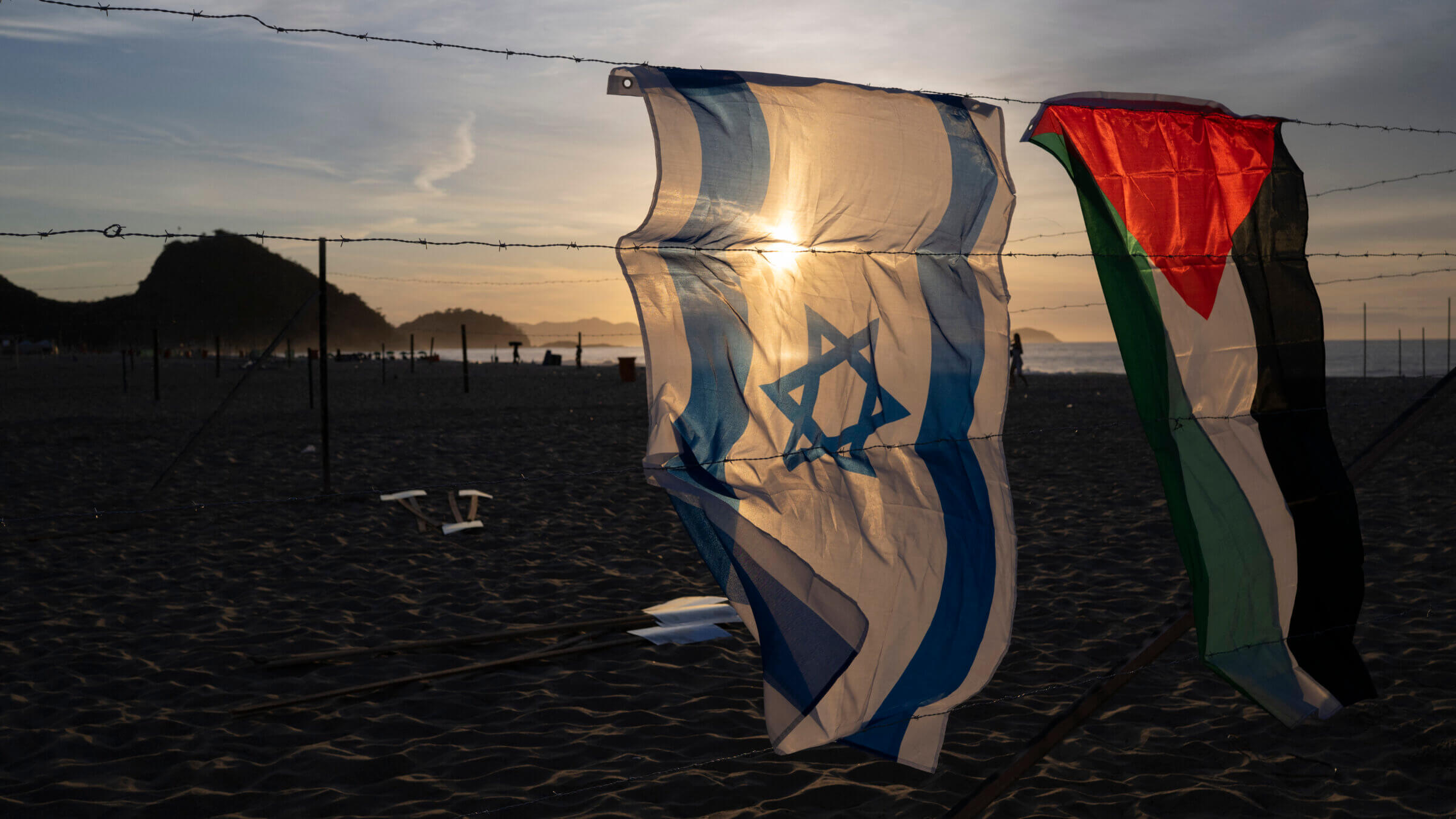
An Israeli and a Palestinian flag hang side by side. Photo by PABLO PORCIUNCULA/AFP via Getty Images

Contributing Columnist Jay Michaelson May 13, 2026
Welcome to the Great Hardening, in which Zionists and Anti-Zionists have each decided that the other side is made up of Nazis.
Literally.
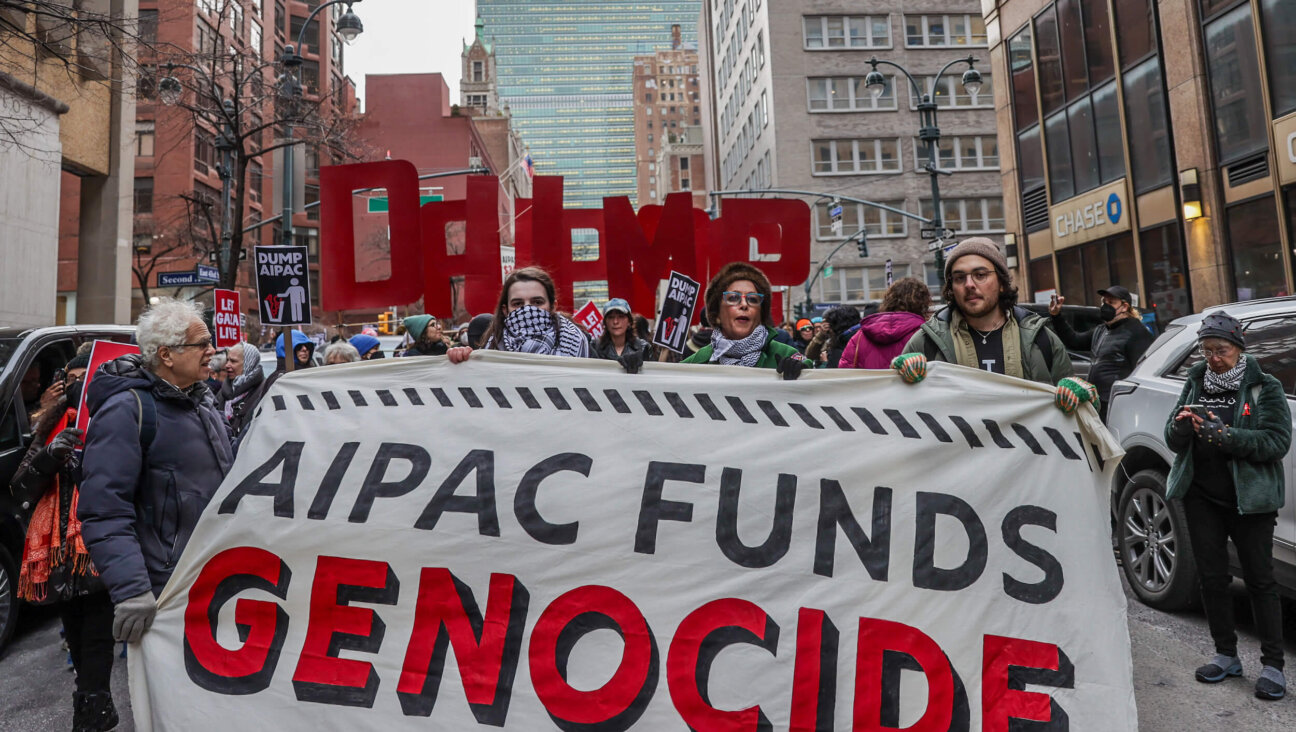
For many on the Hard Left, all Zionists are Genociders. Doesn’t matter if you’re in Standing Together or Smol Emuni — Zionism is settler colonialism and entails genocide. And on both the Hard Right and what I have come to call the Hard Center, Anti-Zionists are Antisemites. Doesn’t matter if you’re Jewish, or even a rabbi — all anti-Zionism, and even strong criticism of Israel, is antisemitism and thus bigotry.
As is typical of this decade of purity politics, each side embodies their rigidity by excluding the impure from the camp, as Leviticus 13:46 commands. On the Hard Left, some of my own progressive communities now explicitly ban “Zionists” (as they understand the term) from participation — at one event, a community meeting was halted because one person identified themselves as Israeli. Israeli DJs, including some who are vocally critical of Netanyahu and others who have “renounced their Israeliness,” have been banned at venues in London, Belgium and New York. Radical inclusion does not include “genociders.”
The Hard Center is equally uncompromising, defining its political opponents (often including liberal Zionists) as bigots who must be defeated, deplatformed and delegitimized. Anti-Zionist Jews aren’t even Jews, they say, and the term “genocide” is a blood libel. I have seen this firsthand as well; since daring to consider whether the term might apply to Gaza, I have not been invited as a scholar in residence or keynote speaker by a single mainstream Jewish organization. Meanwhile, leading institutions of the New York Jewish community now platform centrist or right-wing speakers exclusively, including at religious events happening next week.
On the Left, Right and Center, I have seen artists, academics, writers and musicians de-platformed for not condemning Israel, not condemning Hamas, mentioning Oct. 7, not mentioning Oct. 7, or issuing one’s condemnations without invoking the appropriate shibboleths. And, like the Levitical tzaraat, wrong views are contagious. If you fail to condemn someone who fails to condemn Israel, or Hamas, or antisemitism, or the occupation, then you are condemned.
As Shaul Magid has recently written, the limits of pluralism seem to have been redefined — and tightened. American Jews can accommodate disagreement on theology, halachic observance, intermarriage, LGBTQ inclusion and American politics — but not Israel. Magid himself was recently informed by a synagogue that “no one who is not a Zionist is permitted to speak from the pulpit.” (He identifies as a post-Zionist.) Meanwhile, students who privately protested the choice of Israeli President Isaac Herzog to speak at the JTS graduation had their jobs and livelihoods threatened as a result.
I know that there are many of us who feel caught between the Hard Left and Hard Center (and aren’t engaged with the Hard Right). Present company included, we are exhausted by all the shouting and shadow-banning. Is there nothing we can do about this? Is it just the new normal?
I want to make a case for a softening of the Hard Places — but I admit to some pessimism, because doing so may require a rethinking of what political arguments are really about. And the prescription I offer is thus, well, a little “soft.”
By which I mean: It addresses the real sources of all this hardening, which are emotional, and even spiritual. I mean a softening of the hard walls — built out of certainty, rage, and trauma — that demarcate the boundaries of pure and impure.
I don’t mean resolving our disagreements or pretending they don’t matter. They do matter. I also don’t mean centrism; writing this article, I took one of those online political quizzes and on a scale of 100, with 100 being the most conservative, I scored 15 on economic issues and 10 on social issues. That’s not the center.
What I mean is that our responses to these disagreements are not a matter of political ideology, but of more primal, instinctual drives. Consider: When someone says something you find strongly objectionable, how do you feel, physically? Often the response is physical disgust — like our Israelite ancestors, we want to put the defilement outside the camp. This is not an accident: Neuroscientists tell us that moral disgust activates the same parts of the brain as physical disgust. Which makes sense evolutionarily — it’s safest to keep the contaminant far away — but which affects how we tolerate dissent and disagreement in our midst. Often, we are repulsed by it.
Or consider this: Take a moment to reflect on how you feel — psychologically, tribally, morally, physically — about (take your pick) Israel or Palestine. Speaking for myself, I grew up loving Israel. Even before I visited it (in 1987, on a USY teen trip), I understood that it was the only place where I could feel fully at home. My group was in the majority. I could eat in all the restaurants. And I hated anyone who hated it. I had no space, intellectually or emotionally, for their narrative of 1948. And I still, to this day, have a love for the land and culture of Israel, where I lived for three years.
Is it not obvious that, when we love a person or place or country, we might be biased toward it?
Or maybe you’re on the other side of the emotional-political spectrum. Maybe you are in communities or close relationships with Muslims, Arabs, or others who have family directly impacted by Israel’s actions in Gaza, the West Bank, Lebanon, or Iran. Maybe you have seen videos or movies of atrocities in those places — of innocent children dead or maimed, of entire cities flattened by a supposedly defensive war. So of course you have emotional as well as political responses; you wouldn’t be human if you didn’t.
No wonder the Left and Center are putting up walls. They are in pain. And, as the saying goes, hurt people hurt people.
This is why nationalists never want to see the suffering on the other side. The cognitive and emotional dissonance is unbearable. The people you love have done horrible things. The enemy is not entirely evil; in fact there are many innocent people who have suffered. Their blood, too, cries out from the ground.
Now can you reread the preceding paragraph from the other ‘side’? Maybe the real sides aren’t Israel and Palestine, but Coexistence and Violence.
If these last few paragraphs sound a little ‘soft’, that is the point. Paraphrasing Rev. Dr. Martin Luther King, Jr., hardness cannot drive out hardness. Only softness can do that: coming to see our own pain, sharing vulnerability and uncertainty, and understanding that questions of Palestine and Israel are as emotional as they are political, for all sides of the debate, including the center and right.
I am not naïve here, which is why I am pessimistic. I know, obviously, that the Hard Left, Hard Right, and Hard Center are composed precisely the people least interested in processing our grief or leading with vulnerability. But that doesn’t mean their trauma isn’t there. They’re just enacting it unconsciously rather than consciously.
They may seem like the strong ones, but they are not strong enough to face their own pain.
But doing this kind of inner work is not impossible; I have seen it work in my own life. And then seeing multiple narratives, cultivating intellectual humility, and recognizing that, in fact, there are coherent worldviews on all sides — all that becomes the easy part. When it comes to Israel/Palestine, I have Socialist and Jewish Voice for Peace friends whom I regularly consult for their takes, and I have Security Hawk and Soft Center (by which I mean: sad that coexistence seems impossible, but not hardened or nationalist) friends with whom I do the same. It works because we have been friends for a long time, and when we have argued intensely in the past, there’s been time to let the anger cool. We are invested in one another as people, not as bearers of positions. And when I see myself getting triggered, I step back from the brink.
Maybe we need a change of Jewish metaphor, away from Leviticus and its lepers, and toward the Talmudic sages and their modeling of constructive disagreement. Sincere debate, they said, is l’shem shamayim — for the sake of heaven. And when the disagreement cannot be resolved, elu v’elu divrei Elohim Chayim; both views are the words of the living God. The sage Rabbi Meir even continued to learn from Elisha Ben Avuyah after he committed apostasy.
These rabbis were not softies; they resisted imperialism, created a new form of religious life, and probably saved the Jewish people. Many of them were martyred. And yet they were ‘soft’ in the best ways: They were emotionally, spiritually and intellectually permeable, and, though still limited by their culture in many ways (sexism, for example), they were able to live in community even while strongly disagreeing with one another.
Can we?
Did you know that only 2% of Forward readers donate to support our nonprofit newsroom? That 2% make it possible for millions to read the Forward without a paywall or subscription — removing any barriers to the full and fair Jewish story.
But while the Forward is free to read, it isn’t free to produce. Big stories — like deep dives into the antisemitism data, political scoops or reporting trips to college campuses — take months of research and fact-checking. All while we keep you informed of what you need to know each day.
— Rachel Fishman Feddersen, Forward Publisher & CEO
Support our mission to tell the Jewish story fully and fairly.