At this interfaith calligraphy class, the lines between Jew and Muslim blur
Sacred Scripts brings together young artists and community leaders to write in Hebrew and Arabic, who draw connections between the letters and themselves
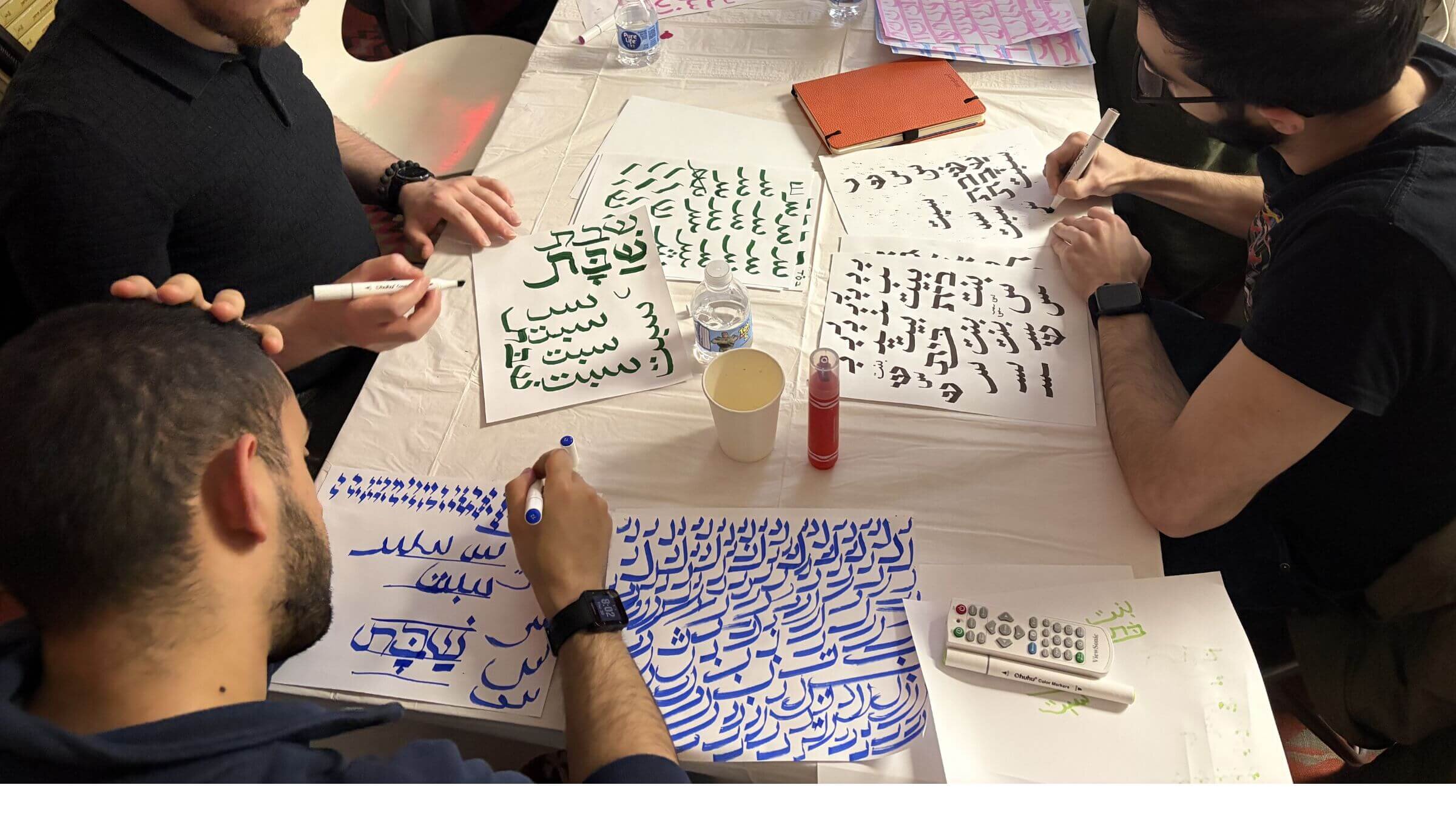
Sacred Script fellows practicing their Hebrew and Arabic calligraphy Photo by Simone Saidmehr
By Simone Saidmehr May 10, 2026
“So…are you Middle Eastern?”
I had just walked into the American Sephardi Federation office in lower Manhattan, where 20 Muslim and Jewish young people gather twice a month to learn Arabic and Hebrew calligraphy together. I was clearly the newbie, and one of the participants was sussing me out.
“I am,” I replied.
“Fully?” he asked.
I gave my usual spiel, explaining my Iraqi and Iranian background.
“Sick,” he said. “I’m only half.”
It struck me then that neither of us had any idea whether the other was Muslim or Jewish.
As I broke bread with the group, we chatted over an odd but familiar spread of kosher pizza and Gojeh Sabz, golf-ball-sized and very tart plums – a common Middle Eastern fruit many of us grew up eating. Somehow, religion didn’t really come up.
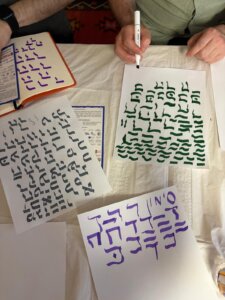
Eventually, felt-tipped multicolored calligraphy pens were passed around, and we began learning to write Hebrew letters — letters I had been perfecting since I embarked on my Hebrew School journey as a fourth grader. I was terrible. My reyshes weren’t swooping as they should, my khafs were somehow uneven and my yuds looked suspiciously like daleds.
Across the table, a young man who had introduced himself to me minutes before as Mohamed from Saudi Arabia had effortlessly filled the page with elegant Hebrew letters. He noticed my frustration. “Don’t worry,” he said. “I’ve done this like a million times. You’ll get it.” 
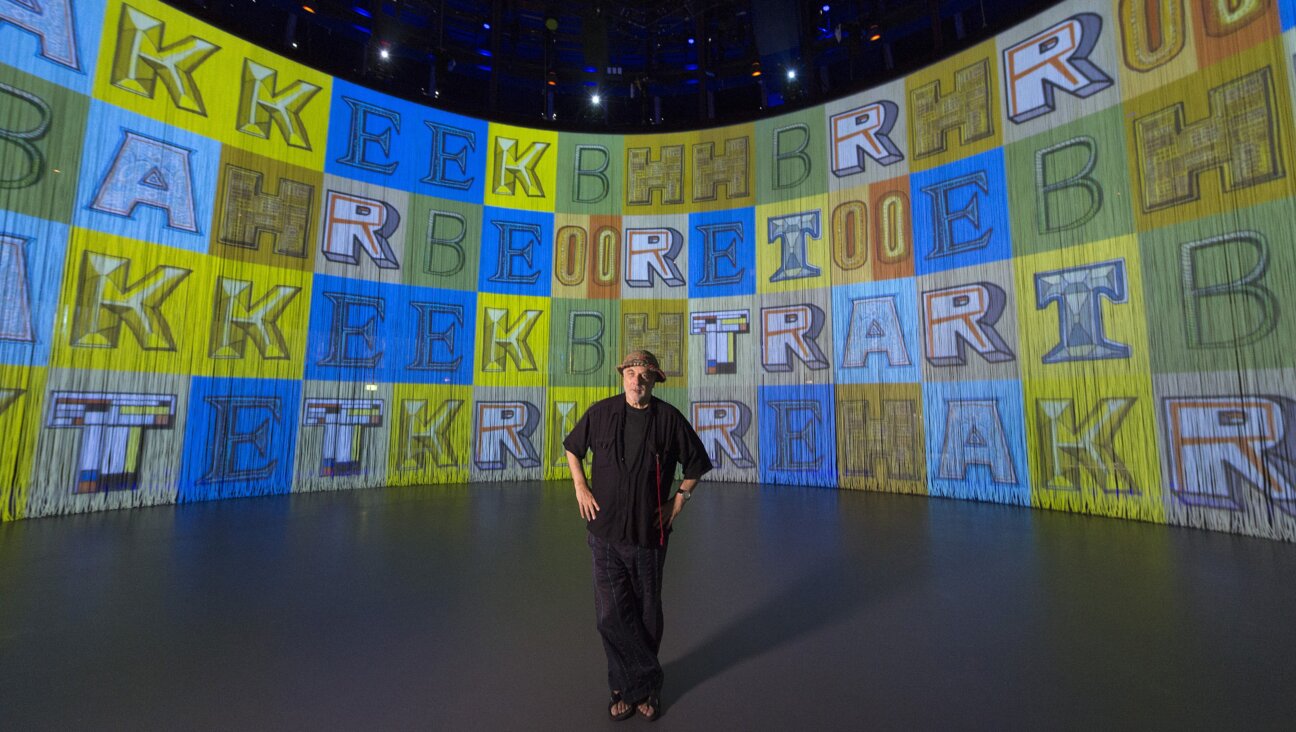
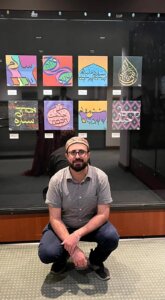
The person at the helm of this unusual form of interfaith exchange is Ruben Shimonov, a 38-year-old Sephardic polymath. I first discovered Ruben’s work when I saw an exhibit of his calligraphy blending Hebrew, Arabic and Farsi at the Museum of Jewish Heritage. I assumed he was a full-time artist, but soon learned that his main gig is serving as an educator, interfaith organizer, and mentor to dozens of Sephardic and Mizrahi college students. Now, he leads Sacred Scripts in NYC, a new six-month-long cohort-based interfaith calligraphy fellowship where Jewish and Muslim community leaders learn the intertwined history and etymology of Hebrew and Arabic.
A Bukharan Jew, Shimonov was born in Uzbekistan, a Muslim-majority country. For him, that background makes interfaith work feel like an extension of his upbringing.
“As a Jew from a community whose culture was shaped by Islamic cultures and histories, it is a natural expression of my Jewish identity to be in interfaith spaces,” he told me. “It’s not something I do because it’s cool or trendy or whatever. I just feel at home, because these are my people. This is my own background.”
From a young age, he was drawn to language, inspired in equal measure by the Hebrew letters he learned for his bar mitzvah and the Arabic script that adorned the mosques and architecture of his hometown.
Eventually, he taught himself calligraphy in three languages and came to see it as a powerful tool for the interfaith work he was already doing — organizing gatherings such as iftars in synagogues and seders in mosques through the Muslim Jewish Solidarity Committee. Over the past decade, Shimonov has led more than 100 interfaith calligraphy workshops around the world, highlighting the deep historical and linguistic connections between Hebrew and Arabic.
This year, Shimonov launched Sacred Scripts alongside his longtime partners at the Muslim American Leadership Alliance (MALA), drawing fellows from networks he and MALA have built over the years. The program brings together young artists and community leaders — many with Middle Eastern backgrounds — who they feel stand to benefit from sustained engagement. Over the course of six months, fellows study calligraphy and the histories of the languages, while connecting over shared meals and cultural outings. This month, they are attending a concert focused on Jewish and Muslim music from the Maghreb.
After Oct. 7, Shimonov said, he witnessed fractures between many Jewish and Muslim organizations that had been working together on interfaith initiatives. “That sense of betrayal and hurt was very real,” he said. “But if the only times you meet are when things are bad, what do you expect? I think the secret sauce to all this stuff is you’ve got to be in it for the long haul.”
The Sephardic connection
During each session, we practice writing while Shimonov lectures on the connections between the two languages. Shimonov gives each language its due, devoting several sessions to studying each before bringing them together.
Eventually, we learn the same words in Hebrew and Arabic — beit and bayt for home, Shabbat and al-sabt for Saturday — the list goes on. Before tackling day one of learning the Arabic alphabet, we practiced writing the phrase Bismillah ir-Rahman ir-Rahim, which appears at the beginning of every surah in the Quran, into Hebrew. Translated word-for-word, it sounds remarkably similar.
For Shimonov, that overlap is the point. He believes strongly that Sephardic and Mizrahi Jews occupy a unique place in interfaith work because of the seemingly endless cultural similarities they share with Muslims from the Middle East and North Africa.
That sensibility is reflected in the space itself. The fellowship is hosted at the American Sephardi Federation, a Jewish institution that looks more like a place to sip chai and do a close reading of Rumi’s greatest hits. The floors are covered with embroidered rugs, the walls are lined with ouds, a pear-shaped Middle Eastern instrument, and endless shelves are packed with rare books in Hebrew, Arabic and Farsi.
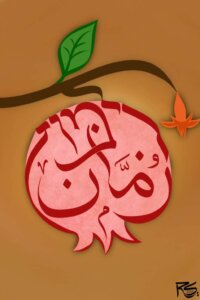
Because of these connections, the days focused on Arabic study are more Jew-y than one might expect. Shimonov takes care to highlight Jewish history in the Middle East, explaining how Iraq — not Europe — was the world’s foremost hub of Jewish life for centuries, where many Jews only spoke Arabic because Hebrew wasn’t widely taught, and presenting pivotal Jewish texts written in Judeo-Arabic.
In Shimonov’s Sephardic approach, the aim is less to “build bridges” — a phrase that has become a catch-all interfaith mantra — than to reveal how much was never separate to begin with.
Ali Saracoglu, a Muslim participant in the fellowship and an artist from Izmir, Turkey, said Sacred Scripts reshaped his understanding of Jewish identity.
When he moved to the United States, his primary exposure had been to Ashkenazi Jewish communities. “When you open the conversation to Sephardi and Mizrahi Jews, you encounter people from Uzbekistan to North Africa to descendants of communities from Spain,” he said. “You start to see a much more global form of Judaism.”
Saracoglu joked that within the group, it was often impossible to tell who was Jewish and who was Muslim unless it came up in conversation.
Nora Monasheri, a 23-year-old Iranian Jew, said that after Oct. 7, she had participated in countless interfaith dialogues at her alma mater, Binghamton University. “I felt like I’d been there, done that on campus,” she said, lamenting that such gatherers were “always very focused on Israel and Palestine, and it felt very forced.”
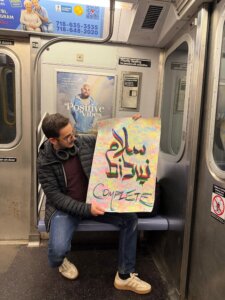
For her, creating calligraphy rather than debating peace agreements from the ’90s is a welcome change.
“I found that some of our most important words in Hebrew are the same in Arabic — faith, charity, blood — So instead of debating each other, we’re discovering this shared history, tradition, and spirituality together.”
For Saracoglu, the program’s artistic aspect is particularly powerful. He first met Shimonov at a one-off interfaith calligraphy workshop two years ago, an experience that stayed with him as an artist. He has been creating ebru, the traditional Turkish art of marbling, since the age of five, and now practices it in his New York City apartment. In a recent series he calls “One Word: Peace,” he layers his marbled designs with calligraphy by both Jewish and Muslim artists — often including Shimonov himself.
During one session, Shimonov read aloud from a Judeo-Arabic translation of the Torah, explaining that many Jews in the Arab world historically translated religious texts into Arabic because many did not understand Hebrew. The word for God was therefore transcribed as the Arabic word, Allah.
I chimed in that my own Jewish parents say “Inshallah” all the time when they simply mean “God willing.” My non-Sephardic friends always found this bizarre, but among this crowd, it barely required explanation.
As he read from the Torah, one Muslim fellow suddenly interrupted.
“It sounds like the Quran!”
Did you know that only 2% of Forward readers donate to support our nonprofit newsroom? That 2% make it possible for millions to read the Forward without a paywall or subscription — removing any barriers to the full and fair Jewish story.
But while the Forward is free to read, it isn’t free to produce. Big stories — like deep dives into the antisemitism data, political scoops or reporting trips to college campuses — take months of research and fact-checking. All while we keep you informed of what you need to know each day.
— Rachel Fishman Feddersen, Forward Publisher & CEO
Support our mission to tell the Jewish story fully and fairly.