Hochul makes play for Orthodox voters with tuition relief and synagogue buffer zones
The incumbent Democrat is moving to lock down a key block and ahead of Jewish showdown with Republican rival Bruce Blakeman
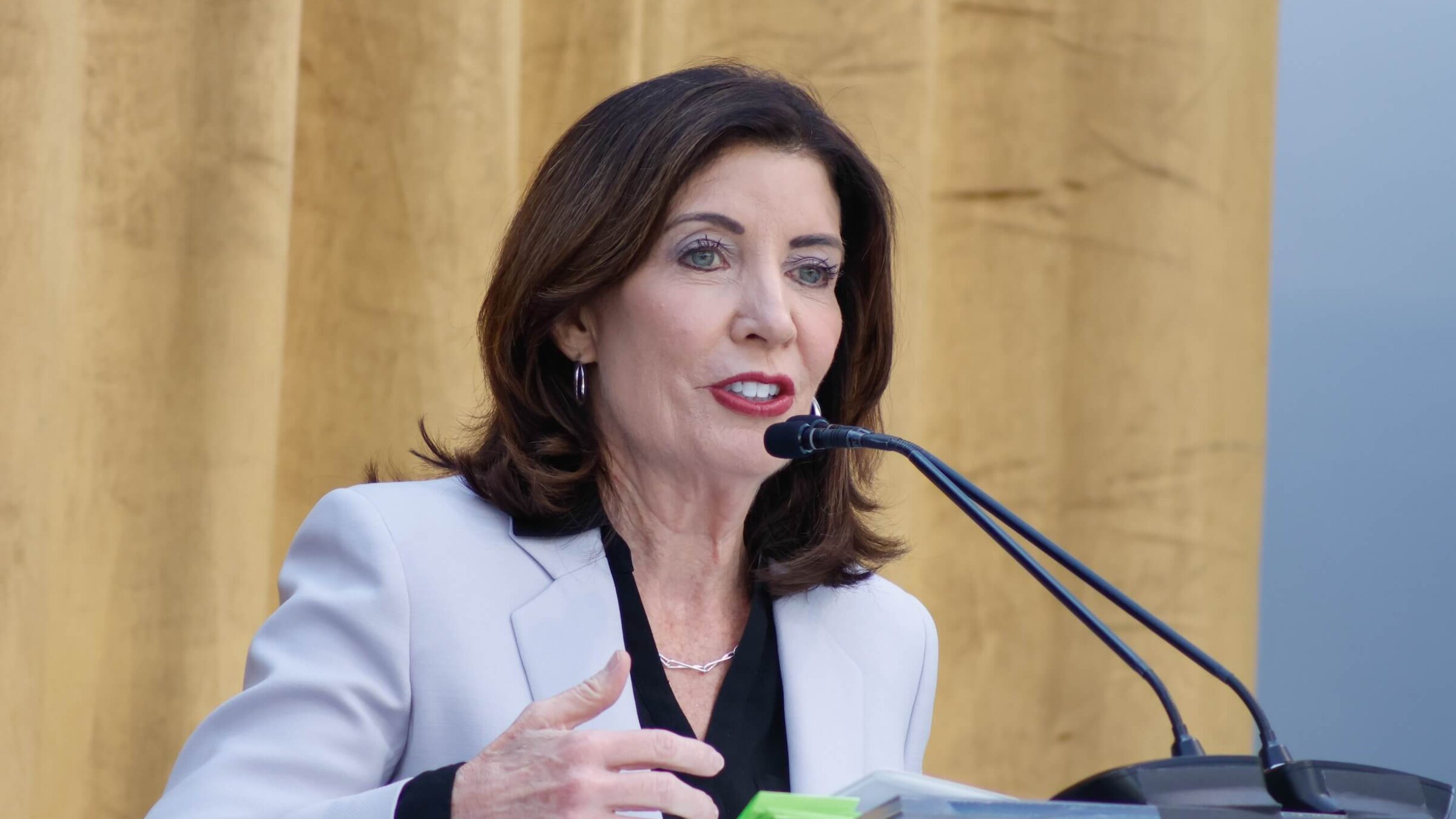
New York Gov. Kathy Hochul on April 24. Photo by Kena Betancur/Getty Images

By Jacob Kornbluh May 11, 2026
New York Gov. Kathy Hochul is making an early play for Jewish voters ahead in her reelection bid, coupling a major initiative to help families pay for yeshivas with tough-on-antisemitism legislation.
The moves aid Orthodox Jewish voting blocs — before her Republican challenger, Bruce Blakeman, gains traction.
A recent Siena University poll of 804 voters found Hochul leading Blakeman statewide by 16 points, 49% to 33%. But among the smaller sample of 65 Jewish voters, the race was far tighter, with Hochul leading just 46% to 41%.
Central to Hochul’s outreach was her announcement last week, during a private meeting with Orthodox leaders, that New York will opt into President Donald Trump’s new federal school-choice tax credit program. Known as the Education Freedom Tax Credit, it allows taxpayers to receive up to a $1,700 federal tax credit for donations to scholarship-granting organizations, which can then fund tuition assistance and other educational expenses.
A spokesperson for the governor confirmed that Hochul is supportive of the program as part of a broader commitment to helping families afford nonpublic education. Emma Wallner, the spokesperson, added that the administration is reviewing the federal program to ensure there are no “poison pills that could harm New York’s education system.”
For Orthodox voters, tuition relief has long ranked alongside Israel and antisemitism as a political priority. In 2014, former Gov. Andrew Cuomo made a last-minute effort to court the community by pledging to expand a state tuition assistance program to cover yeshivas as “a matter of justice.” Cuomo ultimately won 70% of the vote in Borough Park, one of the largest Orthodox strongholds. That proposal later failed in the state legislature.
Hochul and her allies remain mindful of the results of the 2022 governor’s race, when former Rep. Lee Zeldin came within five percentage points of defeating her. Zeldin, who is Jewish, was powered by strong Orthodox support.
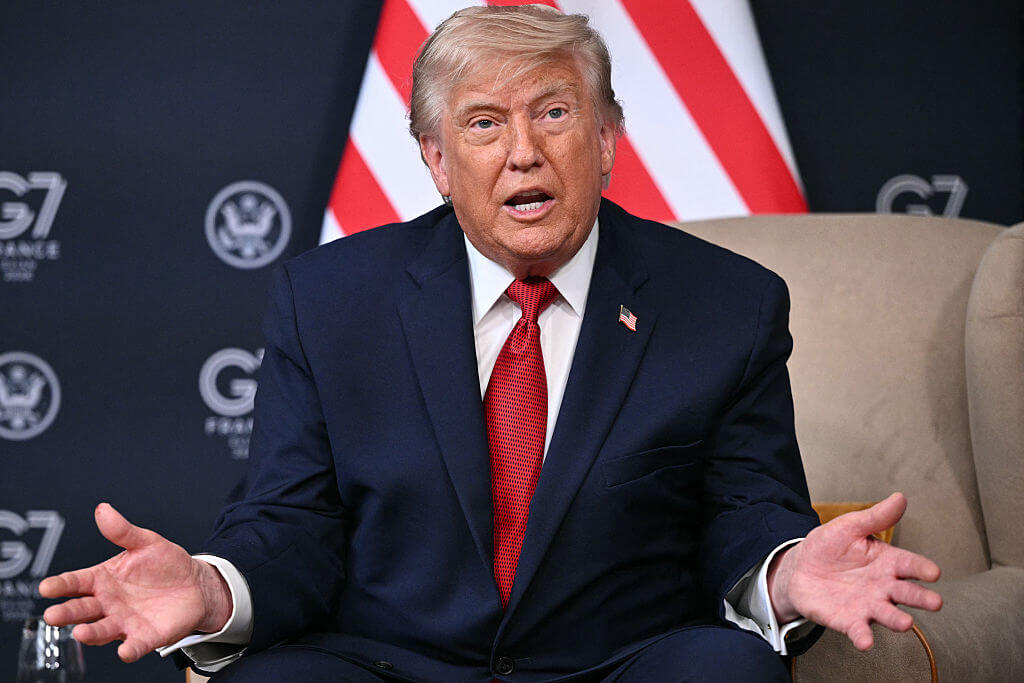
That memory looms large as Hochul prepares for a likely matchup against Bruce Blakeman, the first Jewish executive of Nassau County, who has positioned himself as a tough-on-crime conservative focused on antisemitism and support for Israel.
Blakeman supported the federal program when it was first announced earlier this year. In January, Blakeman criticized Hochul for not joining the tuition-relief initiative.
The Republican candidate has so far struggled to gain broader traction statewide and has yet to build deep relationships within the Orthodox political infrastructure in Brooklyn and Rockland County. Orthodox voting blocs, a traditionally Republican-leaning constituency, have repeatedly backed incumbents and even Democrats when communal priorities align.
Addressing rising antisemitism
Blakeman, who met with Trump at the White House last week to discuss his candidacy, could further face a challenge presenting himself as a stronger protector of the estimated 1.8 million Jews across the state amid rising antisemitism.
Hochul, who endorsed New York City Mayor Zohran Mamdani last year after remaining neutral during the Democratic primary, has been seen by some in the Jewish community as a counterweight within the Democratic Party to the mayor, whose handling of antisemitism and criticism of Israel has left many Jewish voters uneasy.
The Democratic incumbent has publicly opposed several key Mamdani priorities, like universal free buses and a millionaire tax, and has also distanced herself from Mamdani on Israel and pro-Palestinian protests on campus.
Hochul is moving fast on that front, too.
Last week, she announced a tentative budget deal that includes a measure to create a 25-foot buffer zone to protect houses of worship statewide from protest. “We’ve seen demonstrations targeting faith communities outside synagogues, mosques and churches,” Hochul told reporters. This is not free expression, this is harassment, and it has no place in the state of New York.” The measure would go further than a more limited enactment passed by the New York City Council requiring safety plans for protests near houses of worship, which Mamdani allowed to become law without his signature.
Hochul has also proposed an additional $35 million in security funding for vulnerable institutions, bringing total state spending on such protection to $131 million since she took office.
The legislation remains unresolved in Albany. Assembly Speaker Carl Heastie told reporters Thursday there was “no deal” yet on the broader state budget package. Some Jewish lawmakers have also criticized the proposed 25-foot buffer zone as too narrow, arguing it should be expanded to at least 100 feet, similar to protections already in place around polling sites.
Blakeman told the Forward last week that he would push to expand the buffer zone if elected governor. “I think 25 feet is too close,” he said.
David Greenfield, a former New York City Council member who introduced Hochul to Orthodox leaders when she became the lieutenant governor candidate in 2014 and boosted her in 2022, said that Hochul is “cementing her status as the best friend the Jewish community has had in Albany in decades” by pushing this agenda. “At a moment when Jewish New Yorkers are looking for leaders who will actually show up for them, Hochul keeps showing up,” said Greenfield, now head of the Met Council charity organization.
Blakeman’s play
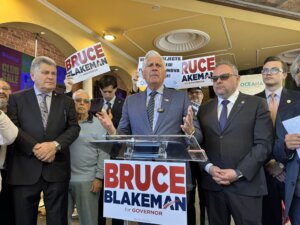
Blakeman has also made fighting antisemitism a central theme of his campaign. On Sunday, Blakeman addressed a rally held by Zionist groups in Queens, after swastikas were found spray-painted on synagogues and homes in Forest Hills and Rego Park. “We have to make sure that every antisemite knows that we will not back down, that we will stand up to it,” he said in his remarks. Speaking to the New York Post, Blakeman also called Mamdani “un-American” and “antisemitic.”
Last week, Blakeman held a press conference in Brighton Beach, a Brooklyn neighborhood with a significant Russian-speaking Jewish population, calling for the cancellation of a planned concert by Yulduz Usmonova, an Uzbek singer accused of making antisemitic statements. “Never again will we tolerate antisemitism or attacks on the Jewish people anywhere in the world, and especially here in Brooklyn, with this huge Jewish community of which my wife Segal was a member of,” Blakeman said.
Blakeman said in a statement to the Forward on Monday he wanted to ensure “every Jewish New Yorker knows Kathy Hochul failed to protect our state from a historic surge in antisemitic hate crimes while I made Nassau a safe haven by increasing police patrols near synagogues, creating buffer zones to stop protests near houses of worship, and banning masks for the cowards who use them to intimidate Jewish families.”
The battle for the Jewish vote traditionally unfolds later in the season, closer to the High Holidays season, when voters pay more attention to the election. But Hochu’s recent moves signal she is not waiting until the fall to lock up support from a swing and reliable voting bloc.
Did you know that only 2% of Forward readers donate to support our nonprofit newsroom? That 2% make it possible for millions to read the Forward without a paywall or subscription — removing any barriers to the full and fair Jewish story.
But while the Forward is free to read, it isn’t free to produce. Big stories — like deep dives into the antisemitism data, political scoops or reporting trips to college campuses — take months of research and fact-checking. All while we keep you informed of what you need to know each day.
— Rachel Fishman Feddersen, Forward Publisher & CEO
Support our mission to tell the Jewish story fully and fairly.